

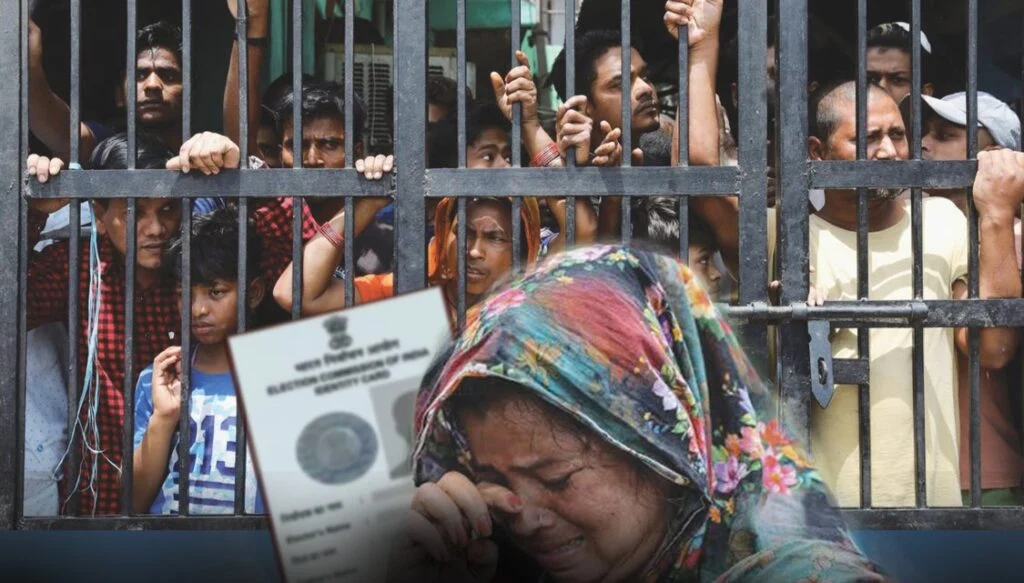
The vote is a democratic right; arbitrary exclusion from the electoral roll can deny citizens a voice in their government.A Reuters investigation published on Nov. 16, 2026, “Deleted from India’s Voter Rolls, Some Muslims Face Detention, Deportation”, brings this danger into disturbing focus. Sarita Chaganti Singh and Mohammad Ponir Hossain document cases in which the Special Intensive Revision (SIR) of electoral rolls has become entangled with police action, citizenship questioning, detention and deportation.
The central question is stark: can deletion from an electoral roll become grounds for treating someone as a foreign national, detaining and expelling them? An electoral roll determines voting eligibility; it is not a citizenship register.
An Electoral Revision with Extraordinary Consequences
Approximately 130 million names have reportedly been removed nationally during SIR, including around nine million in West Bengal. Reuters cites Sabar Institute figures showing that Muslims accounted for about 70 per cent of 2.7 million names removed after closer scrutiny in the state, despite constituting around 27 per cent of its population. This does not, by itself, prove discriminatory intent, but the disparity demands investigation.
On May 27,2026, the Supreme Court recognised the ECI authority to undertake SIR. That authority does not validate every deletion: criteria must be uniform, voters must have a fair opportunity to establish eligibility, and remedies must be effective.
Sahida Fakir: A Family Rooted in India, a Mother Across the Border
The Reuters investigation recounts the case of 38-year-old Sahida Fakir. On July 19,2026, she reportedly left her Mumbai home to buy vegetables and never returned. According to her account, plainclothes police detained her, seized her phone and deported her to Bangladesh, separating her from her husband and two children.
Reuters found that her parents and grandparents appeared on West Bengal electoral rolls dating to 1952 and that Fakir had been a registered voter since at least 2008. Court records place her among 149 people deported during the operation. Her family has challenged the deportation.
The government’s account differs. Authorities told the Calcutta High Court that Fakir had produced a Bangladeshi birth certificate and failed to provide credible evidence of Indian citizenship. She disputes this, saying her phone contained identity documents and that she was denied an adequate opportunity to produce them.
These competing claims require judicial examination. Foreign nationality must be established through a competent legal process; absence from an electoral roll cannot prove it. Her case raises grave questions of due process, family life and state power.
Nasiruddin Sheikh: When Deletion Becomes an Accusation
Nasiruddin Sheikh, a utensil hawker from West Bengal, illustrates the consequences. Reuters reported that he and 22 others were detained while working in Chhattisgarh. Nineteen were released after 14 days when their names appeared on revised rolls; Sheikh and three others remained detained for 32 days.
Sheikh alleged that a police officer called him ‘Bangladeshi’ because his name was absent from the voter list. His appeal was reportedly pending before a special tribunal. If substantiated, the disputed deletion was treated as proof of foreign nationality before the appeal was decided.
The Politics of Infiltration
At a Haryana rally on Nov. 5, Union Home Minister Amit Shah reportedly linked the removal of alleged ‘infiltrators’ from electoral rolls with their identification and expulsion from India. Identifying foreign nationals residing unlawfully is legitimate, but must rest on evidence and established procedures, not religion, language or electoral discrepancies.An undocumented migrant and a citizen whose documents are disputed are not interchangeable. Conflating them risks wrongful detention of poor people, migrant workers and marginalised communities.
An investigation by The Reporters’ Collective, published on October 16,2026, adds a crucial dimension. Examining ECI software and responses to Right to Information applications, it found that the system had no provision to identify or tag deleted voters as foreign nationals. More than 100 EROs in Bihar confirmed that no non-Indian citizens had been identified during SIR. The ECI also withheld information sought from 12 states.
The findings expose a gap between SIR’s political rationale and its administrative machinery. If the ECI lacked the software and procedure to identify foreign nationals, how can deletions be presented as detection of infiltrators? The government and ECI must answer the questions raised.
What the Constitution Permits
The distinction between electoral eligibility and citizenship determination is fundamental. Article 326 provides for adult suffrage subject to prescribed qualifications; Article 325 prohibits exclusion from electoral rolls solely on grounds of religion, race, caste or sex. Sections 16 and 19 of the Representation of the People Act, 1950, set out eligibility and disqualifications, including the citizenship requirement.
In its May 27,2026 judgment in Association for Democratic Reforms v. Election Commission of India, the Supreme Court upheld the ECI’s authority to conduct SIR and undertake limited citizenship-related scrutiny for electoral purposes. It distinguished this from final citizenship determination under the Citizenship Act, 1955, which must follow due process before the competent authority. The Court emphasised notice, an opportunity to respond, reasoned decisions and appeal. Electoral deletion is not an order of deportation.
Article 21 protects every person’s life and liberty; Article 14 guarantees equality before the law. Maneka Gandhi v. Union of India (1978) requires procedures affecting liberty to be fair, just and reasonable.
APCR’s Fact-Finding Report: The Alleged Weaponisation of Form 7
A fact-finding report by the Association for Protection of Civil Rights (APCR), West Bengal, titled Allegations of Misuse of Form-7 and Targeting of a Particular Community under ‘Not Indian Citizen’ Claims in the SIR Process, provides a direct parallel. Based on field visits, eyewitness accounts and documents, it records alleged irregularities in Form 7 objections during SIR.
Form 7 is used to seek deletion of a name from an electoral roll. APCR reports that a list published on Jan. 25, 2026 for one polling booth in Sandeshkhali, North 24 Parganas, contained approx. 2,253 names. Similar lists in neighbouring booths brought the constituency total to around 5,963. Members of a particular community were allegedly marked ‘Not Indian Citizen’ or ‘Dead’.
APCR questioned how the objections were prepared. It observed that challenged voters’ details were computer-typed while objectors’ details were handwritten, raising suspicion that applications had been centrally prepared online using Muslim citizens’ names and EPIC numbers, then submitted with handwritten objector details. It also noted incomplete addresses and hearing notices reportedly delivered only a day before proceedings.
These allegations require independent investigation and are not judicially established findings. Nevertheless, the reported pattern raises serious questions about organised attempts to manipulate deletions and deny voters a fair hearing. APCR recommends a high-level investigation, an independent judicial inquiry and legal action against those found responsible.
If a process designed to ensure electoral accuracy is misused to label living voters dead or foreign, it becomes a tool of disenfranchisement. Form 7 objections require transparent verification, scrutiny of objectors’ identity and authority, timely notice to affected voters and accountability for false declarations.
The ECI’s Constitutional Responsibility
Article 324 obliges the ECI not merely to publish revised rolls but to protect eligible citizens from arbitrary exclusion. Migrant workers, poor citizens, women whose addresses change after marriage, elderly people and those with limited records face particular risks. Poverty, migration or imperfect paperwork cannot erase citizenship.
The ECI should publish state-wise data on deletions, reasons, referrals, appeals and restorations, and explain safeguards against treating deletion as proof of foreign nationality. The government should independently examine detentions and deportations linked to SIR. Allegations of unlawful detention, denial of access to documents and deportation without due process require investigation. Those facing citizenship allegations need legal assistance, independent adjudication and effective remedies.
Democracy Cannot Survive Erosion of Citizenship Rights
The cases of Sahida Fakir and Nasiruddin Sheikh expose a deeply disturbing possibility: that an administrative decision, still open to appeal, can become a presumption of foreignness, and that this presumption can cost people their liberty, separate families and even drive them across an international border. If this is not an inversion of the rule of law, what is?
The government must answer some fundamental questions. Who authorised the use of electoral deletions as grounds for detention and deportation? Under what law can the absence of a name from a voter list be treated as evidence of foreign nationality? What independent verification preceded these deportations? Were the affected individuals given access to their documents, legal representation and a meaningful opportunity to challenge the allegations? And who will be held accountable if Indian citizens have been wrongfully detained or expelled?
The ECI, too, cannot take refuge behind the technical language of electoral revision. Did it investigate allegations of mass misuse of Form 7? What action was taken against those who may have submitted false objections? Why should citizens bear the consequences of procedural failures over which they had no control? An institution entrusted with safeguarding the franchise must explain not only how many names it has deleted, but also how it has protected those entitled to remain on the rolls.
These are not questions against national security or lawful action against illegal immigration. They are questions about whether the state can pursue legitimate objectives by abandoning the very constitutional restraints that distinguish a republic from arbitrary rule. A government cannot invoke the language of infiltration to evade the burden of proof, nor can an electoral authority allow administrative suspicion to acquire the force of a judicial finding.
India’s freedom struggle was not fought to replace foreign rulers with an unanswerable domestic state. It was fought to establish a constitutional republic in which the government is accountable, the law applies equally and no individual is rendered defenceless before the machinery of power. When the state can delete citizens’ name, question their nationality, deprive them of liberty and deport them without a demonstrably fair process, the issue is no longer merely electoral malpractice. It is a crisis of constitutional governance.
An electoral roll is a record of voting eligibility, not a certificate of nationality, and certainly not a warrant for detention or deportation. The government must establish the legal basis for every such action, the ECI must account for every wrongful exclusion, and independent investigations must determine whether the process has been deliberately manipulated. Anything less would amount to institutional evasion.
Ultimately, the question before India is larger than the fate of a few individuals or the electoral rights of one community: Can a government claim to defend the nation while denying its people the protection of the Constitution? Can the ECI claim neutrality when allegations of organised disenfranchisement remain unanswered? And can a democracy retain its legitimacy when administrative suspicion is allowed to decide who belongs and who must leave?
If these questions remain unanswered, SIR will be remembered not simply as an exercise in revising electoral rolls, but as a warning of how easily the instruments of democracy can be turned against the people they are meant to empower.