

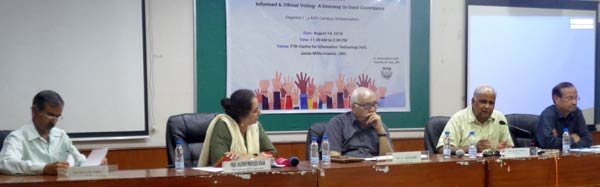
Many people are saying that a lot of money can be saved if we go for simultaneous polls. What troubles me the most is that should we value our democracy with money? Some argue that the money saved would be used for development. Is development and democracy opposite to each other? The idea of simultaneous polls to me is neither desirable nor feasible. It is nothing but a backdoor entry towards presidential form of the government,” said Jagdeep Chhokar, founder member and Trustee of ADR (Association for Democratic Reforms) in reply to a question after moderating the panel discussion on, “Informed and Ethical Voting – a Doorway to Good Governance,” organised by ADR Campus Ambassadors at Jamia Millia Islamia on 14 August.
Chhokar in his reply to another question said, NOTA is an investment in the democracy. The Supreme Court Judgment in the NOTA case has a sentence which says that if there are more and more NOTA then political parties will be forced to put better candidates. The present form is that if a candidate gets 2000 votes and 1999 NOTA votes then the candidate is declared a winner. But the question is should the Supreme Court have gone further and said what would happen when NOTA gets more votes than the candidates.
The ADR started Campus Ambassadors Programme in 2018 to engage college students in political and electoral reforms process proactively.
Dr. S.Y. Quraishi, former Chief Election Commissioner of India, informed the gathering about his PhD in Social Marketing from Jamia which was unique in the entire world at that point of time and how it helped him throughout his carrier, including as CEC. Quraishi also shared his experiences of how freebies were distributed to the electorates and apart from the traditional method what was surprising that a fake marriage party was organised without bride and groom just for the freebies to the people. The former CEC, while replying to a question, on one nation one poll, said, for the Election Commission logistically it may be a good idea however the whole idea is not feasible as it has been diluted one after another.
Prof Sanjay Kumar, Director of Centre for the Study of Developing Societies (CSDS), during the panel discussion, said, after having seen all the data put up by ADR related to candidates and funding the level of disenchantment is for me the same against our politicians and the people as well. There is general perception that if we are educated we may be more informed. It is true that the voters have become more informed with the increase of literacy over the years.
Kumar further said, during 1996 Lok Sabha polls, 19 per cent said they read political news in paper which increased to 24 per cent in 2004 and almost 46 per cent during 2014 polls. So we should expect that voters are more informed for the reason that education has increased and people read more political news and participation in rallies also increased over the years.
“But the big question: Do they exercise their vote in an informed manner. Now should an informed voter vote for the candidate or for the credential of the party. In the last 25 years, according to our data in all elections more than 60 to 65 per cent voters just voted blindly for the party. It means vote for the party is very high as compared to the candidates and this is certainly not informed voting because vote for a candidate can be said to be informed voting as compared to vote for the party,” argued Kumar.
Prof Nuzhat Parveen Khan, Dean Faculty of Law, Jamia Millia Islamia, while highlighting the importance of NOTA, said there is a wide gap in percentage of voting in urban areas as compared to that in rural areas and in order to educate and make people aware more workshops should be organised by the ADR to educate people about the importance of informed and ethical voting.
Maj. Anil Verma, head of ADR, while introducing ADR’s journey so far, highlighted the function, approach, goal, challenges and achievements along with some of the landmark judgments on the PIL filed by ADR since its inception, said that we try to provide all kinds of data to make people aware about the background of the candidate to help the people make a better choice. There is democracy but it has to be preserved and nurtured and citizens should play active participation in a democracy. On the international parameters Indian democracy is considered a flawed democracy. The nature of polity today is self first, party second and the nation last which we the citizens have to change.