

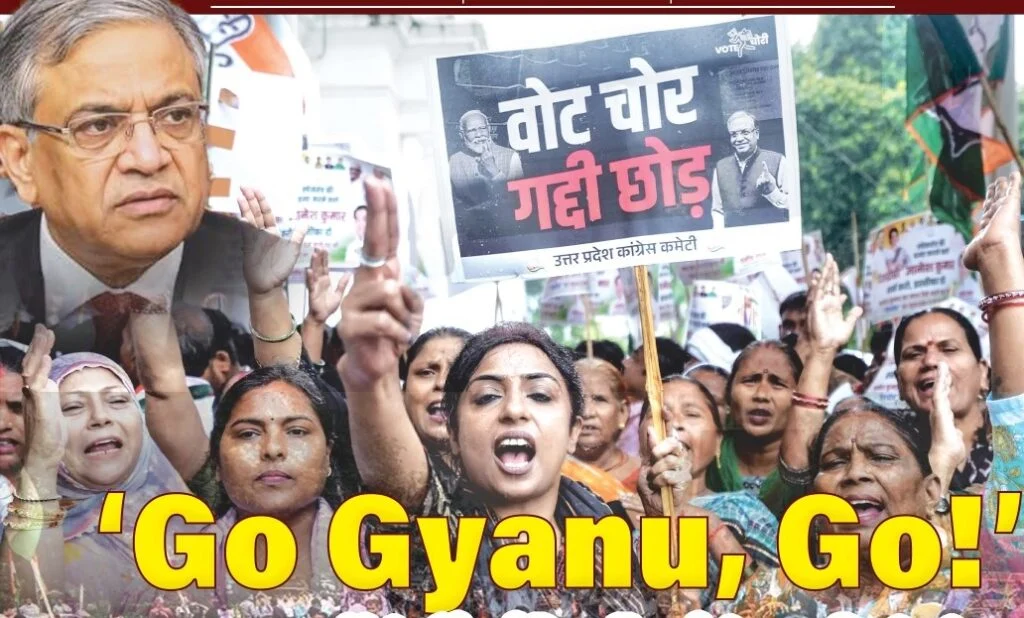
‘Go Gyanu, Go!’‘Gyanu Must Go!’– the slogans are no longer confined to protest sites. They are reverberating across the country, turning into a growing political roar.Since The Indian Express’ explosive expose, ‘vote chori’(vote theft) has emerged as the defining political issue of the moment. What may once have been dismissed as an opposition charge can no longer be brushed aside so easily?
The heat is rising, the protests are spreading like wildfire, and the pressure on Chief Election Commissioner Gyanesh Kumar is mounting by the hour. His position is becoming increasingly untenable, while questions are also being raised about those who continue to shield him.
The political message from the streets is unmistakable: there can be no credibility for an election watchdog facing such serious allegations without full accountability and answers.
The political battle over the integrity of India’s electoral rolls has moved from Parliament to the streets. Despite the Delhi Police denying permission for a proposed demonstration at Jantar Mantar, the designated protest site, protesters gathered in the capital on October 2 and again over the weekend. Heavy security was deployed around the area, with scores of protesters detained while in Mumbai, the Gen Z-driven Cockroach Janta Party launched the ‘remove Gyanesh Kumar’ campaign from Mumbai’s Shivaji Park. On October 4, around 150 activists were detained as demonstrations continued at Jantar Mantar.
The police detained multiple individuals in New Delhi during the second day of protests led by CJP and allied opposition groups. The protests oppose SIR, which demonstrators argue unfairly benefit Prime Minister Narendra Modi. They are also calling for the resignation of chief election official, Gyanesh Kumar. The youth-led protests represent a significant challenge to Modi’s long-standing leadership. Security forces intervened after around 100 protesters breached barricades and chanted slogans accusing election authorities of manipulation. Notable figures including Independent MP Kapil Sibal, student leader Neha Bora, and political activists Prashant Bhushan and Yogendra Yadav participated in the protests. Police have not released the number or identities of those detained.
On October 2, previous protests were similarly disrupted, with arrests made under rules against mass gatherings. Critics claim that a recent nationwide voter-verification effort has disenfranchised millions of eligible voters. The Election Commission defends the initiative as necessary to clean voter lists, though it has now instructed officials to add legitimate voters who were mistakenly removed.
The demonstration led to the detention of around 150 protesters by police amid heightened security. The protest appears to be gaining momentum as public figures and political parties become increasingly vocal. In a related development, a CPI Member of Parliament wrote to Home Minister Amit Shah, expressing concerns over police officers allegedly concealing their identification during the handling of the protests. The scale of the restrictions imposed around the protests has itself become part of the political controversy. Entry and exit at 11 Delhi Metro stations in central Delhi were shut amid heightened security, while internet services in and around Jantar Mantar were suspended for 12 hours.
For the Opposition, the restrictions have only sharpened the political message: the fight over ‘vote chori’ is no longer merely a dispute over electoral rolls but, they argue, a larger battle over the credibility and independence of the Election Commission.
INDIA Bloc Launches Nationwide Mobilisation
Training its guns on Prime Minister Narendra Modi and the Election Commission, the 20-party INDIA bloc has announced a nationwide campaign against what it calls ‘vote chori’ and electoral subversion.At a meeting in New Delhi on September 30, leaders of the Opposition parties unanimously resolved to step up the campaign seeking the removal of Gyanesh Kumar and to mobilise people across the country.The meeting, attended by Congress president Mallikarjun Kharge, Sonia Gandhi, Rahul Gandhi, Omar Abdullah, Mamata Banerjee, Supriya Sule and other leaders, lasted around three-and-a-half hours. Uddhav Thackeray and Hemant Soren joined virtually.
Briefing the media afterwards, Kharge said the Opposition parties had agreed on a six-point action plan. Beginning October 2, “Save Democracy” marches and protest demonstrations are being organised across districts until October 8 to create awareness about the alleged ‘vote chori’.
On October 6, Opposition MPs are scheduled to march towards the Election Commission headquarters. The INDIA bloc also plans to seek an appointment with the President in the second week of October to submit a representation on what it describes as constitutional and electoral concerns.The alliance has further announced five major rallies across the country during October and November, including one in Delhi on November 1.
Congress Demands Gyanesh Kumar’s Removal
Earlier, the principal opposition Congress demanded resignation of Narendra Modi and Home Minister Amit Shah, saying they have no moral right to continue after the revelations about ‘vote-chori’ being carried out at their behest by the panel chief. After the meeting, the Congress Working Committee (CWC) also reiterated its demand for Kumar’s removal, the rollback of SIR and the restoration of 13.30 crore names which have been deleted so far from the electoral rolls.
In its resolution, the CWC expressed concern over what it called the ‘systematic subversion’ of the electoral process and said recent developments had vindicated Rahul Gandhi’s repeated warnings about ‘Vote Chori’.“An exercise of doubtful constitutional validity cannot be allowed to decide who may vote in the world’s largest democracy,” the resolution said.
Kharge has also called on Prime Minister Modi to resign on what he described as ‘moral grounds’, alleging that the CEC acted under the Prime Minister’s influence and pressure.“Today, the protector has become the predator,” Kharge said, arguing that institutions meant to safeguard voters’ rights were instead facilitating their exclusion.
These political allegations made by the Opposition have been rejected by the government and the Election Commission, which maintains that the electoral-roll revision is intended to ensure the accuracy and integrity of voter lists.
Rahul Gandhi: ‘We are not going to take it lying down’
Addressing the INDIA bloc meeting, Rahul Gandhi said Opposition parties were unanimous in their view that the electoral process had been undermined.He alleged that the BJP, Prime Minister Modi and Gyanesh Kumar had attacked the country’s democratic structure and said the Opposition would continue its campaign.Gandhi also claimed that the Opposition had succeeded in convincing large sections of the public that elections were being manipulated and said a new sense of resistance was emerging, particularly among young people.The Opposition, he said, had a collective responsibility to defend the Constitution and democratic institutions.
Mamata Banerjee, too, accused the Election Commission of electoral manipulation in several states, including Bihar, West Bengal, Haryana, Madhya Pradesh and Maharashtra, as well as during the 2024 Lok Sabha elections. She demanded Kumar’s immediate resignation and said the Opposition would continue the fight.
Election Commission Under Fire
Meanwhile, the Election Commission’s own September 26 press note and subsequent instructions to state Chief Electoral Officers have become a fresh point of contention.Congress leader Jairam Ramesh has described the Commission’s response as ‘damage control’ and questioned why the legality and compliance of its ECINet platform needed to be certified only after concerns had been raised.
Ramesh pointed to the ECI’s January 22, 2026 announcement of ECINet, which described the platform as being developed in accordance with the Constitution, the Representation of the People Acts and the Registration of Electors Rules. He has questioned the Commission’s subsequent decision to constitute a committee to examine compliance.
The Opposition argues that the developments amount to an admission that safeguards governing the electoral-roll exercise were inadequate or improperly applied. The Election Commission, however, has maintained that corrective measures are being taken to ensure that eligible voters are not excluded.
Former Election Chiefs Raise Concerns
The controversy has also drawn scrutiny from former election officials.Former Chief Election Commissioner O.P. Rawat has questioned aspects of the SIR exercise and the scale of voter deletions, saying in an interview with a national daily that it was unprecedented since Independence for such a large number of eligible voters to lose their voting rights.
Rawat has also expressed concern over the credibility of the Election Commission, saying the institution was once regarded as a ‘gold standard’ and arguing that the other Election Commissioners should have done more to check decisions they considered problematic.
Former CEC S.Y. Quraishi, speaking to Radiance, similarly said the Commission’s image and credibility had suffered serious damage and that rebuilding public confidence could take years.
The Opposition has also called for electoral reforms extending beyond the immediate controversy. Kharge said there was consensus among Opposition parties that elections should be conducted through ballot papers rather than EVMs. The INDIA bloc has also urged the Supreme Court to expedite cases relating to SIR and other alleged electoral irregularities.
The Congress and its allies have framed the issue as a larger constitutional battle – one that they say concerns not merely the names on electoral rolls but the fundamental right of citizens to choose their representatives.The government and Election Commission reject allegations of deliberate vote manipulation and maintain that electoral-roll revision is necessary to remove inaccuracies and ensure that lists contain eligible voters.
But politically, the controversy is showing no signs of fading.From the slogans outside Jantar Mantar to the INDIA bloc’s nationwide mobilisation, the ‘vote chori’ campaign has become a sustained challenge to the Election Commission’s credibility. With demonstrations continuing despite restrictions, Opposition parties stepping up their campaign and questions being raised by former election officials, the demand for Gyanesh Kumar’s resignation is likely to remain at the centre of the political battle in the weeks ahead.
For the INDIA bloc, the issue has now been framed as a fight over the vote, the Constitution and the credibility of India’s electoral system. For the Election Commission, the challenge is to answer the allegations, demonstrate that legitimate voters have not been excluded and restore confidence in the integrity of the electoral process.