

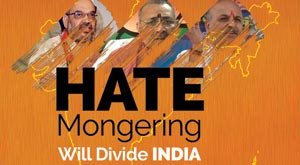
MOHAMMAD NAUSHAD KHAN takes stock of the hate speeches made by some political leaders during their respective campaigns for Lok Sabha elections and concludes that hate mongering will divide India.
It is easier to break than to mould, easier to destroy than to build and even easier to instil hate than to strengthen bonding and building confidence. Elections in India, to some, have more or less become a genuine platform to make their presence felt with provocative speeches aimed at dividing the plural society. Hate speech by any political leader not only undermines democracy, but also harms the spirit of togetherness, social and cultural bonding and the idea of India as a secular and democratic state.
Election campaign began on a positive note, be it only in words with the developmental agenda by all political parties and all were competing for the development or the work done for the welfare which they thought of worthy to mention in order to set the tone of the election agenda for the 2014 polls. All the political stakeholders in fray either praised their development story or criticised others’ claims leading to a political tug of war.
Initially, the body language of the Congressmen revealed during the campaign that they have lost heart and have made up mind to sit in the opposition. The BJP generally contests election with Hindutva and development but this time it was initially cautious and chose to deliberately ignore its Hindutva plank to put forward a palpably assumed reformist and rebrand image of its prime ministerial candidate Narendra Modi. But soon after, all the rhetoric behind the development agenda of the political parties got overshadowed by the hate speeches from across the political board with one party trying to win over another with hate speech and malicious campaign. The idea behind all these notorious speeches is believed to polarise the minds to the fullest extent possible.
During the process of the election campaign the path breaking hate speeches reportedly made by leaders of different political parties at various places are: 1. Those who are opposing Narendra Modi will have no place in India and will have a place only in Pakistan. (Giriraj Singh, BJP). 2. At Azad Maidan in Mumbai, Muslims attacked police, burnt vehicle, damaged memorials and molested policewomen. Modi will teach a lesson if he comes to power. (Ramdas Kadam, Shiv Sena) 3. Election in Western Uttar Pradesh is an election for honour, for seeking revenge and time has come to teach a lesson to those who committed injustice through ballot. (Amit Shah, BJP). 4. If Modi tries to make Uttar Pradesh into Gujarat, then we will chop him into tiny pieces…I am not scared of getting killed or attacking someone. I will fight against Modi. (Imran Masood, Congress). 5. The country has not to be given in the hands of a murderer… the victims of Muzaffarnagar should avenge by pressing the button. (Azam Khan, SP)
On 12 March, 2014 the Supreme Court, while responding to a PIL filed by Pravasi Bhalai Sangathan, a Delhi-based non-governmental organisation, directed the Law Commission to draft guidelines in order to curb hate speeches being made by political leaders and religious outfits and give its recommendations to the Centre. The Court observed that in the wake of hate speeches there was a need for guidelines and regulations because hate speeches destroy the fabrics of democracy and violate the provisions of the Constitution. The Supreme Court also asked the Law Commission to see whether a political party can be de-recognised if its leaders indulged in hate speeches.
“Effective regulation of hate speeches at all levels is required as the authors of such speeches can be booked under the existing penal law and all the law enforcing agencies must ensure that the existing law is not rendered a dead letter,” the order stated. Earlier, on 30 April, 2013 the Apex Court said that the government must have the courage to act and punish the hate speech makers. A bench headed by the then Chief Justice Altamas Kabir issued notices to all states as law and order is a state issue and said that hate speeches are not good for the country and not good for the common man either. A public figure should be more careful while delivering speeches in public.
The present rule of law states that if the hate speech aimed at provoking enmity between groups of different religions then under Section 153 A of IPC police can arrest the hate speech maker without warrant, non-bailable, non-compoundable and imprisonment up to three years or fine or both. But if the hate speech given from a place of worship then the punishment would be jail up to 5 years under 153B(2). If it has been done so to provoke riots, then under 153B IPC, police can arrest without warrant, non-bailable, non-compoundable and imprisonment up to 6 months or fine or both. On 21 April, All India Muslim Majlis-e Mushawarat, the umbrella body of Indian Muslim organisations, said that the Election Commission of India is playing partisan politics by removing the ban on Amit Shah while retaining the same in the case of Azam Khan. The Election Commission has also failed to take action against so many BJP leaders who have crossed all limits during the election campaign.
Seema Mustafa, in her article, “India on a hate list” in The Statesman on 25 April has reasonably said, “Strangely enough, at a time when the Election Commission should have been at its most proactive it seems sluggish and almost non-responsive, taking a long time to reach a decision on the issues that are making a mockery of the secular and democratic tenets of the Indian Constitution. At times it also forgets that its role is not to forgive and forget in the face of apologies but to take action on the basis of the offence. And one would have thought that hate speeches would have invited the strongest action from the august Election Commission.
In a fresh move, the Election Commission on 23 April authorised and asked the common man to check electoral malpractices by uploading a video or audio clip of an inflammatory speech, illegal cash or liquor distribution to the EC website. Election Commission over the years gained wide recognition worldwide for its outstanding role and let that perception earned over the years in the minds of the people remain true in the years to come.