

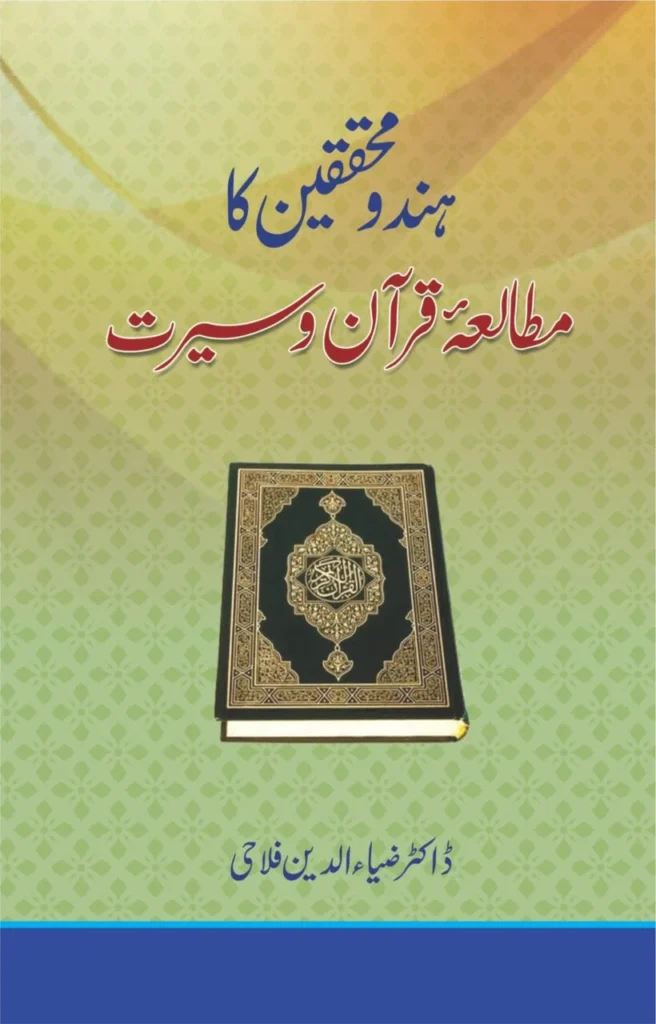
Title:Hindu Muhaqeqeen ka Mutala e Quran O Seerat (Urdu)
Author:Dr. Ziauddin Falahi
Publisher:MMI Publishers, D 307, Abul Fazl Enclave, Jamia Nagar, Okhla, New Delhi-110025
Pages: 144
Price: Rs. 115 (Paperback)
Reviewed By Dr. Rahmatullah
Department of Islamic Studies, AMU
The Qur’an and the Seerah (Prophet’s Biography) have attracted the attention of scholars from different religious, cultural and intellectual backgrounds. In India, centuries of interaction among different religious communities have encouraged several non-Muslim scholars to study the Qur’an, Islamic teachings, and the life of Prophet Muhammadﷺ. Dr. Ziauddin Falahi’s book,Hindu Muhaqeqeen ka Mutala e Quran O Seerat(Hindu Scholars’ Study of the Qur’an and Seerah), is a valuable contribution to this area of study.
Dr. Ziauddin Falahi is a renowned Islamic scholar and professor of Islamic Studies at Aligarh Muslim University, Aligarh. He has contributed abundantly to the burning issues of Islam and modern world. His writings comprise both conventional Islamic education and the modern social sciences. His works on the Qur’an and Seerah, which deals with the current social matters, deserve specific attention.
The book under review is written in Urdu and published by MarkaziMaktaba Islami Publishers, New Delhi. It consists of 144 pages and comprises an introduction, four chapters, and an appendix.
In the introduction, the author highlights that several Hindu writers acknowledged the importance and universal character of Islamic teachings. They urged their fellow Hindus to abandon hostility towards Muslims and argued that Hindu Muslim enmity could hinder the progress of India and other Asian nations. These scholars also believed that the arrival of Muslims in India had contributed to the development of Indian civilisation through various intellectual, cultural, and social influences.
The first chapter “Hindu scholars’ study of the Qur’an,” introduces eight books written in English by Hindu scholars on the Qur’an. The author observes that most of these writers acknowledged the spiritual, social, and ethical teachings of the Qur’an, although they differed in their views regarding its Divine Revelation. The author broadly classifies these scholars into three groups. The first group, which includes Bhagwan Das and Srivastava, accepted the Qur’an as a revelation from God. The second group, represented by M. N. Roy, Devkar, Tewari, and Ram Swarup, recognised the contemporary relevance and practical value of Qur’anic teachings but expressed questions about their Divine origin. The third group, including Maharishi, Dayanand Saraswati and J. Tewari, is presented by the author as hostile and prejudiced towards Islam. They denied the relevance of Qur’anic teachings and portrayed them as contrary to humanity. This classification reflects the author’s assessment of the diverse views adopted by Hindu writers in their engagement with the Qur’an.
The second chapter deals with thirteen English language books on the Seerah written by Non-Muslim scholars. The author examines the works of both moderate and biased writers and offered a valuable insight into their diverse views on the life and teachings of Prophet Muhammadﷺ. He highlights the views of several Hindu scholars who urged Indians to overcome religious prejudices and promote Hindu–Muslim unity as an essential tool for India’s progress and development. Among the scholars discussed are M. N. Roy, N. K. Singh, and T. L. Vaswani. Their writings offer useful insights in understanding of Hindu intellectual engagement with the Seerah.
The third chapter “Hindu scholars’ writings on the Seerah: an analytical study of Urdu and Hindi literature” examines seven books and highlights the role of Urdu as a medium of communication between Hindus and Muslims. The author notes that Hindu scholars often drew upon the writings and poetry of prominent Muslim intellectuals and literary figures such as Ghalib, Hali, Iqbal, Sir Syed Ahmad Khan, and Amir Ali. The chapter also examines poetic accounts of the Seerah, Hindu poets who composed Naat in praise of Prophet Muhammadﷺ, and the accounts of four women who embraced Islam.
The fourth chapter “Hindu scholars’ views on Islamic ethics: an analytical study of English writings of the 20th century,” examines Hindu scholars’ views on Islamic ethical teachings. The author analyses the views of both protagonist and antagonist scholars on various ethical and social aspects of Islam such as human brotherhood, communal harmony, jihad, and peaceful coexistence. The scholars presented as protagonist to Islamic teachings include Prof. T.L. Vaswani, N.K. Singh, Nitin Vyas, and R.B. Harshchandra, while those portrayed as antagonist include Ram Shankar Srivastava, Ram Swarup, and J.G. Tewari. Through this classification, the author shows that Hindu scholars did not hold a single and uniform view on Islamic ethics.
The appendix adds further value to the book. It contains excerpts illustrating the positive and negative views expressed by many of the Hindu scholars whose works are discussed. These passages allow readers to engage directly with the writers’ arguments and form their own judgments about their intellectual positions.
Overall, the author follows a clear and consistent approach throughout the book. Each chapter begins with an introduction that explains its purpose, significance, and subject matter. The author then summarises the main contents and evaluates the key arguments of the works under review. This approach makes the discussion easy to follow while helping readers to develop a deeper understanding of the ideas presented.
The book highlights the keen interest shown by Hindu scholars in 19th and 20th century India in studying Islam. It also brings out the positive attitudes towards Islam expressed by many Hindu writers of that period. Although some writers showed hostility and prejudice towards Islam, the book offers a broader picture of Hindu intellectual engagement with Islam during these centuries.