

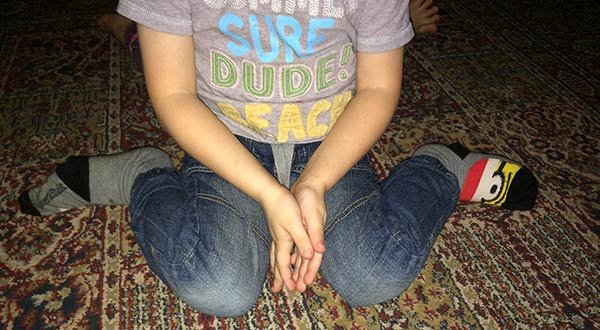
Have you ever noticed your kids playing with toys? Kids usually play in seated position. Many of them like to sit in ‘W sitting’, which is a very common child habitual act. In this position, children sit on their bottoms, with their knees bent, feet tucked under, and their legs splayed out to the side in what looks like a “W”. This is a standard sitting position because children feel supported and comfortable. However, while this may seem comfortable and secure, many parents do not know or recognize the danger of letting a child sit like this for too long.
Why do children W-sit?
W-sitting is the most adaptive posture which children of all ages love to attain. Children often rely on this position for trunk and hip stability to allow easier path way in front, while playing. A child born with hip flexion and external rotation as it develops automatically to adjust inside the womb during birth, but gradually hip angle changes as the child starts to stand and walk. This is also very commonly seen in early age, between 4-6 years and can extend till 15 years, due to normal anatomical development (acetabular angle, femoral anteversion, tibial torsion). So, the child easily attains a comfortable sitting posture to sit or to do activities in W- sitting.
What’s wrong with W-sitting?
Sitting in a W-position for too long can affect a child’s development and growth patterns, e.g. Orthopaedic Problems, Delayed Development of Postural Control and Stability, and Delayed Development of Refined Motor Skills.
What are the common complications of W-sitting?
Back Problem
W-sitting can cause long-term orthopaedic and back deformities. Particularly in children, it is necessary to strengthen the back muscles for sitting. This strengthening occurs in most seated positions. However, W-sitting allows the body to collapse in on itself, depriving the child of the strong back muscles that will be provocative to back pain, hip pain later in life.
Trouble in Developing Motor Skills
W-sitting can also discourage a child from developing hand functional movements due to the restricted trunk rotation. In this position, the child tends to simply pick up objects on the right with the right hand, and those placed to the left with the left hand. It will also affect the ability to do table top activities like ‘Writing’.
Shortened/Tightened/Lengthen Muscles
Muscular tightness is very common in this type of sitting and it is progressive. This position places the hamstrings, hip adductors, internal rotators and heel cords (cuff tendon) in an extremely shortened range. This tightness or contractures (a permanent shortening of a muscle or joint) will encourage another pattern of sitting.
Structural Abnormality of Hip (Hip Dislocation)
Hip Dislocation is very common in W-sitting, especially if there is history of Hip Dysplasia (Hip drop), due to increased femoral anteversion. Some children may have hip drop from birth itself (congenital); such children are strictly monitored not to sit in W- sitting.
Walking Abnormality
W-sitting will have a serious impact on child walking also. Scissoring Gait or Cross leg gait, in-toeing gait mostly happens due to muscular shortening and imbalance in between the groups of muscle, mostly visible in children with cerebral palsy.
Deformity on Spine or Posture Deformity
In W-sitting there will be possibility of Round Back along with Scoliosis. This is a symptom of mal-development or immature child. Sometimes this posture variation may occur due to child Habitual sitting, to act fantasy like adult sitting.
Core Weakness and Poor Balance
W-sitting position results in a larger base of support, which is a compensatory strategy for abdominal and trunk extensor weakness and poor balance.
HOW to prevent child to avoid W-sitting?
The most effective and easiest way to prevent a problem with W-sitting is to prevent it from becoming a habit (it is the first thing to do). Anticipate and catch it before your child even learns to W-sit and encourage the child alternate ways to sitting – side sitting, long sitting, sitting on a low stool, sitting in Criss-Cross leg, baby sitting chair, baby holder sling, functional training, squatting, core strengthening, lower limb stretching, prone lying, consistent verbal command, and also Seek Help from Special Educator, Occupation Therapist, and Physiotherapist if needed.
Hospital run training programme for kids to Correct, Educate, Prevent and Maintain good posture and fitness.
[SANGEETA LASKAR is Physiotherapist & Ergonomist, AktivHealth]