

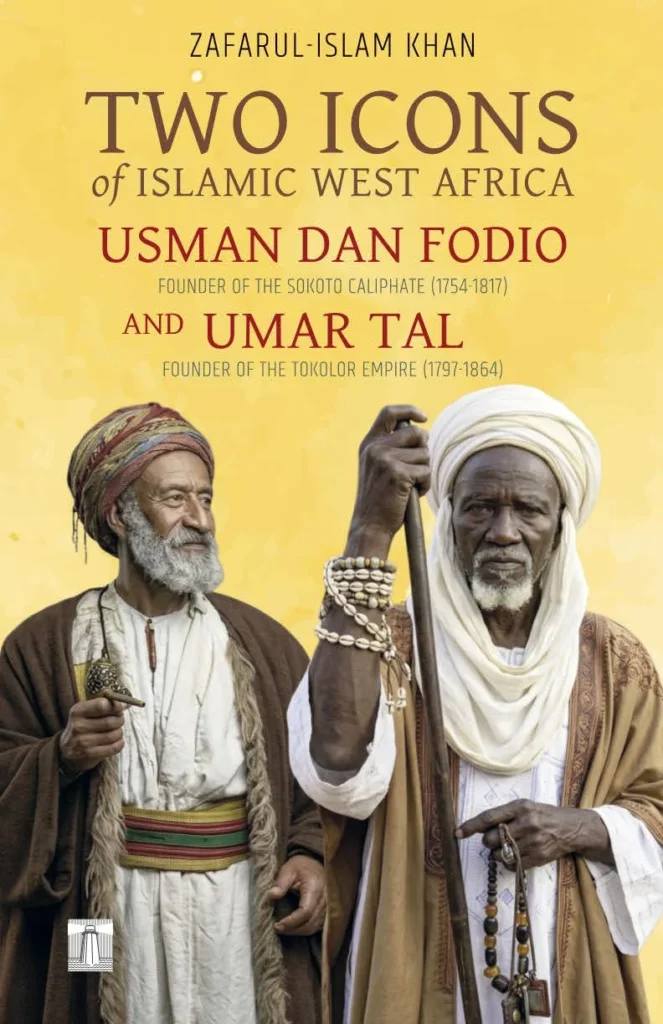
Title: Two Icons of Islamic West Africa: Usman Dan Fodio and Umar Tal
Author:Zafarul-Islam Khan
Publisher:The Institute of Islamic and ArabStudies, New Delhi
Reviewed by Syed Nooruzzaman
These days, countries in the African continent are in the news mostlyfor wrong reasons. Darfur, a part of Sudan, faces the world’s mostserious humanitarian crisis because of the unending civil war and thefamine that may lead to thousands of people dying of starvation if noeffective preventive measures are taken soon.
But there was a time when Africa, mainly its northern and westernparts, attracted the world’s attention owing to its Islamistscholar-leaders establishing empires. Two such geniuses, Usman DanFodio (died in April 1817) and Shaikh Umar Tal (1797-1864), foundedIslamic empires using the idea of hijrah (migration) in the 18thcentury in an interesting manner.
Usman’s empire called the Sokoto caliphate comprised areas in today’sNorth Nigeria and the surrounding towns and villages, and Shaikh Umarwas behind the Sokoto Empire that existed in Mali and its vicinity.
How they persuaded or influenced people to migrate (to undertakehijrah) to areas where they could fearlessly observe their religiouspractices has been discussed in Dr Zafarul-Islam Khan’s latest book,“Two Icons of Islamic West Africa”.
Dr Khan points out that the two leaders used the idea of hijrah as astrategy to consolidate their positions in the areas where theyestablished their powerful caliphates. The author says, “The idea ofhijrah has been employed in a number of places as a standard line ofdefence against Western colonial advances ; for example, hijrah ofMuslims from Andalus after its fall in Christian hands in 1492 CE,movements led by Algeria’s Amir Abd al-Qadir (d. 1883), Mauritania’sMa’ al-Ainayn (d. 1910), Somalia’s Abdullah Hasan (d. 1920), India’shijrah movement of 1920 and the migration of Muslims from areas takenover by the Russians in the Caucasus during the nineteenth and earlytwentieth centuries.”
Dr Khan informs us that Shehu was probably the first Muslim scholar tocome out with a treatise on the idea of hijrah. Two more such volumeswere produced but only after a gap of half a century.
Sheikh Umar defended the hijrah idea forcefully when he was faced withthe view, quoting what the Prophet of Islam said when Makkah wasconquered. The Prophet’s saying has it that “there is no hijrah afterthe conquest of Makkah.” Sheikh Umar’s explanation was that thehadith basically declares that there will be no further migration fromMakkah after it ceased to be an abode of kufr. He, however, quotesanonymous sources in support of his idea.