

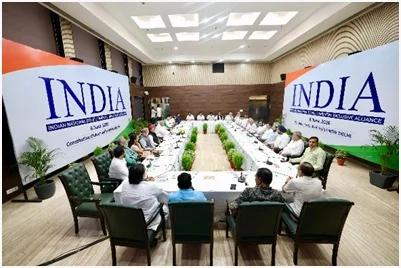
Barely days after the conclusion of the latest round of Assembly elections, leaders of the Indian National Developmental Inclusive Alliance (INDIA) gathered in New Delhi on June 8 in what was projected as a powerful demonstration of unity against the Narendra Modi government and the BJP. Yet the show of unity was not entirely complete. Notably absent were key Tamil Nadu allies, including the DMK, one of the largest and most influential constituents of the INDIA bloc.
The optics, nevertheless, were impressive. Twenty-five opposition parties, representing a broad spectrum of India’s political landscape, came together under one roof. Senior leaders including Congress president Mallikarjun Kharge, Congress Parliamentary Party Chairperson Sonia Gandhi, LoO Rahul Gandhi, West Bengal Chief Minister Mamata Banerjee, Samajwadi Party chief Akhilesh Yadav, RJD leader Tejashwi Yadav, Jammu and Kashmir Chief Minister Omar Abdullah, and representatives of Left parties, regional formations and other opposition groups attended the meeting.
Yet beyond the symbolism of unity, a fundamental question emerged: What exactly is the INDIA bloc’s strategy for confronting what it describes as an unprecedented assault on democracy, constitutional institutions, electoral integrity, employment, inflation and social justice?
For critics, and even some sympathetic observers, the answer appears troubling. Rather than announcing nationwide campaigns, public protests, mass movements or grassroots mobilisation, the alliance largely resolved to write letters, seek judicial intervention and hold more meetings.
Five Resolutions, One Strategy
Addressing the media after the meeting, Kharge announced five major decisions adopted unanimously by the alliance.The most significant among them was the decision to jointly write to Chief Justice of India Surya Kant regarding the Election Commission’s Special Intensive Revision (SIR) of electoral rolls, alleged vote manipulation and what several leaders described as the ‘stealing of elections’.
The bloc also demanded immediate resignation of the Union Education Minister over alleged failures relating to examinations such as NEET and CBSE, called for an all-party meeting on the economy, unemployment, inflation and farmers’ issues, institutionalised bi-monthly INDIA bloc meetings, and decided to continue daily coordination meetings during the forthcoming Parliament session.
The decision to write to the Chief Justice attracted particular attention.If, as several INDIA bloc leaders repeatedly argued, India’s electoral system is facing a crisis of legitimacy and millions risk disenfranchisement through the SIR exercise, critics ask whether a letter to the judiciary can substitute for a nationwide political campaign.
Call for Resistance
The most forceful intervention came from Rahul Gandhi, whose lengthy address reflected both urgency and frustration.Gandhi argued that opposition parties were still operating under the assumption that India’s institutions remained neutral. According to him, that assumption no longer holds.
He alleged that the BJP had acquired overwhelming influence over institutions ranging from the bureaucracy and intelligence agencies to the legal system and the Election Commission. “The problem is that you will not have a free and fair election to win,” Gandhi warned.
He argued that opposition parties must move beyond conventional electoral politics and embrace a broader politics of resistance. Citing initiatives such as the Bharat Jodo Yatra, campaigns around NEET and local struggles against controversial projects, he insisted that resistance, not electoral calculations, must become the defining principle of opposition politics.
In reference to DMK, Gandhi promised to endure ‘every humiliation’ necessary to keep the coalition united and repeatedly stressed that defeating the BJP required unprecedented cooperation among opposition forces.
Missing from the Streets
The INDIA bloc meeting came at a time when opposition parties have repeatedly alleged electoral irregularities, constitutional violations, economic distress, rising unemployment, examination scandals and attacks on minorities and marginalised communities.Historically, such allegations would have been accompanied by largescale public campaigns, nationwide yatras, coordinated protests and sustained street mobilisation.
There was no call for a countrywide movement against unemployment. No coordinated protest programme against inflation. No nationwide campaign against alleged electoral manipulation. No mass mobilisation plan on examination irregularities.The absence of such initiatives has fuelled criticism that the alliance is increasingly looking towards the courts to resolve fundamentally political questions.
Writing to the Chief Justice regarding electoral disputes may be a legitimate supplementary strategy, critics argue. But can it become the primary strategy of an opposition coalition claiming to represent hundreds of millions of Indians?
Over the past decade, opposition parties across India have increasingly turned to the judiciary to challenge controversial laws, electoral processes, arrests of political leaders, gubernatorial decisions and constitutional questions. However, the growing judicialisation of politics has also generated concern.
Political analyst Abdi Shah believes the trend reflects a deeper crisis within opposition politics. “When political parties pass the buck to the courts on issues affecting over a billion people, they reduce massive public crises to narrow legal disputes,” Shah said. “This isn’t just an escape route; it is an abdication of political responsibility that leaves citizens to fend for themselves.”
According to Shah, courts can adjudicate legal questions but cannot substitute for political mobilisation.His criticism echoes a broader concern among observers who believe democratic politics risks becoming excessively dependent on litigation.
Kharge, in his opening remarks, urged alliance partners to deepen coordination and build upon what he described as previous successes in Parliament.He accused the government of undermining constitutional values, misusing investigative agencies, marginalising opposition-ruled states and failing to address economic distress. He also raised concerns about unemployment, examination irregularities and alleged discrimination against weaker sections.
Political observers note that the electorate increasingly expects opposition parties not merely to criticise government policies but also to demonstrate leadership during moments of crisis.
Hyderabad and Beyond
The alliance has decided to meet again in Hyderabad in August and institutionalise meetings every two months.From an organisational perspective, the decision represents progress.Some observers suggest that bi-monthly meetings risk becoming substitutes for political action rather than instruments of it.If the alliance believes, as Rahul Gandhi asserted, that democratic institutions are under unprecedented pressure and elections themselves are vulnerable to manipulation, critics ask whether waiting two months between meetings reflects the urgency of the moment.
The meeting may ultimately be remembered less for its resolutions than for the dilemma it exposed.The INDIA bloc appears increasingly united in its diagnosis of India’s challenges. Its leaders broadly agree on concerns relating to electoral integrity, constitutional values, economic distress, unemployment, social justice and institutional independence.
For now, the INDIA bloc has chosen the path of letters, consultations and court interventions.Whether that strategy can effectively challenge a politically dominant BJP remains uncertain.What is certain, however, is that millions of Indians grappling with economic hardship, educational uncertainty and democratic anxieties will judge the Opposition not by the number of meetings it holds or letters it writes, but by its ability to transform concern into action.
As the alliance prepares for its next gathering in Hyderabad, one question lingers: if the Opposition truly believes democracy itself is under threat, can it afford to remain largely confined to conference rooms?