

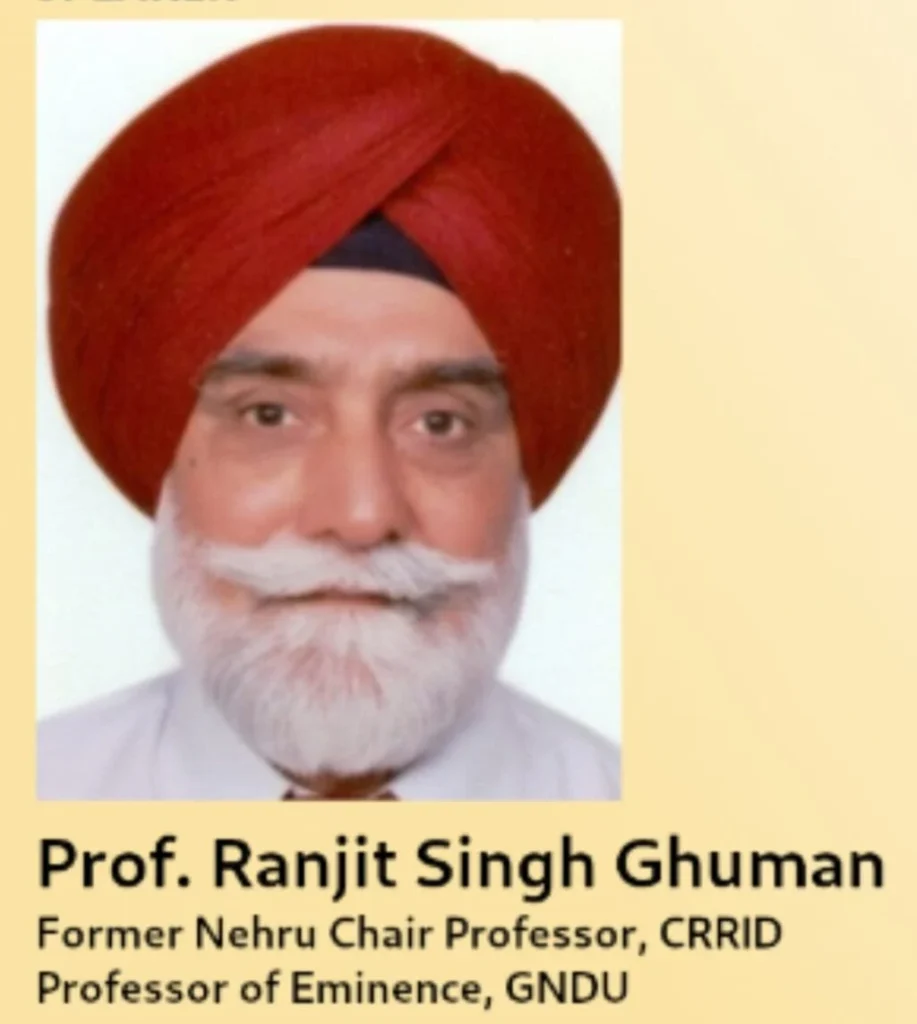
Prof. Ranjit Singh Ghuman has stressed that drug abuse is a national challenge requiring coordinated action by the Centre, states, law enforcement agencies, educational institutions and civil society, alongside prevention, de-addiction and rehabilitation.
India’s drug menace cannot be tackled through arrests, border surveillance and political promises alone. Addressing the crisis requires a comprehensive national strategy that confronts the social, economic, cultural and political factors driving drug addiction, dismantles trafficking networks and ensures long-term rehabilitation for people struggling with substance dependence, said Prof. Ranjit Singh Ghuman, Professor of Eminence at Guru Nanak Dev University (GNDU).
In an interview with Radiance, Prof. Ghuman emphasised that drug abuse and trafficking were not confined to Punjab but formed part of a wider national and international challenge requiring coordinated action across governments, states and institutions. While Punjab illustrates the seriousness of the problem, he argued that the underlying causes must be addressed through a sustained, multidimensional approach rather than isolated enforcement campaigns.
The murder of Parminder Singh Chotta, a crusader against the drug menace in Punjab, has once again brought the issue into public debate. With the Punjab Assembly elections approaching in early 2027, political parties have renewed their attention to the issue. However, the broader questions raised by the incident concern the effectiveness of India’s response to drug trafficking, the accountability of public institutions and the need to prevent addiction across the country.
Prof. Ghuman observed that drug addiction had remained a prominent issue in Punjab’s political discourse for more than 15 years, with parties repeatedly incorporating the issue into their election manifestos. Yet, he argued, the persistence of the problem demonstrated the limitations of approaches that did not adequately address its underlying causes. The lessons from Punjab, he suggested, are relevant to the national debate on drug abuse and the responsibilities of governments and society.
According to Prof. Ghuman, the first requirement for an effective response is an honest acknowledgement of the scale and complexity of the problem. Governments and society must identify the reasons people turn to drugs, the conditions that enable trafficking networks to operate and the failures that prevent people from receiving treatment and support.
He argued that the problem was systemic and therefore required a systemic solution. Awareness, prevention, enforcement, de-addiction and rehabilitation must operate together, supported by policies that address the social, cultural, economic and political circumstances associated with substance abuse.
A strategy centred primarily on arrests may remove individual offenders from circulation without necessarily disrupting the networks responsible for supplying drugs or preventing new consumers from entering the market. Similarly, treatment programmes may produce only temporary improvements if recovering individuals return to environments where drugs remain accessible and social support is inadequate.
Prof. Ghuman stressed that a sustainable response required political commitment, administrative accountability, professional intervention and meaningful public participation. These responsibilities extend beyond any single state government and require cooperation between the Centre, state governments and institutions working in public health, education and law enforcement.
Identifying the politician-police-smuggler nexus as a major challenge in Punjab, Prof. Ghuman said alleged patronage and support for trafficking networks could undermine enforcement efforts. He argued that authorities must focus on dismantling major supply networks rather than concentrating disproportionately on small-time offenders and people suffering from addiction.
The issue also raises wider questions about accountability in drug enforcement across India. Trafficking networks operate through interconnected routes, financial arrangements and distribution systems that cannot be effectively addressed by isolated police action. Intelligence sharing, investigations into larger networks and coordination between agencies are therefore essential.
Punjab’s 553-kilometre international border with Pakistan presents a particular challenge, with drones and other methods reportedly being used to transport narcotics across the border. Prof. Ghuman noted that the extension of central forces’ operational jurisdiction up to 50 kilometres inside the border area placed additional responsibility on them to prevent cross-border smuggling.
However, he maintained that border security alone could not provide a complete solution. Internal distribution networks must also be investigated, while other routes, including the sea route, require attention as part of a broader national strategy.
The underlying principle, he suggested, is that enforcement must address the entire supply chain. Without effective action against major traffickers and those who may facilitate their operations, arrests of low-level offenders risk producing limited and temporary results.
One of Prof. Ghuman’s principal recommendations is a fundamental change in the treatment of people suffering from addiction. He argued that drug users should not automatically be viewed as criminals but should be recognised as people who may need medical treatment, psychological assistance and social rehabilitation.
“They are victims of systemic problems or distortions in the system,” he said, emphasising the need to treat addiction as a public-health and social challenge while maintaining firm action against trafficking.
This distinction is important for national policy. While those involved in the illegal drug trade must face appropriate legal action, people struggling with substance dependence need access to treatment and support that can help them recover and reintegrate into society.
Prof. Ghuman highlighted the problem of relapse after de-addiction. Citing findings from his study, he said more than 66 per cent of those who had undergone de-addiction had relapsed. He attributed this, in significant part, to inadequate family and social support, an unsupportive environment and peer pressure, along with the continued availability of drugs.
These findings underline the importance of rehabilitation beyond the treatment centre. Families, educational institutions, civil society organisations, healthcare professionals and local communities must help recovering individuals sustain their recovery and rebuild their lives.
Referring to Punjab’s Buddy Programme and Outpatient Opioid Assisted Treatment (OOAT) programme, Prof. Ghuman acknowledged the importance of treatment initiatives but cautioned against the risk of prolonged dependence on medicines such as buprenorphine without appropriate medical supervision. He argued that treatment programmes must be carefully monitored and tailored to patients’ needs.
The wider lesson for India is that de-addiction services must be accompanied by continuing medical care, counselling, social support and rehabilitation opportunities.
Prof. Ghuman called for greater coordination between central and state governments, law enforcement agencies and neighbouring states to tackle drug trafficking effectively.He emphasised the importance of sharing real-time intelligence on smuggling routes, trafficking networks and emerging patterns of substance abuse. Agencies should also exchange information about successful prevention and rehabilitation programmes so that effective approaches can be adapted across different regions.
Click here to read in full