

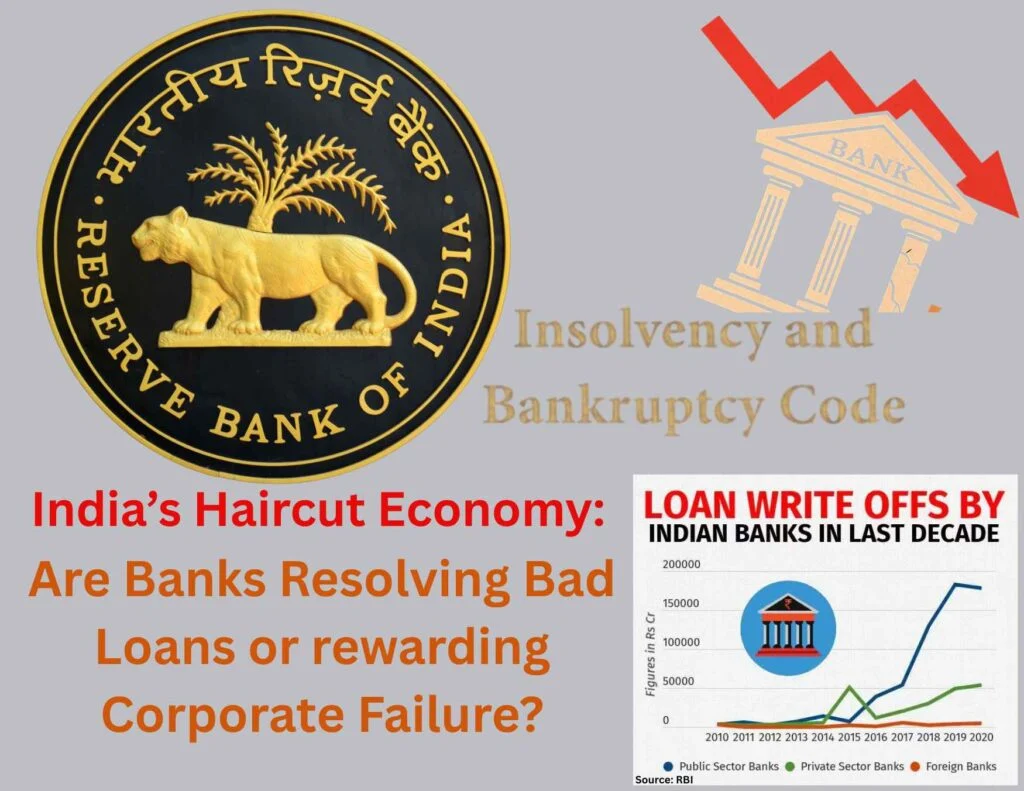
When an ordinary borrower misses a few EMIs on a home loan or vehicle loan, recovery notices arrive quickly, credit scores collapse, assets are seized and legal proceedings begin. Yet when some of India’s largest corporations default on loans worth thousands of crores, the outcome often looks remarkably different. Banks negotiate ‘haircuts’ running into 60, 70 or even 90 per cent, accepting only a fraction of what they had originally lent.
This glaring contrast has turned the haircut policy under the Insolvency and Bankruptcy Code (IBC) into one of the most controversial features of India’s banking system. While regulators and bankers defend it as a pragmatic mechanism to maximise value from failed businesses, critics argue that it has evolved into a system where corporate excesses are socialised while private gains remain protected. The central question is no longer whether haircuts are necessary – they often are – but whether the current framework has struck the right balance between economic efficiency and public accountability.
In banking, a haircut refers to the reduction in the amount that creditors agree to accept while resolving a stressed loan. Under the IBC, creditors evaluate competing bids and often settle for substantially less than the admitted claims because liquidation would fetch even lower value. On paper, the logic is sound: recovering something is better than recovering nothing.
However, the aggregate numbers tell a troubling story. By September 2025, creditors had realised only about ₹3.99 lakh crore against admitted claims of ₹12.31 lakh crore in resolved insolvency cases– an average haircut of nearly 67 per cent. In simple terms, banks have recovered barely one-third of what they were owed. While every insolvency case has unique circumstances, such consistent erosion raises uncomfortable questions about valuation, lending discipline and accountability.
The list of major insolvency resolutions illustrates the scale of losses. While the resolution of Essar Steel resulted in a relatively modest haircut of around 23 per cent, many other cases were far more severe. Reliance Infratel reportedly involved a haircut close to 90 per cent, Jet Airways over 90 per cent, Aircel more than 80 per cent, Alok Industries above 80 per cent and several others witnessed creditors writing off the overwhelming majority of outstanding debt. Even where recoveries were relatively better, banks still absorbed losses amounting to tens of thousands of crores.
Defenders of the system correctly argue that these losses did not arise because of the IBC; they were created years earlier through poor lending decisions, economic downturns, policy failures and corporate mismanagement. The insolvency process merely determines how much can still be salvaged. This argument deserves serious consideration because liquidation frequently produces even lower recoveries than negotiated resolutions.Yet this defence addresses only part of the problem.
The more fundamental concern is how such enormous bad loans accumulated in the first place. Most of these defaults originated from loans sanctioned by public sector banks using public deposits. Were credit appraisals robust? Were project risks properly evaluated? Were politically connected promoters given preferential treatment? Did regulators intervene early enough when warning signals first emerged? These questions rarely receive the same public attention as insolvency resolutions themselves.
Equally disturbing is the asymmetry in the treatment of borrowers. Small businesses, farmers and retail borrowers seldom receive the generous restructuring opportunities available to large corporate debtors. Their defaults often invite swift recovery action, asset seizure and litigation. Large corporations, by contrast, can spend years negotiating restructuring packages, challenging proceedings in courts and eventually benefiting from insolvency resolutions that dramatically reduce their debt burden. Whether this disparity is justified by commercial realities or reflects systemic bias remains an important public policy debate.
Another overlooked aspect is who ultimately acquires these distressed assets. Many bankrupt companies do not disappear; they change ownership. Steel plants, ports, power projects, telecom infrastructure and manufacturing facilities are often acquired by financially stronger corporate groups at heavily discounted valuations. Companies such as ArcelorMittal, Tata Steel, JSW Steel, Vedanta, Piramal Group and, more recently, the National Asset Reconstruction Company Limited (NARCL), have emerged as significant participants in acquiring distressed assets.
From a market perspective, this transfer of assets can improve efficiency by placing productive resources in stronger hands. Economically, preserving operating businesses and protecting employment may justify accepting lower recoveries. However, the process also raises concerns about wealth redistribution. Assets originally financed through public money are frequently transferred to new owners at steep discounts while taxpayers indirectly bear much of the financial loss through repeated recapitalisation of public sector banks.
This creates a moral hazard. If influential borrowers believe that eventual insolvency could substantially reduce their liabilities, incentives for financial discipline weaken. Although the IBC bars defaulting promoters from easily regaining control of their companies, critics argue that indirect routes, related-party transactions and prolonged litigation have sometimes diluted these safeguards. Insolvency law must not become an implicit insurance policy against reckless corporate borrowing.
The banking sector also faces a governance challenge. Large haircuts should automatically trigger rigorous reviews of lending decisions. Officials responsible for sanctioning risky loans, approving repeated restructuring or ignoring early warning signs should be subject to transparent scrutiny wherever negligence or misconduct is established. Without accountability at the lending stage, insolvency merely treats the symptoms rather than curing the disease.
The Reserve Bank of India has significantly strengthened prudential norms, asset quality recognition and stressed asset resolution frameworks since the banking crisis of the previous decade. The IBC has undoubtedly reduced endless delays that characterised earlier debt recovery mechanisms. Credit culture has improved in many respects, and recoveries today are generally better than those achieved under the fragmented pre-IBC regime. These are genuine institutional achievements that should not be overlooked.
Nevertheless, success cannot be measured solely by the speed of resolution. A system that routinely writes off two-thirds of outstanding loans deserves closer examination. Greater transparency in valuation methods, more competitive bidding, stricter forensic audits, earlier intervention in stressed accounts and stronger recovery from promoters in cases involving fraud or wilful default would help restore public confidence.
India’s insolvency framework was designed to rescue economic value, not corporate privilege. It should remain a mechanism for preserving viable businesses rather than legitimising massive losses without corresponding accountability. Every rupee written off ultimately represents public savings entrusted to banks. The issue, therefore, extends far beyond balance sheets;it concerns public trust in financial governance.
The debate over haircuts is not about opposing insolvency reform. Modern economies require efficient bankruptcy systems. The real challenge is ensuring that insolvency does not become a convenient exit route for irresponsible borrowing while ordinary citizens continue to shoulder the costs. Until the banking system convincingly answers that concern, every major haircut will continue to invite the same uncomfortable question: are banks minimising unavoidable losses, or normalising the privatisation of profits and the socialisation of losses?