

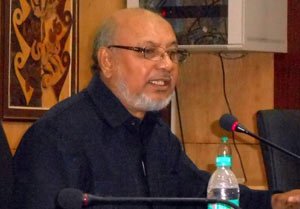
H ABDUR RAQEEB, Convenor, National Committee on Islamic Banking and General Secretary, Indian Centre for Islamic Finance (ICIF), spoke at length on the prospects, growth and acceptance as well as challenges of Islamic Finance and Islamic Banking in an exclusive interview with MOHAMMAD NAUSHAD KHAN. Excerpts:
What is the basic philosophy of Islamic Finance?
Islamic Finance is based on the principles of Islamic Shari’ah. One of its most important aspects is that it is interest-free. The second important feature is that there is no speculation. The third is that there is no gambling. The fourth one is that it does not consider the activity or the product which is unethical or haram; for example, casino, pork, pornography, banking products based on interest and weapons of mass destruction.
How is Islamic Banking superior to Conventional Banking?
Islamic Banking is superior. Unlike in Islamic Banking, if we go to a conventional bank, we cannot get money without collateral. Only the rich can provide collateral. Even if the project is not viable and one is ready to pay collateral, he can easily get the money. But those who have got experience, capacity and their project is meant for human welfare, may not get money if they are not in a position to provide collateral. Even after forty years of nationalisation of banks, 60% of people do not have access to formal banking services and only 5.2% of villages have banks branches. Then, who are depositing the money and who are getting the benefit? Only a fraction! Big people are getting the benefit. You know in Vidarbha how farmers are committing suicides. There is acute starvation. The small farmers who work in the field for long hours are not getting money. Nowhere in the world are people in so distress. Conventional banking is only for the haves. And because of these shortcomings of conventional banking the rich are getting richer and the poor are getting poorer.
Is there awareness about Islamic Finance in India? Or do you think a lot more is required to be done to educate people about it?
Yes, not only awareness is poor but at the same time there is misunderstanding about Islamic Finance or Islamic Banking. When we talk about Islamic Finance, people think it is only for Muslims. And even Muslims are sceptical about whether it is possible to have a bank which is interest-free. So a lot of awareness has to be created among people.
Muslims themselves had not been in this financial system for about 300 years. Muslims and non-Muslims are required to be told about the humane side of the Islamic Finance or Islamic Banking. Marginal farmers, petty traders, landless labourers, self-employed and unorganised sector enterprise, ethnic minority and women – aam aadmi of the country continue to form “the financially excluded class”.
According to Sachar Committee Report, the banking sector has categorised Muslims and Muslim concentration areas as “Negative Zone”. This exclusion is due to reasons of their faith, interest being not permitted. Reports also reveal that in relation to those who have dealings with banks, thousands of cores of their interest money is lying idle in banks and these savings are not ploughed back by them into the economic activity of the country.
Which model of Islamic Banking will be suitable here in India? Is it Malaysian model or any other? Or should India have its own model?
No, no. The whole thing is that we have got several models. For example, the UK model is there, Japan model is there and so many countries have accommodated the Islamic products in their own respective banking systems. We want that to begin with we can have models like UK, Japan, France or even Malaysian model. One can follow any model or give it any name but the basic principle is that it should be based on Shari’ah with the sole purpose to help the common man and the weaker sections in the society. India is growing; but Indians aren’t. Huge disparities exist between different segments of the Indian society. There are “Oceans of Poverty and Islands of Prosperity”. The top 20 rich Indians earn as much as 30 crore poor people in the country as per Mr. Bimal Jalan, former RBI Governor.
The Government of India, particularly Finance Ministry and RBI should allow Interest-free Islamic Finance and Banking for inclusive growth of the marginalised and the minorities of the country as well as for the infrastructure development with real economic growth and employment generation. If Kerala can have NBFC based on Interest-free Islamic principles, why not Delhi for inclusive growth of the marginalised and minorities?
In one of your programmes you said Islamic Finance can change the face and future of India. How is it possible?
Actually, Islamic Finance is inclusive in nature. The poor can also get money. The most important one is that Islamic investment is growth-oriented. Today in the conventional financial engineering only paper money is being transferred. There is no actual economic growth in such type of transaction. Most of the Islamic Finance is based on ethics. For example, we have got Sukuk called investment. These are asset-based bonds. For example, if you want to have an airport or power plant of 20000 crore. Most of the people will participate; the government will participate; and then they will make a big project. And then it can be leased or sold out anytime. This is based on economic growth with employment generation. The poor can also afford to do so. It does not depend on whether or not the individual has got money if the project is viable. The bank and the one who has made investment will be partners.
But when one goes to the conventional financial system, there he has to pay interest. It does not matter whether the project is viable or not. Or the project is being carried out for the benefit of people; nobody cares in the conventional system of finance. But in the Islamic Financing it is looked upon whether it is ethical or social financing. It will not be based on interest. It will be mutually beneficial for people. It has inherent inclusive growth. It will not only help the rich to become richer but can bridge the gap between haves and have-nots.
But where does the fault lie? Is there lack of political will? Or, is the resistance simply because it has come from a particular religious community?
First thing is that there is lack of awareness. Even the Muslims are not aware what Islamic Finance is. Some misunderstanding is also there. So far it has not been placed in the national agenda of any political party and Alhamdulillah, ICIF is doing this and trying to persuade concerned authorities from top to bottom. We are talking to people, religious scholars, political parties, business groups, economic thinkers and all those who can influence the very idea to promote Islamic Finance.
Islamic Finance should also be included in the Madrasa and various other educational systems. There has to be greater understanding among religious scholars as Caliph Umar said al dunia bil maal. The world is with finance and if you do not have finance, you do not have any place in the society. Al momim al qawi means a strong momin viz. a man with wealth and talent as well. A community is only asking for something and does not have money, will only beg. If you are a strong community, you can demand things. For example, the Jains are less than one per cent but they can demand things. But Muslims they say are 15 per cent and yet they don’t have any voice because they are not financially strong. There is inherent system in our religion. There is zakat system. When we go for prayer there is a mosque for people to pray collectively but where is the Baitulmaal. There should be a collective system of Zakat. This mechanism has to be evolved in our Muslim society. The awareness that the Muslims have to be economically empowered has to be created.
Will you pressurise political parties to include the issue of Islamic Finance in their manifesto?
Definitely, last week in our meet with Arvind Kejriwal I pleaded with him and submitted a document that it should be included in manifesto. I have received a message from him that his manifesto committee is looking into it. We have also talked to the chairman of the Minority Commission and provided him with all necessary documents and have urged him to put it before AICC so that it is included in the manifesto. Likewise, I have talked to many political parties or the stake holders to expedite the process that can make Islamic Banking or Islamic Finance a reality across India soon.
Our country needs US$ 1 trillion to upgrade its infrastructure in order to achieve its target of annual growth of 8-9% – almost double in the 12th Five-year Plan than the 11th Five-year plan. Standard & Poors’ Document released on 13 October, 2011 – “Will Islamic Finance play a key role in funding Asia’s huge infrastructure task?” mentions that conventional lending markets being jittery. The world is now looking towards alternatives to conventional finance and Islamic Finance is one such alternative. Some of the Islamic Finance products like Sukuk are increasingly used by both the developing countries like Indonesia and Malaysia and developed countries like UK, France and Germany. India should also make use of the resources awaiting investment in the GCC countries.
Will Islamic Banking become a reality soon?
In 2008, a committee was formed by the Planning Commission of India that was called high level committee on financial sector reforms. The findings were placed on its website seeking feedback from the people. The ICIF created awareness among the people and met financial and banking experts in India and abroad and also talked to the committee. I personally met Dr Raghuram Rajan in Hyderabad and presented before him and said that you have got everything but when you are talking about inclusion you are not including the marginalised sections and the minorities when combined they can become majority. There are 20 per cent Muslims and 40 per cent marginalised people. And if they are not included then how can you talk of inclusive growth. And then, the High Level Committee on Financial Sector Reforms – CFSR of the Planning Commission of India headed by Dr Raghuram Rajan, the present Governor, RBI got included two paragraphs in the report which recommended interest-free finance to be introduced in the main banking sector for growth with inclusion and innovation. He has certainly opened the window from where the concept of Islamic finance will get accommodated in our financial system one day.
How can Islamic Finance ease the burden on Indian Economy?
Interest-free Islamic Finance has emerged as a viable alternative world over after the financial meltdown of the west. It is growing at the rate of more than 15%. Not only Muslim countries but modern, secular and industrialised countries like the UK, Singapore, France, Japan and Hong Kong have become hubs of Islamic Finance and Islamic Banking. Even World Bank considers it as a priority area. Very recently, Prime Minister David Cameron of Britain has announced plans for Britain to become the first western country to issue Sukuk, or Islamic bond. So Islamic Finance will not only save India but it can also transform world economy. People are now talking that Islamic Finance can save the world.