

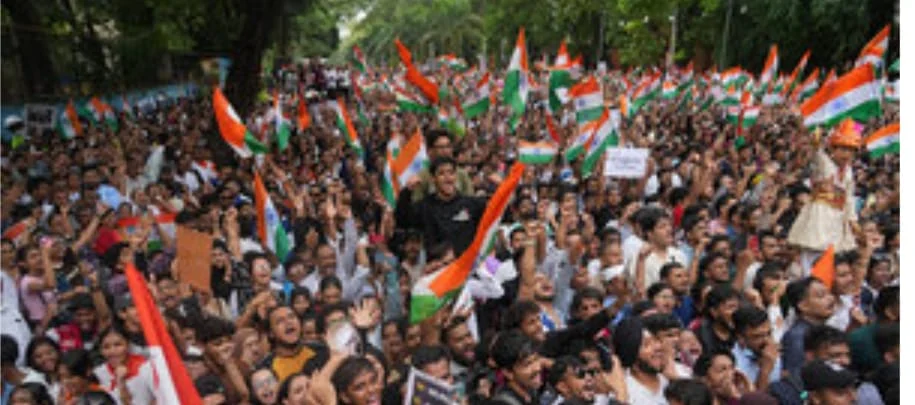
The ongoing protest at Jantar Mantar has emerged as more than a demonstration against a specific government action. It has evolved into a larger assertion of the constitutional values of free speech, dissent and the citizen’s right to question authority. Protesters, students, academics, lawyers, retired judges, civil society members and political activists have repeatedly argued that democracy cannot thrive if criticism of those in power is viewed with suspicion rather than as an essential democratic safeguard.
Throughout the demonstrations, speakers have maintained that dissent is not an obstacle to democracy but one of its defining characteristics. Placards carrying messages such as ‘Dissent is Democracy,’‘Question Without Fear,’ and ‘The Constitution Protects Our Voice’ have become defining images of the protest. Organisers contend that the movement is aimed at defending constitutional freedoms and preserving the space for peaceful disagreement in public life.
The emphasis on dissent has also drawn strength from the views expressed by members of the higher judiciary and distinguished legal scholars. Their observations have repeatedly been cited during public meetings at Jantar Mantar to underline that the Constitution envisages an active citizenry capable of questioning governmental actions.
Among the most widely discussed remarks are those of Justice Ujjal Bhuyan, who has consistently emphasised that constitutional democracy requires citizens to possess the courage to question authority. Speaking on constitutional values, Justice Bhuyan observed that unquestioning obedience is inconsistent with democratic governance and that meaningful democracy depends upon informed citizens who are prepared to ask difficult questions. According to him, constitutional morality flourishes only when citizens are free to express disagreement without fear of intimidation or retaliation.
His observations have resonated strongly with participants at the Jantar Mantar protest. Speakers have argued that democracy loses its vitality when dissent is equated with disloyalty or anti-national conduct. They contend that questioning public policy, demanding accountability and criticising governmental decisions are legitimate exercises of constitutional freedoms guaranteed under Articles 19(1)(a) and 19(1)(b) of the Constitution.
Several senior legal luminaries have echoed similar concerns over the shrinking space for democratic debate. Former judges and eminent constitutional lawyers have repeatedly stressed that disagreement with the government is neither a crime nor an act against the nation. Instead, they argue that dissent strengthens institutions by compelling governments to justify their decisions and remain accountable to the people.
Legal experts addressing public discussions surrounding the protest have referred to the words of distinguished jurists who have maintained that constitutional freedoms cannot exist merely on paper. They argue that the freedom of speech necessarily includes unpopular opinions, uncomfortable criticism and peaceful resistance against policies considered unjust. According to them, democratic institutions become stronger, not weaker, when governments tolerate criticism and engage with opposing viewpoints.
The significance of peaceful protest has also found judicial recognition in several constitutional decisions. Protest organisers have frequently referred to the Bombay High Court’s observations affirming that peaceful demonstrations constitute an integral part of democratic participation. The High Court has emphasised that the right to assemble peacefully and express dissent cannot be denied merely because the views expressed are inconvenient to those in authority. While acknowledging that reasonable restrictions may be imposed in the interests of public order, the Court underscored that such restrictions cannot extinguish the very essence of the constitutional right to protest.
These judicial observations have acquired renewed relevance amid ongoing debates regarding restrictions on public assemblies, permissions for demonstrations and the policing of protest sites. Lawyers associated with the movement argue that administrative concerns cannot become a pretext for suppressing peaceful expression. Instead, the State bears the responsibility of facilitating lawful protests while maintaining public order through proportionate measures.
Participants at Jantar Mantar have also cited earlier constitutional jurisprudence of the Supreme Court affirming that freedom of speech forms the cornerstone of democracy. They argue that the Constitution envisages a marketplace of ideas where differing opinions coexist and where governments remain answerable to citizens rather than insulated from criticism.
Several retired judges and senior advocates addressing public meetings have warned that democracy suffers when fear replaces dialogue. According to them, constitutional governance demands that governments listen to criticism rather than silence it. They have argued that history demonstrates how societies progress through questioning established practices and encouraging reasoned debate rather than enforcing conformity.
Students participating in the protest have similarly described dissent as an educational and democratic value. Many argued that universities have historically served as spaces where ideas are debated freely and where young citizens learn the importance of constitutional rights and responsibilities. They expressed concern that intolerance towards criticism could discourage independent thinking and weaken democratic participation among future generations.
Civil society organisations supporting the protest have maintained that constitutional patriotism requires citizens to defend democratic institutions by exercising their rights responsibly. According to them, peaceful protest represents faith in constitutional methods rather than rejection of the democratic system. Demonstrators insist that their presence at Jantar Mantar reflects confidence in constitutional remedies and public dialogue.
The movement has also witnessed cultural expressions of resistance, including poetry readings, musical performances and public recitations of the Preamble to the Constitution. Organisers say these activities symbolise their commitment to democratic ideals, equality before law and constitutional freedoms. Many speakers have invoked the legacy of India’s freedom movement, arguing that questioning authority has historically contributed to social reform and democratic progress.
Observers note that the ongoing mobilisation has shifted public discourse from immediate political controversies to broader constitutional questions concerning liberty, accountability and the relationship between citizens and the State. Rather than focusing solely on policy disagreements, the protest increasingly frames itself as a defence of democratic principles that transcend partisan politics.
Supporters of the movement argue that the right to question authority remains indispensable in a constitutional democracy governed by the rule of law. They maintain that democracy flourishes not through unquestioned obedience but through informed participation, reasoned criticism and peaceful engagement with public institutions.
As the protest at Jantar Mantar continues, the recurring message from demonstrators, constitutional scholars and legal luminaries remains strikingly consistent, dissent is not an act of defiance against democracy but an affirmation of it. Echoing Justice Ujjal Bhuyan’s call for the courage to question and reinforced by judicial recognition of the right to peaceful protest, the movement has sought to remind the nation that constitutional freedoms acquire real meaning only when citizens can exercise them without fear. Whether the ongoing demonstrations ultimately influence public policy remains to be seen, but they have undeniably rekindled a nationwide conversation about the indispensable role of dissent in preserving India’s constitutional democracy.