

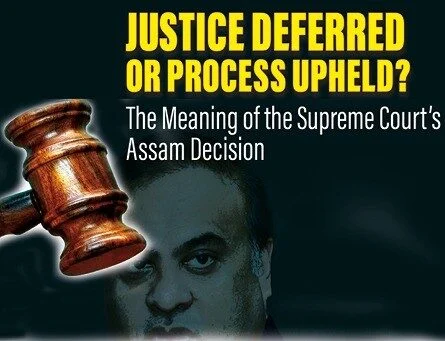
The Supreme Court’s recent order directing petitioners to approach the Gauhati High Court in their plea seeking action over alleged hate speech by Assam Chief Minister HimantaBiswaSarma has triggered debate extending far beyond jurisdictional technicalities. On paper, the decision reflects a settled judicial principle: High Courts are ordinarily the first constitutional forums for the enforcement of rights within their territories. Yet when allegations concern a sitting Chief Minister, the question inevitably shifts from procedure to consequence. Does insistence on institutional discipline strengthen constitutional balance – or does it risk postponing accountability when power itself is under scrutiny?
This dilemma sits at the core of constitutional democracy. Procedure is not ornamental; it structures federalism, distributes judicial authority, and guards against forum shopping. But citizens often turn to the Supreme Court directly in politically sensitive disputes because it is perceived as the most insulated forum for urgent constitutional protection. The order, therefore, lies at the intersection of two legitimate imperatives: preserving institutional hierarchy and ensuring that access to justice remains effective when authority is involved.
The significance of the ruling will ultimately depend not on where the case is heard, but on how swiftly and independently it proceeds. In constitutional systems, justice is shaped as much by time as by outcome.
The Constitutional Architecture of Remedies
India’s constitutional design distributes responsibility for protecting rights between the Supreme Court and the High Courts. Article 32 guarantees direct access to the Supreme Court for enforcement of fundamental rights – a provision Dr. B.R. Ambedkar described as the “heart and soul” of the Constitution. Article 226, meanwhile, equips High Courts with even broader powers, enabling them to issue writs not only for fundamental rights but for other legal protections as well.
The Supreme Court has consistently maintained that litigants should ordinarily approach High Courts first unless exceptional circumstances justify direct intervention. This approach reflects both constitutional logic and institutional necessity. High Courts are not subordinate tribunals but primary constitutional courts within their regions. Allowing them to address disputes first reinforces federal balance and prevents the over-centralisation of justice in Delhi.
Seen in this light, the order is doctrinally consistent rather than extraordinary. By requesting the High Court to hear the matter expeditiously, the Court signalled that it was not refusing scrutiny but redirecting it to what it viewed as the appropriate constitutional forum.Yet doctrinal correctness does not settle the constitutional question raised by the case.
Institutional Order in a Politically Sensitive Case
Public attention stems less from jurisdictional theory and more from the nature of the allegations. Complaints against ordinary citizens proceed through routine criminal channels. Allegations against a sitting Chief Minister occupy a structurally different space, because the executive authority ultimately oversees the administrative machinery responsible for investigation. That reality inevitably shapes public confidence in neutrality.
This is precisely why petitioners in politically sensitive cases often approach the Supreme Court directly. Article 32 functions not only as a legal mechanism but also as a constitutional assurance that scrutiny can remain visibly independent of local pressures.
The present dispute therefore places two constitutional values in tension: judicial federalism, which relies on High Courts as frontline guardians of rights, and democratic expectation, which demands that proceedings involving powerful officials be both independent and immediate.
By directing the petitioners to the High Court while emphasising expedition, the Supreme Court attempted to reconcile these principles. But the reconciliation is fragile. In matters where delay itself alters the balance of accountability, the forum question cannot be treated as purely procedural.
Procedure and the Reality of Delay
Procedural redirection is rarely neutral in practice. Moving a case from the Supreme Court to a High Court introduces additional filings, listings, and procedural stages that, even when institutionally justified, tend to stretch timelines.
In cases involving public officials, time is not an abstract variable. Delay can dilute public scrutiny, weaken evidentiary momentum, and allow the accused to continue exercising authority without judicial determination. What appears structurally proper may, in lived reality, operate as a postponement of accountability. Indian public life offers several examples where litigation over political speech has stretched across years, long after the immediate consequences had played out. Such precedents make the question of judicial timing inseparable from the question of justice itself.
Article 32 was conceived precisely to guard against this risk. The framers recognised that remedies must remain immediate where rights are threatened by power. When the Supreme Court declines to exercise that jurisdiction, even for principled institutional reasons, it therefore raises an unavoidable constitutional question: whether procedural discipline, however justified, may at times function less as a pathway to justice and more as a mechanism that slows its arrival.
Accountability and the Power Imbalance
The case also feeds into a broader democratic concern: the accountability of those in high office. Indian law does not create different criminal standards for political authorities. Yet initiation of proceedings often depends on administrative processes that may appear hesitant when senior officials are involved.
In such contexts, courts are not merely adjudicators of guilt; they are guarantors of the credibility of the rule of law. Judicial intervention signals that constitutional equality operates across the political hierarchy.
The Supreme Court’s order does not remove judicial scrutiny; it relocates it. But in politically charged matters, relocation can also mean diffusion. Public faith depends not only on eventual adjudication but on whether the process appears immediate, accessible, and insulated from influence.
Where citizens perceive distance between grievance and remedy, constitutional confidence weakens long before judgment is delivered.
Hate Speech and Constitutional Secularism
The dispute also intersects with India’s evolving hate-speech jurisprudence. Courts have repeatedly held that speech capable of inciting hostility or threatening communal harmony must be addressed firmly while remaining consistent with free expression protections. Such cases are not merely about words; they test the constitutional commitment to equality, secularism, and public order.
Yet enforcement in this domain has often appeared uneven, shaped by political context and administrative response. This structural inconsistency is precisely why citizens increasingly seek judicial oversight. Courts are seen not only as interpreters of law but as stabilisers of constitutional values when executive initiative appears uncertain.
That expectation places the judiciary in a demanding position: required to uphold constitutional morality while exercising institutional restraint. The balance is delicate, but it is also central to democratic legitimacy.
Public Trust and the Perception of Constitutional Justice
Orders of this nature shape not only doctrine but public confidence in constitutional justice. Some will read the decision as a principled reaffirmation of judicial federalism. Others will interpret it as procedural caution in a politically sensitive case.
For ordinary citizens, however, the issue is rarely jurisdiction in the abstract; it is reassurance in practice. When allegations concern powerful officials, people look for clear signals that the law moves with urgency and independence. If proceedings appear slow, distant, or layered in procedural movement, the question that arises is not whether the Court followed doctrine, but whether equality before law is visibly functioning.
This is why constitutional legitimacy depends not only on technical correctness but on responsiveness that can be seen and felt. Courts must ensure that justice is not only delivered through proper channels but delivered without avoidable delay, particularly where the authority of office itself is under scrutiny.
If the High Court acts swiftly and decisively, the order may reinforce confidence in decentralised constitutional remedies and demonstrate that institutional discipline does not weaken accountability. But if proceedings slow or lose momentum, the same decision risks being remembered as a moment when procedural order diluted urgency – and when the passage of time quietly worked in favour of the accused.
The Test of Process Is Justice
The Supreme Court’s decision in the Assam matter raises a question larger than one petition. By redirecting the case to the High Court, the Court reaffirmed a foundational principle: constitutional justice in India is designed to function through layered institutions rather than a single central forum.
Yet democracy depends not only on structure but on effectiveness. When allegations concern those in power, citizens look to courts for visible and timely accountability.
The meaning of this decision will therefore be determined not by jurisdictional theory but by the pace and independence of what follows. In a republic committed to justice, democracy, and secular equality, procedure must serve justice, not slow it.
Whether this moment comes to symbolise process upheld or justice deferred will depend on whether the next stage ensures that constitutional scrutiny moves with urgency rather than waits behind it.
In the end, constitutional courts are judged not only by the correctness of their orders but by the confidence they inspire among citizens. Where timing blurs accountability, even procedurally sound decisions risk being remembered as moments when justice paused while power moved on.