

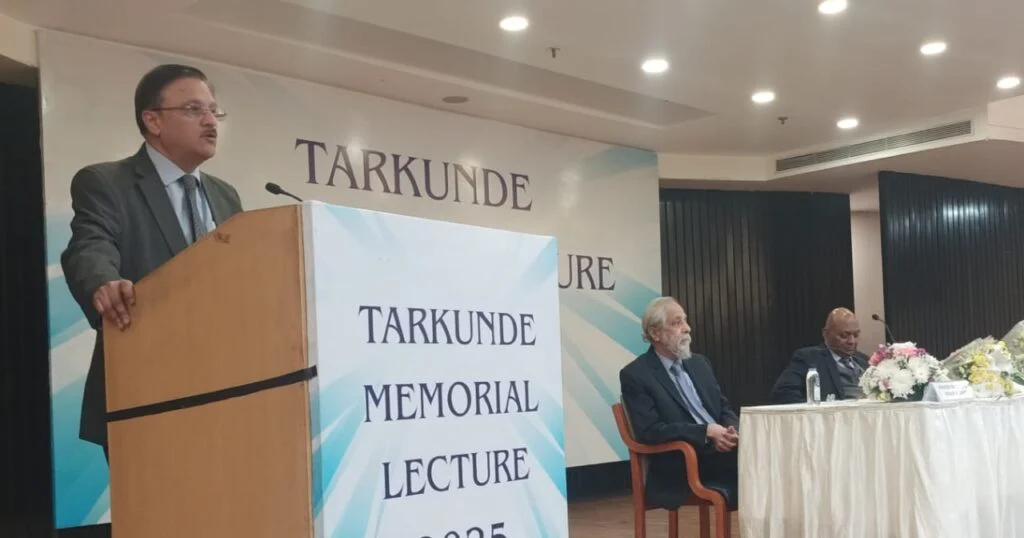
 At the 16th V.M. Tarkunde Memorial Lecture held at India International Centre, New Delhi on December 5, 2025, former Supreme Court judge Justice A.S. Oka delivered a stirring call for national revival of scientific temper, humanism, and constitutional morality. The lecture, organised by Tarkunde Memorial Trust, brought together some of India’s legal luminaries, scholars, and civil liberties advocates, all united by the enduring legacy of Justice Tarkunde, celebrated as the father of civil liberties movement in India.
Justice Oka opened with a deeply personal reflection, recalling how an inspiring speech by Tarkunde during his student days in Mumbai left a permanent imprint on him and several of his classmates, eventually leading them to associate with People’s Union for Civil Liberties (PUCL). Although Oka never saw Tarkunde argue in court, he learned of his intellectual discipline, ethical clarity, and uncompromising rationalism through close associates such as M.A. Rane and C.R. Dharvi. Their ethos, that honours must never be sought but only conferred, was emblematic of the moral culture Tarkunde embedded within the legal community.
A significant portion of Justice Oka’s lecture revisited Tarkunde’s pioneering contribution to electoral reforms. Oka highlighted the farsighted recommendations of the Jayaprakash Narayan appointed committee chaired by Tarkunde: a multi-member Election Commission, lowering the voting age to 18, state funding of elections, and creation of elected voter councils to deepen grassroots participation. While some proposals were eventually implemented, several remain unrealised. Tarkunde anticipated debates that continue to dominate public discourse today, particularly the rising influence of money and the need to safeguard electoral integrity.
The central theme of Justice Oka’s address “Our Constitution and the Fundamental Duty to Develop Scientific Temper” was firmly rooted in Tarkunde’s rationalist worldview. Oka recalled an interview where Tarkunde, an avowed atheist, asserted that morality deteriorates not because of a lack of religion but due to the absence of reason. This conviction, Oka said, lies at the heart of Article 51A(h) of the Constitution, which makes it a fundamental duty of every citizen to develop scientific temper, humanism, and the spirit of inquiry and reform.
Yet this duty, Justice Oka argued, has remained largely neglected. When fundamental duties were introduced through the 42nd Amendment, even respected constitutional scholar H.M. Seervai dismissed them as having no enforceability. But over time, judicial interpretation shifted. Landmark cases such as AIIMS Students’ Union and Charu Khurana affirmed that the State must create conditions that enable citizens to fulfil these duties. Environmental jurisprudence, too, is rooted in a constitutional integration of Articles 21, 48A, and 51A(g), giving rise to doctrines such as sustainable development, intergenerational equity, and the precautionary principle.
Despite this, Oka warned, scientific temper remains alarmingly weak in Indian society. Drawing from the life and work of rationalist Dr. Narendra Dabholkar, he described how simple scientific demonstrations debunked claims of ghosts, miracles, and occult practices. When Dabholkar and astrophysicist Dr. Jayant Narlikar conducted a rigorous academic study disproving astrology, their research was met not with debate but hostility, a reflection of deep-seated societal resistance to scientific reasoning.
This resistance has grave consequences. Oka pointed to recent proposals to cut more than a thousand old trees to expand facilities for the 2027 Kumbh Mela, an example of how cultural practices can override ecological responsibility, despite the constitutional mandate under Article 51A(g). Without embedding scientific temper in policy, governance, and public life, constitutional protections for the environment cannot be effectively realised.
Justice Oka placed special emphasis on education as the most crucial instrument for cultivating constitutional values. Civics receives minimal attention in school curricula, and fundamental duties are barely taught. The result is widespread misunderstanding, students often perceive fundamental duties as restrictions on rights rather than expressions of constitutional morality. Unless scientific temper, rational inquiry, and environmental responsibility are integrated into education from the earliest levels, he warned, Article 51A will remain “dormant and decorative.”
The lecture was framed by reflections from two senior jurists deeply connected with Tarkunde’s legacy. Justice Madan Lokur, President of Tarkunde Memorial Trust, in his introductory remarks, explained why the Tarkunde Memorial Lecture has endured for 16 years while many others have faded: the issues Tarkunde confronted, authoritarianism, communal polarisation, superstition, and shrinking civil liberties, remain urgent and unresolved. Lokur recalled Tarkunde’s steadfast role during Emergency and his leadership of Citizens for Democracy and PUCL, emphasising that his unwavering rationalism and constitutional fidelity continue to serve as guiding beacons.
Senior Advocate Raju Ramachandran revisited the early 1970s crisis, when he first encountered Tarkunde’s writings and recognised his stature as a moral compass in turbulent times. He also drew attention to Tarkunde’s involvement in Forum for Democracy and Communal Amity after the Babri Masjid demolition, underscoring his belief that communal harmony and democracy are inseparable.
Justice Oka’s message was unambiguous: a constitutional republic cannot survive without scientific temper, and the revival of reason is essential to the revival of democracy itself.