

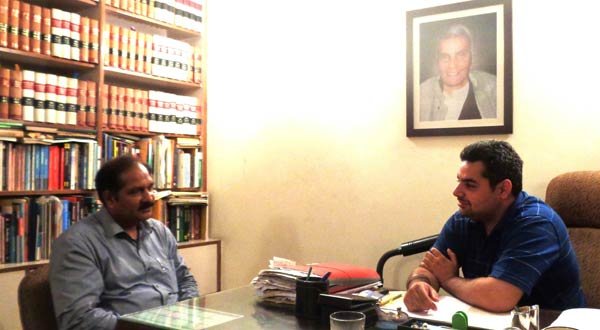
IT-Kanpur alumnus, DR MOHAMMAD SALIM ENGINEER, is presently Secretary General of Jamaat-e-Islami Hind. He has done PhD in 4G mobile communication technology and was former Head of the Department of Electronics and Communication Engineering at Malviya National Institute of Technology, Jaipur. In an interview with MOHAMMAD NAUSHAD KHAN, he said that Justice Sachar used to say one thing repeatedly and particularly in his last days that it is not required by the Muslims to say that they are faithful to the nation and prove their loyalty every now and then.
Any memory you have of Justice Sachar which you feel like sharing with us?
I was in contact with Justice Sachar for the past 22 years when I was in Jaipur (Rajasthan). He used to be very active in human rights activities and human rights violations even when he was Judge. He became more active in these issues after his retirement. He used to come there to attend programmes and was actively associated with PUCL (Peoples Union for Civil Liberties) and FDCA (Forum for Democracy and Communal Amity) which was established in early 1993 after the demolition of Babri Masjid. He was the senior founder member of FDCA and Justice VM Tarkunde, who was popularly known as Father of the Civil Liberties Movement in India, was the president of FDCA. Justice Sachar, Kuldip Nayar and many more eminent personalities were associated with this forum.
Justice Sachar was a very simple man and was very open. He was so cordial and assessable that we never felt like taking prior appointment. He did not believe in unnecessary formalities and used to be very cordial during meetings and interaction. He was never hesitant to attend even small meetings. His main concern was democracy and democratic environment. He strongly supported constitutional values, equality, liberty, fraternity and justice and freedom and he was of the opinion that based on these values the country can become strong, can develop and prosper. Personally he did not believe in religion but he believed that religious people are more committed and religion makes an individual good person. To him Communalism was not linked to religion. A person can be communal even if he is not religious. A religious individual can also be liberal and secular so communalism should not be linked to religion. He believed in freedom as enshrined in the Constitution like religious freedom. I used to interact with him during meetings of PUCL and FDCA.
On Eid day, I remember he never missed to call me and he used to be the first person to wish me on that day. Also he used to call me often to discuss issues and know my viewpoint on certain issue. He used to ask me to come to his house if I was in Delhi to discuss issues. Such was the openness in him. He used to ponder and think over small issues as well.
I remember an instance which may have been reported as well. Once he was travelling by airplane. He ordered non- veg food. In his ticket it was written Muslim food. He took it very seriously and informed or even complained to the higher authorities how you can relate food with religion. This shows his sensitivity and how minutely he used to observe things.
I remember another instance when after Muzaffarnagar riots our FDCA team conducted a survey there to take stock of the situation. The FDCA team comprised ND Pancholi, Prof Prem Singh, Shafi Madni, and Mohammad Ahmed visited with the team. A detailed report was prepared and was then sent to Mulayam Singh. The team also wanted to meet Mulayam Singh to discuss this report but could not get appointment to do so. Justice Sachar was very angry then for not getting an appointment on such an important matter.
Justice Sachar used to say one thing repeatedly and particularly in his last days that it is not required time and again by the Muslims to say that they are faithful to their nation and prove their loyalty every now and then. Who has given them the rights to ask Muslims to show their faithfulness towards the country and prove their loyalty? Muslims should not be always defensive and keep on proving their loyalty toward the nation. Even when the case of Triple Talaq was in the court, he organised a meet at his residence and called people well versed on the issue, like some advocates, Muslim women and some women activists, I was also present in that meet. His concern was to find some ways out otherwise the government might bring in some laws which may eventually hurt the provision of the personal laws as mentioned in our Constitution. He wanted us to come out with some provision before the government acted on it in order to preserve the sanctity of the personal laws.
What do you think the minority and the country lost after the death of Justice Sachar?
The personality of Justice Sachar was a great asset to the country. He was the true representative of the spirit of the Constitution. He was a judge but basically he was an activist. He became more popular after Sachar Committee Report and what he and his team did at that point of time with honesty and total commitment cannot be found in any other report on Indian Muslims. It was indeed exemplary and has set an authentic benchmark for the India Muslims. He was personally not very happy for the fact that the report did not receive the kind of attention it was required to.
Did Justice Sachar express his disappointment during meetings and interactions on non-implementation of Sachar report?
Yes, his displeasure was clearly felt. He used to say we did our best and now it the duty of the government to work on it and used to emphasise on Equal Opportunity Commission apart from others. He was indeed disappointed for the non-implementation of his report because he always believed that the report could have been used to improve the condition of the people. Even after ten years of submission of the report a programme was held at Gandhi Peace Foundation, I was also there and there too people expressed displeasure for non-implementation of the report.
What according to you should be the real tribute to Justice Sachar? Is it implementation of Sachar Report or anything else?
Sachar Report can be said to be only a part of his personality. The realisation of the idea of India based on the spirit of the Constitution, freedom, equality, dignity, rights was his dream and the country moving forward in this direction would be the real tribute to him in my view.