

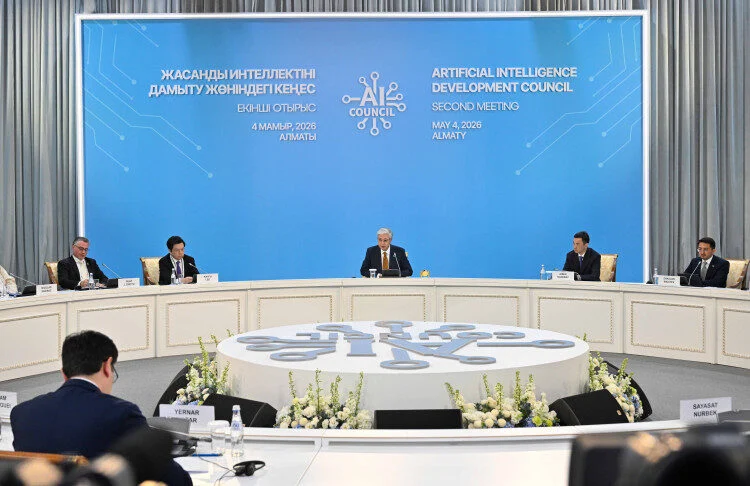
Speaking to government officials and international experts, President Kassym-Jomart Tokayev described artificial intelligence as the central force shaping today’s global economy, cautioning that delays in adoption could widen the divide between developed and developing countries. He characterised the present moment as a critical juncture, noting that traditional growth models driven by natural resources and labour are rapidly losing relevance.
Tokayev warned that Kazakhstan is already exhibiting signs of a “middle-income trap,” where existing economic drivers are weakening while new engines of growth remain underdeveloped. To avoid stagnation, he stressed the need to move beyond isolated digital initiatives and adopt a comprehensive, system-wide transformation, according to Akorda.
A key concern, he said, is the absence of clear metrics to assess the true impact of the digital economy. Broad indicators such as GDP growth often obscure how much progress is driven by innovation rather than conventional sectors. He directed the government to develop precise tools to measure the economic contribution of digitalisation and AI.
Highlighting data as the backbone of effective AI systems, Tokayev called for the rapid development of unified data infrastructure and the digitisation of archives. He noted that without standardised, accessible, and machine-readable data, even advanced technologies cannot deliver meaningful economic outcomes.