

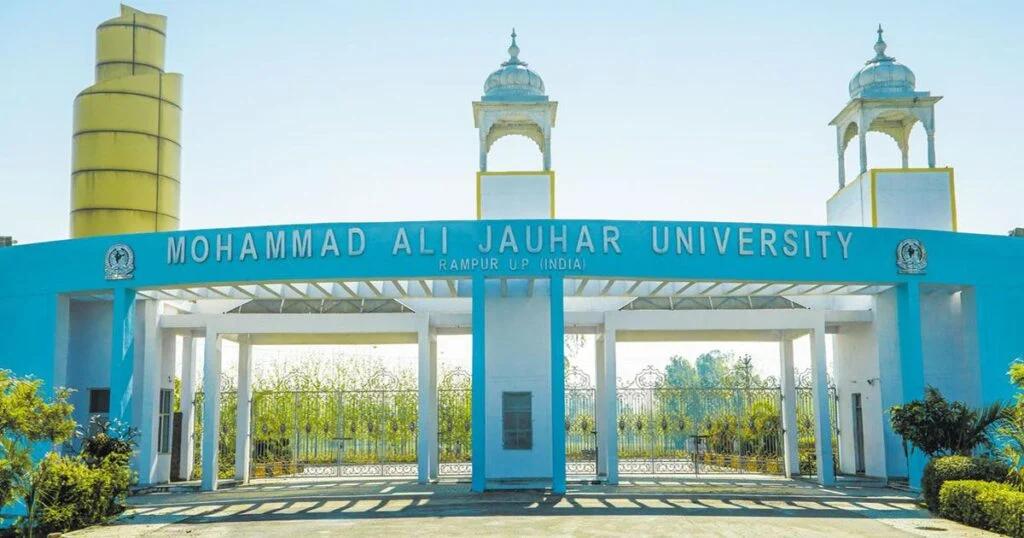
The order to demolish 38 out of 40 buildings of Mohammad Ali Jauhar University in Rampur, Uttar Pradesh has raised serious questions. Is the present government targeting the university as part of a vendetta? Is the demolition order in line with legal procedures against ‘illegal construction’? These questions cannot be answered unless we analyse the law relating to the controversy. There are two sets of laws and application of those laws depends on the fact under whose jurisdiction the area of university was located at the time of its building construction.
To decide the legality of an issue, it is mandatory to check which law is applicable at a particular point of time. Under one set, there are two laws namely, U.P. Panchayat Raj Act, 1947 and U.P. Land Revenue Code 2006, on the other, U.P. Urban Planning Development Act, 1973 under which demolition order was issued. However, Moradabad Divisional Commissioner’s court on July 27, 2026 stayed the proposed demolition of 38 buildings at Mohammad Ali Jauhar University until the final hearing.
The University’s foundation stone was laid down on September 18, 2006 and its construction activities continued till 2018. The Rampur Development Authority (RDA) was established on April 15, 2005. For what was RDA waiting till 2018? Probable answer may be that initially, 23 villages along with Rampur Nagar Palika were included in the ambit of the RDA. In July 2024, the RDA expanded its boundaries and included 39 villages around the city within its ambit. Singankhera village was also among them. At that time, Singankhera was not under the jurisdiction of the RDA. Under whose jurisdictionwasit? Jauhar University was built in the jurisdiction of Singankhera Gram Panchayat or under the first set of laws. University located in Rampur’s Singankhera village came under RDA jurisdiction only in September 2024, years after the buildings were constructed. Obviously, the question arises which law was applicable at the time of construction?
Land lying in rural areas is dealt with Uttar Pradesh Land Revenue Code, 2006. Land for University was bought from Bhumidhars (farmers) of Sigankhera thereafter, Trust became Bhumidhar of all that land. According to Section 75 of this Code every tenure-holder who is Bhumidhar has exclusive right to retain the possession over the land and it may be used for any purposes whatsoever. The Bhumidhar is free to construct the building for residential use and establish the educational institution. The only bar with respect to this exclusive right is given in section 80. Clause (1) of section 80 provides “where a Bhumidhar uses his land for any purpose other than agriculture, the Sub-Divisional officer (SDO) may, suo motu or on an application moved by such Bhumidhar, either make a declaration that the land is being used for the purpose not connected with agriculture or reject the application within 45 working days. Who is liable for the compliance of Section 80? Clause (7) of Section 80 provides that “no declaration under this section shall be made by the SDO, if he is satisfied that the land or part thereof is being used or is proposed to be used for a purpose which is likely to cause a public nuisance or to affect adversely public order, public health, safety or convenience or which is against the uses proposed in the Master Plan”. Hopefully, university may not be causing anything above said and it is an established fact that University’s area was not under the proposed Master Plan. Before passing demolition order, District Magistrate (DM) should have verified whether Section 80 was complied with or not as SDO performs his duty under the supervision of DM. If Jauhar University has flouted the rules, it should not have been set up in the first place. The DM should have initiated action against the SDO of the time before issuing the demolition order.
Section 15 the U.P. Panchayat Raj Act, 1947 provides a long list of functions of Gram Panchayat and the development of university area is surely covered by this section. Moreover, Section 15-A provides that “a Gram Panchayat shall prepare every year a development plan for the Panchayat area and submit it to the Kshettra Panchayat concerned before such date and in such form and manner as may be prescribed”.
If Azam Khan built this university on illegal land, it is essential for RDA to explain which law was violated. It is not sufficient to claim that University’s buildings were constructed without the permission of RDA. University located in Rampur’s Singankhera village came under RDA jurisdiction only in September 2024, years after the buildings were constructed.
Let us examine the second set of laws i.e., U.P. Urban Planning Development Act, 1973. Section 52(f) of this Act says that “nothing in this Act shall apply to the construction of unmetalled roads intended to give access to land solely for agriculture purposes”. It is axiomatic that U.P. Urban Planning Development Act, 1973 under which the RDA works, is not at all applicable to agriculture land.
Objects of the Development Authority given in section 7 of the Act are as follows “the objects of the local development authority shall be to promote and secure the development of the development area according to plan and for that purpose the Authority shall have the power to acquire, hold, manage and dispose of land and other property, to carry out building, engineering, mining and other operations, to execute works in connection with the supply of water and electricity to dispose of sewage and to provide and maintain other services and amenities and generally to do anything necessary or expedient for purposes of such development and for purposes incidental thereto:
Provided that save as provided in this Act nothing contained in this Act shall be construed as authorizing the disregard by the Authority of any law for the time being in force”.
The core idea is to develop the area and, in fact, this area was developed on the construction of University’s buildings. Moreover, proviso of this section clearly prohibits that Authority cannot disregard the existing laws of the time and, in this case, the existing law were U.P. Revenue Code, 2006 and U.P. Panchayat Raj Act,1947.
Section 16 of U.P. Urban Planning Development Act, 1973 provides that “after the coming into operation of any of the plans in a zone no person shall use or permit to be used any land or building in that zone otherwise that in conformity with such plan:
Provided that it shall be lawful to continue to use upon such terms and conditions as may be prescribed by bye-laws made in that behalf, any land or building for the purpose and to the extent for and to which it is being used upon the date on which such plan comes into force”.
This proviso again is pertinent in this matter as use of land will not be interfered with prior to the date of enforcement of plan.
Caught between under-regulation and over-enforcement, and between two governments, the students stand to lose the most. Recently, the Supreme Court of India, in Zulfiquar Haider v. State of Uttar Pradesh (2025) gives a strong message to governmental and statutory bodies that demolition of structures, particularly residential ones, cannot be undertaken lightly or without strict adherence to the rule of law. The DM of Rampur must have honoured this message.
[The writer is a professor, Department of Law, AMU, Aligarh. Email: ishrat364@gmail.com]