

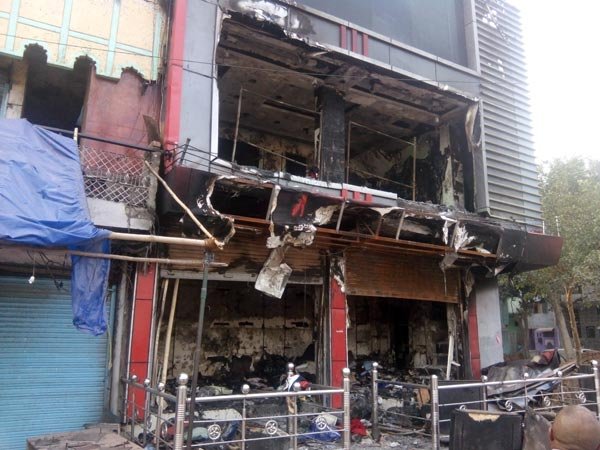
In the backdrop of recent communal riots in Trilokpuri, Bawana, Mundka and Okhla areas of the national capital, MOHAMMAD NAUSHAD KHAN analyses the rising riot culture and urges the concerned citizens to strive to restore peace and harmony in the country.
Thousands of riots have occurred in various parts of the country in recent years. Thousands have lost their lives and properties worth trillions have been burnt. Communities have been displaced. Communal harmony is shattered on a routine basis. The only beneficiary of this disquieting situation is the political class that is reaping political dividends at will. Riot after riot has vitiated the ethos of a plural society. This time, it was Trilokpuri, where communities living in peace were provoked.
Trilokpuri, in East Delhi, hit the headlines on many occasions but mostly for wrong reasons. It was recently in the news for communal clashes that erupted from the North Block No. 20 in front of a makeshift temple in the area. The nature, the pattern and the sequence of events remind us of the horrors of anti-Sikh riots in Delhi and Muzaffarnagar riots in Uttar Pradesh. The sensitivity and the response of the people during and after the violence averted major backlash. There are many versions of the clash as some hold it was spontaneous while others believe it was planned to polarise the masses the way Uttar Pradesh was polarised after Muzaffarnagar riots.
A fact-finding team comprising members from various organisations like Advocate N.D. Pancholi of PUCL, Dr. S.Q.R. Ilyas of Welfare Party of India, Intizar Naeem and Inamur Rahman of Jamaat-e-Islami Hind and Kashif Ahmed Faraz and Advocate Abubaker Sabbaq of APCR visited the riot-torn areas of Trilokpuri on 25, 27, 28, 29 and 30 October to assess the ground reality.
The team visited the showroom which was burnt, and talked individually and collectively with the riots affected people from both the communities. First of all, the team visited the Muslim-dominated locality, then Mata ki Chowki where the trouble had begun on the Diwali night, and then the non-Muslim locality.
During their interaction, one thing said by one and all belonging to both the communities is that the police didn’t act the way it should have, and that it acted in a partisan manner. The way the police remained a mute spectator initially gave the impression that it was acting under duress. The showroom owner told the delegation that on the troubled day he was assured by the police at 2 a.m. that nothing would happen but the showroom was burnt at around 4 a.m. and that too in the presence of the police personnel.
 The team also learnt that there was no tension prevailing among the local people and they are living in peace even today. Many of them still believe that people from adjoining areas or from other places attacked Muslims from eight sides which appeared to have been pre-planned and they were aided and abetted by local political leaders.
The residents complained that Muslim women were beaten and abused very badly. Even the handicapped were not spared. The language used by the rioters was very derogatory and highly provocative. What is remarkable is that Muslims showed maturity and did not harm non-Muslims living in the locality where Muslims are dominant. Even shops of non-Muslims were open in the Muslim locality. Muslims exercised utmost restraint and displayed courage which helped them, otherwise it could have resulted in a major tragedy because the rioters were fully prepared and had attacked them from all possible sides to inflict maximum damage.
The incident of Mata ki Chowki was very small but everyone is worried about how such a small incident could spiral into a full blown communal riot. There are many questions yet to be answered. Who instigated the riots? Why were the rioters allowed to go on rampage? Why did the police let loose the rioters? Will the victims ever get justice?
Mata ki Chowki was initially a garbage dumping site. Some people living close by might have thought that if an idol is placed, nobody will throw garbage there. Just in front of it stands a mosque. The function at Mata ki Chowki was over and still loudspeaker was on. There is possibility that Muslims who were getting disturbed while saying namaz might have asked them not to use loudspeaker at that time and this resulted in a heated exchange. The other version which also came to be known was that some youths were consuming alcohol and along with them was a Muslim boy. Even if this was the case, it was a problem erupted in Sector 20 and it should have got resolved there itself. But, how it reached Sectors 27 and 28 and why only one showroom was gutted are to be ascertained.
 One particular incident reveals the intention and the motives behind the riots. When the mob of rioters was moving the policemen were laughing and some media persons were also seen with cameras at that point of time. It is very painful. If policemen play such roles then it will not be too far that people’s trust in the police establishment will be severely damaged. It is the responsibility of the police to maintain law and order. The police should be made accountable. During the interactions of the delegation it also came to light that the victory of BJP at the centre has boosted the morale of its affiliated organisations and they are doing all they can without any fear.
The disquieting factor that came up during the visit was that as the Assembly elections are at hand and the Trilokpuri seat was won by AAP candidate last time, so local BJP leaders might have attempted to polarise the masses in order to increase their tally. In the entire incident, 70 people were injured, including 56 policemen. So far the police have arrested 68 people in connection with the riots.
In Trilokpuri, Dalits are approximately 80 per cent and Muslims 20 per cent. The people got the glimpse of Muzaffarnagar riots where more than 50,000 people had to live in camps. Almost 30 years ago, Block No. 32 was full of Sikh community but the 1984 anti-Sikh riots forced out almost the entire Sikh community from Trilokpuri. As per estimates available out of 2,700 Sikhs killed during the 1984 riots, 350 Sikhs were killed in Trilokpuri alone.
After Trilokpuri, religious passion was instigated and all attempts were made to fuel communal tension in Bawana. Here too, Muslims sensibly avoided direct confrontation and the issues were resolved in an amicable manner. It did not stop there as another attempt was made in Okhla, in South Delhi where a slaughtered pig was thrown in a mosque which many believe is a desperate attempt to keep Delhi on the tinderbox ahead of Assembly elections.
Very recently, Aam Aadmi Party has initiated a process to form all-religion peace committees in all 70 assembly segments in Delhi. Former Chief Minister of Delhi Arvind Kejriwal has also appealed to prominent personalities and citizens of Delhi to actively participate in maintaining communal harmony in Delhi. “The AAP is of the firm view that there is a deliberate pattern to arouse communal passions in the recent incidents witnessed in Trilokpuri, Bawana, Mundka and Okhla,” Kejriwal said in a statement.
The memories of riots in Kokrajhar, Muzaffarnagar and Saharanpur are still fresh in the minds of the victims.
The Muzaffarnagar riots have changed the political map of Uttar Pradesh. In Muzaffarnagar, property attachment proceedings have been launched against 12 absconding accused in a riots case. The accused are Praveen, Manoj, Bintu, Vijender, Rahul, Kalu, Anuj, Amit, Dhiraj, Dhanna, Cheni and Vikas.
In Bihar there has been a spurt in communal violence since BJP parted ways with the JDU. The State has witnessed 170 incidents of communal violence ever since. When they were in alliance the average incidents of communal clashes reported in a month were three or four which has increased to average 10 incidents a month. During the Jeetan Ram Manjhi tenure alone there have been 38 cases of communal violence so far.
The riot culture gaining roots day by day has to be stopped for a better India. People of India who want to see India on top of the world in every sphere should do all that can make India “a land of peace” and prosperity and refrain from all that can make India “a land of riots”, chaos and destruction that will only hamper growth and development and weaken social fabric. The very motto for which we used to hold our head high at international fora is unity in diversity, which needs to be restored before it is too late.