

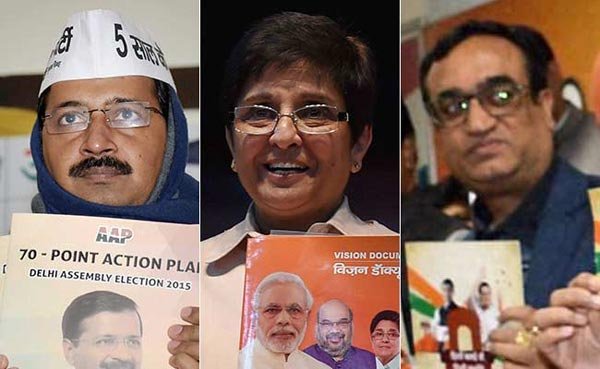
MOHAMMAD NAUSHAD KHAN analyses the manifestos released by major political parties for the Delhi Assembly elections.
At the time when Delhi election campaign was in full swing and drawing close, US President Barack Obama raised the political temperature in the national capital by saying that the acts of intolerance experienced by the religious faiths in the past few years in India was more than enough to have shocked Mahatma Gandhi. The statement was significant and timely because most political parties at that point of time were out in the field with ample promises and guidelines for the next five years.
Manifesto is important because any new policy and its effective implementation in Delhi will surely have a ripple effect in other parts of the country. If we go by the mood of the people, their turnout in the rallies, the pre-poll surveys, the highest voter turnout and the exit polls, it becomes crystal that the Delhi will have a new government soon.
No doubt, intolerance across the length and breadth of the country is growing by the day. During the election campaign and even before the election process had begun, there were a series of communal disturbances and attacks on churches in various parts of the Capital. But the lack of political will has reflected in the manifestoes and vision documents of political parties.
Minorities are the most vulnerable section and when one talks of intolerance and communal disturbance, it is the minorities who happen to occupy the space in the subconscious mind. So it becomes essential to know what political parties have got to offer for minorities. And what the next five years would be for them. Won’t they feel as second class citizens in the next five years? Will there be some cordial and conducive atmosphere for them in these years?
Now if we examine the contents of the Aam Aadmi Party manifesto, the party has raised reasonable concern on the growing communal tension and attack on the places of worship particularly in Delhi. The party in its manifesto has categorically mentioned development and equality for all minorities: “The recent communal tension witnessed in Delhi is totally out of sync with the social fabric of the city. We stand firmly against attacks on places of worship and inflammatory speeches across Delhi. Upholding the spirit of Swaraj, Mohalla Sabhas will set up peace committees to ensure harmony in their respective neighbourhoods. We will bring transparency in the functioning of Delhi Waqf Board and ensure that encroachments on Waqf property by private parties as well as the government are removed.”
But what the manifesto grossly missed was that of the security of Muslims as it happens to be the vital concern of the Muslims in Delhi as well as across the length and breadth of the country. Most recently the declaration made by the NIA in the run up to the Liaqat case speaks volumes of how genuine the concern remains and how important it is for political parties to address the issue.
The Congress manifesto has emphasised the welfare of SC, ST, OBC and minorities. Modernisation of madrasa education, setting up of a Haj House in Dwarka, providing easy loans for self-employment, encouraging enrolment and retention in schools by providing stipends, and improvement in employment opportunities by granting adequate scholarships for taking professional/technical/vocational/skill development courses are mentioned therein. The Congress manifesto attempts the issues of minorities half-heartedly and ignores their genuine concerns. It is indeed silent on the spate of communal riots and religious intolerance. Neither has it mentioned any measures like the communal violence bill to contain riots. Congress throughout campaigned half-heartedly and their tall leaders only appeared when the campaign was in the last phase.
The BJP in its manifesto seems to have only touched some issues and left out many pertinent ones. It has mentioned training centres of proficiency to be opened to train minority workers in various skills and enterprises, a madrasa board, modern education, proper schools and colleges in areas with predominantly minority population, and consultation with religious leaders to strengthen the waqf board. Though the party campaigned aggressively yet it was not enough to convince the electorate. The party failed to live up to the promise it had made earlier or in other words failed rather miserably to respect their sentiments.
What was important to note during the campaign is that the BJP kept from issues like conversion and love jihad and possibly refrained from using such languages during the campaign. As against some leaders of the BJP and affiliates have done to derail the development agenda and change the political discourse to match their ideological political aspirations and vested interests. The show cause notice to some of the leaders by the party was not enough to send a strong message. Delhi election by all notch remains paramount and the results shall impact the national political scenes in one way or the other. Even though party president Amit Shah has made his point by saying that Delhi election is not a referendum for the centre. He may have his own reason but one thing is sure that the verdict will reflect something and create a perception that will have its own impact on the national polity.
Most of the regional satraps have rallied behind AAP to express their solidarity and the mood of the election campaign has motivated the regional strongholds like SP and JDU to revitalise their cadre and support base with renewed strength and hope in their respective states.
With the constituency wise manifesto a different meaning and importance has got attached to it. People now take manifesto seriously to some extent but still it has to go a long way when the party considers it scared guidelines prepared to be delivered during the period it is promised for. Let us hope people’s political maturity will compel political parties to live by the declaration made by them in their manifestos and implement them in totality in a time bound period. Let us also wish that the party that comes to power respects the mandate as well as the spirit of the manifesto and equally abide by the Constitutional obligations and duties towards citizens. Only then people’s faith in democracy will get nurtured and strengthened each passing day.
The new government in power must set the best example of good governance and delivery of justice and equality for all. Lastly, let’s hope people’s faith in the government and the governance is restored beyond doubt and criticism. Let its governance get emulated and respected worldwide. The new government can expand its support base to neighbouring states and ultimately emerge stronger on the national scene gradually and smoothly only through good governance.