

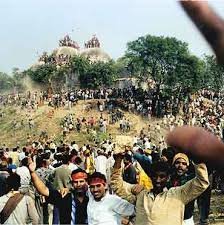
The Liberhan Commission submitted its four-volume report to the Government on June 30, 2009. It might have been the longest time taken by any commission. Liberhan’s claim that the report got delayed due to non-cooperation of leaders involved may have some truth as one knows Kalyan Singh avoided appearing before the Commission for a long time, and so was the attitude of many of those alleged for the demolition. Still all the hearings were complete by 2004. Did it take five long years to write the report? Such a long delay in the report coming out defeats half the purpose of the same.
One of the minor reasons of delay has also been the differences in the approach of Justice Liberhan and its chief counsel Anupam Gupta. After Gupta interrogated Advani, Justice Liberhan told him to apologise to Advani for being harsh. While Gupta maintains that Justice Liberhan had been soft on Advani, despite his role of the chief mobiliser for demolition.
One awaits the attitude of the Government towards the Report, is it going to be forthright objective or dictated by political exigencies. That apart, since the Report was submitted some of the accused have been hiding for cover, and some others are saying that since already 17 years have lapsed how the report can be meaningful, if at all? Some of them have questioned the timing of the Report.
That those involved in demolition will own up the crime and honestly confess to that is something not to be expected. Still Uma Bharati was honest enough to say that “I definitely wanted Ram temple to come up (in Ayodhya) and I definitely wanted that building (Babri Mosque) to come down but not in that manner. But I am not going to apologise. I am ready to be hanged for it.” It was the same Uma Bharti, who along with Sadhvi Ritambhra was exhorting the kar sevaks by saying, ek dhakka aur do: Babri Masjid tod do” (Give one more push, break the Babri mosque). She also expressed her joy after the demolition by hugging another accused, Murli Manohar Joshi, who was sharing dais with her. Among others who shared the dais, when the demolition work was in progress, were Lal Krishna Advani, Ashok Singhal and K. Sudarshan.
How do people respond to the crime after executing it, is a matter of great variance. The same Murli Manohar Joshi, who before the demolition had told his followers, “…demolish the masjid, nature of kar seva will be determined by sants and not by courts, demolition is prerequisite for temple building”, in the hearing of the Commission said, “With all humility, I say that the incident was never remotely conceived by us.” This despite the fact that Vinay Katiyar, the then Bajrang Dal chief had asserted, “Masjid will be demolished and debris will be thrown in river Sarayu.” During the deposition he distracted from the main issue and doubted the need of the commission and said that Ram Lalla is the owner of the place. While Lal Krishna Advani had stated, “The kar seva will be done with bricks and shovels, kar sevaks are not going to Ayodhya to sing bhajan and kirtans.” Later he declared that the day of demolition was the saddest day of his life. Which is the real Advani is not difficult to ascertain.
K.Sudarshan, who later became RSS Sarsnghchalak, stated that he heard Nirmala Deshpande saying that the Mosque fell due to the explosion inside. Nirmala Deshpande disowned the statement. Kalyan Singh takes the cake as far as turnarounds are concerned. Before the demolition he committed to the National Integration Council and through a sworn affidavit to the Supreme Court, that he would protect the mosque. When demolition began, he did not deploy 20000 central forces stationed at a distance barely 10 minutes from the place. Later he was imprisoned for a day and he proudly justified his inaction in the path of Ram temple. He filed a 300-page affidavit, taking a line, which was in accordance with his then party’s line, stating that it was a spontaneous act by uncontrollable kar sevaks. With his problems beginning with BJP, he hit out at A.B.Vajpayee, Advani and Joshi saying Babri was destroyed on the instructions of senior BJP leaders.
The then Prime Minister P.V. Narasimha Rao was famously having the afternoon siesta when the Babri Masjid was being demolished and he covered his inaction by putting the blame on Kalyan Singh. Immediately he promised that the Mosque will be restored at the same spot.
It all raises the question of political morality. How the actors in the tragic act have been taking stances according to political necessities. How they regard that public memory is short and they can wriggle out of their crimes by mere play of words.
And now when the Report has been tabled in Parliament, can one expect justice? The experience so far is far from optimistic. Congress weighs the issues on the scale of political advantages or otherwise. On one hand it tries to put a show that it will do justice and when the crunch time comes one finds it wanting in resolve to stand firmly for secularism and justice. Political calculations have been its guiding load stones. So even now one is not sure about the real justice coming through after 17 long years of wait.
BJP on its part is a divided house. It has used the Ram Temple agitation and the consequent demolition and the violence for politically strengthening itself. It is around this agitation, demolition and violence that it came to occupy the major position on the political scene in India. Now having been in power and having seen that Lord Ram cannot eternally help it to keep coming to power, some of its major leaders have been rethinking the political line to be adopted.
What one sees around is the total opportunism for the sake of power. The politicians of all hues realise the necessities of such issues to be in power. They also see that beyond a point it can be counter productive. Now it’s up to them to keep adopting double standards or to come to adopt democratic issues as their political base. Can BJP shift from such issues and take up the issues of the poor and downtrodden? This is a million-vote question. This is also a question related to the goals of its political parent, the RSS. How does RSS evaluate its future role on Indian political chessboard? Indications are RSS will stick to Hindutva and Ram temple type of issues, come what may. One only hopes in despair that people indicted in the Report have honesty to own up their acts and face the legal consequences for their commitments!