

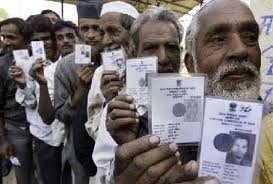
India is in the process of constituting 15th Lok Sabha and for that purpose election is going on. All rounds of polls have been almost completed and the results are awaited. The trend of the election shows that about 50 per cent voters cast their votes. The less percentage of votes is generally assigned to the excessive heat without adequate facility of water and electricity. But it also shows the disinterest of the voters who do not expect any material change by the outcome of the election. To them election is only a game of politicians who, by all means and tactics, want to get access into the political structure so that they may earn excessive money, enjoy due or undue privileges and influence the administrative set-up to extract benefit for themselves and for their families and groups. However, the present parliamentary election is not only unique for less percentage of votes but also for its outcome and the situation that follows it.
The experts of election trend and statistics are expecting that this time also the parliament will be a hung one. No party will get majority in the parliament. It is also not certain that the two alliances – UPA led by the Congress and NDA led by BJP – will get majority. Moreover, both are now very fragile because their constituent groups are contesting the election separately forming other alliances and groups. The moment they will expect more privileges and benefits they will disassociate themselves from the old one and make new alliances.
In case the difference of seats between Congress and the BJP is less as expected and other parties particularly BSP, SP with Lalu and Paswan alliance increase their seats in the parliament, the political situation will be very complex and dangerous. The locally influential parties will be in the best position to bargain and they will not hesitate to avail themselves of this opportunity. Whatever the situation may be but one thing is certain that the government will not be stable. And whoever the Prime Minister may be it will be very difficult for him to continue for a considerable period of time.
Individuals and groups every time pressurise the ruling elite for privilege and benefit and if the latter yields to their demand they put more and more. At the end of the day the ruling elite would have no alternative except to withdraw itself from the power structure. It affects the stability and efficiency of the democratic set-up.
The Third Front is not very strong. It cannot get as many seats as required to form the government independently without the support of Congress or BJP. Thus, it will not be in a position to form the government. It can only support BJP or non-BJP government and can get some important ministerial posts. If Congress gets highest number of seats in the parliament, it will try to unite its allies, consolidate its position and form the government. It will also manoeuvre the other small groups to win their support. Similar is the case if the BJP gets highest number of seats.
The problematic situation is when the leading parties of both the alliances get similar number of seats and fail to unite their respective allies because they want to associate with other alliances either to get Prime Minister’s post or other important ministerial posts. In this situation the think-tanks of both the national parties, Congress and BJP, will prefer to remain outside the government because in forming government they will get nothing except discredit. Their strategy will be to support any person or group from outside. Thus, three groups will be more active to form the government. They are BSP, Mulayam, Lalu and Paswan alliance and Sharad Pawar’ group. All of them will try their best to get the support of others on the condition that their candidate will be Prime Minister.
In this power struggle the Left parties can play a very crucial role. Their support to any aspirant group will make its chance bright. As a result fresh polarisation and bargaining will take place. The BSP will be in advantageous position because it can easily get the support of Left parties as its leader stated earlier. The SP along with Lalu’s alliance will not tolerate the BSP in power, and they would have no alternative except to come back to their old alliance UPA and support it. The problem is that BJP will not sit idle. It may support BSP from outside so that it may form the government and provide BJP with an opportunity to humiliate Congress-led alliance, UPA. All these possibilities depend upon the number of seats which BSP and SP get in the parliament.
However, the next government will be the government of alliance, a fragile alliance which will be difficult to complete its term. It will always be in pressure and can break at any time. It may also be possible that the nation will reach the point where the fresh election would be necessary. Indian democracy is the largest democracy of the world. It has passed through very odd and critical situations but it has survived. It is its credit. It is now more than half a century old and it is expected that it will develop maturity and work for the welfare of people, solve their problems, provide them with adequate facilities for survival, raise standard of living and remove poverty. It has failed on this front and it is its dark aspect.
The fact is that certain abnormal trends have developed in Indian politics. First, criminalisation of politics took place and muscle power became important to mobilise voters in favour of a party or group. Political parties protected and patronised them because they required the support of such persons if they had to remain in power. This was a sort of deviation in Indian politics because most of political parties were not based on any ideology or principles. Those parties which had certain ideologies were not very strict to the principles because voters were affected by factors other than principles. As a result they had to take the support of criminals and muscle powers.
Secondly, the darkest aspect of our democracy is that election is contested on the basis of religious and caste sentiments. Parties which project themselves as the protectors and supporters of a particular religious group and its sentiment easily mobilise public opinion in their favour. The irony is that the members of the parties neither follow that particular religion in true sense nor understand its spirit in the real sense. They only exploit the sentiment of people and project the view that the group in question deserves the lion share in the privileges of the state and they will give it to the group if come in power. The promises made during the election were generally lost in the jargon of the words when parties come in power.
The bitter fact is that the lives of the poor and downtrodden remain the same. The speeches, slogans and appeals made to raise and activate the sentiments of a particular section of the electorate create social distance, hatred and a gulf between different groups. This trends and strategy are dangerous to the nation because they adversely affect the unity and solidarity of the country. Our leaders and parties do not mind it because their motto is only to get access either by hook or crook in the political structure and extract privileges and benefits. It is immaterial for them that the strategy which they adopt is good or bad, dangerous or beneficial.
There are certain caste-based parties. They also give the impression that they are the protector of the interests of a particular caste. They get advantage of the numerical strength of a caste group and when they come to power, they distribute the privileges to that group. This sectarian feeling hampers the progress and development of the nation.
The important factor in the development of the nation is a change in the mindset of people particularly of those who are involved in the governance. The entire administrative set-up should be based on liberal ideas rather than on sectarian feelings. Those who stir up religious and caste sentiments in order to get vote are only interested in their own benefit. Their priority is only to extract some kind of benefit from the political situation. They have no concern with the service of people and nation. Such type of people defames Indian democracy. They do not hesitate to do any undemocratic or immoral act whenever time comes.
In the circumstances stated above the result of Parliamentary Elections of 2009 is very crucial. If no party gets considerable number of seats, there will be high level of political bargain and no decorum will be maintained. Persons and groups can go to any extent and cross every limit. Congress and the Left parties led by Marxist Communist can play a significant role in restraining the political bargain and establishing healthy precedent either by forming the government in coalition or by supporting those groups which are sincere to the welfare and development of the nation.