

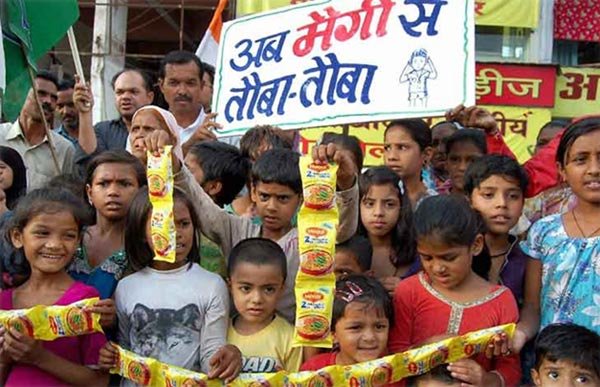
ARSHAD SHAIKH delves deep into the soup the once legendary MNC brand Maggi is in in India.
With a whopping Rs 2000 crore in annual sales, Maggi noodles – Nestle India’s flagship product – was the unstoppable FMCG behemoth that acquired legendary status in the history of successful MNC brands in India, till concerns were raised over the presence of lead beyond permissible levels and monosodium glutamate (MSG). Following a string of state governments banning Maggi, the FSSAI finally came down on Nestlé India, forcing it to announce a total recall of the noodles from Indian stores.
THE BEGINNING OF THE END
In March 2014 a Barabanki FSDA (Food Safety and Drug Administration) team led by 40-year-old Vineet Kumar Pandey collected some packets of Maggi from an Easy Day outlet and submitted them for testing. The preliminary lab report revealed that the contents had MSG beyond the permissible limit. However, Nestle India challenged the findings and appealed for further tests. The sample was sent to a referral laboratory in Kolkata, which not only confirmed the presence of MSG but detected levels of lead much beyond the prescribed limit. The Kolkata report for the sample collected in 2014 came out in the second half of April 2015 and quickly became public through the media. In the days that followed, several states ordered the popular noodles off the shelves.
REGULATOR CRACKDOWN
FSSAI (Food Safety and Standards Authority of India) has ordered Nestlé India to withdraw and recall all the nine approved variants of Maggi instant noodles from across the country. The company has also been told to desist from any further production, processing, import, distribution and sale of Maggi with immediate effect. The regulator show-caused the company to present its case in 15 days, failing which FSSAI might withdraw the “product approval” of the nine variants issued by it in June 2013. The FSSAI’s order is based on high lead and MSG content in samples from four states – Uttar Pradesh, Delhi, Gujarat and Tamil Nadu. FSSAI CEO Yudhvir Singh Malik declined that the regulator was only gunning for multinationals. He added that the regulator had already decided to widen the scope of the investigation.
The FSSAI order listed out the ailments that heavy metals such as lead could cause, such as anaemia, paralysis, damage to the brain, kidney and reproductive and immune systems. FSSAI clarified that the presence of MSG was natural in food products, but Nestlé India mentions “no added MSG” on Maggi packets.
India’s premier food safety regulator was perturbed with Nestle’s marketing strategy and blamed Nestle saying: “The apparent reason for using such information on the label is driven by an undue commercial advantage / benefit to create an erroneous impression in the minds of consumers regarding the character of the product.” The FSSAI order further cited the US Food and Drug Administration as saying food with any ingredient containing MSG naturally could neither claim ‘no MSG’ or ‘no added MSG’ nor be classified as “spices and flavouring”.
HEALTH HAZARD
Maggi has basically three components – the white noodle block, the spice powder which comes in a sachet and the covering package. The spice powder which has colouring agents may also be one of the sources of lead. The plastic cover is outsourced and could be of sub-standard quality. The machinery could also be a potential contaminant, as could the water used to wash the flour. Research shows that once lead goes into bones, it stays for 30-35 years. It bio-accumulates, has no beneficial role and inhibits biological processes. It can disrupt nervous and reproductive systems, the kidneys, and it can cause high blood pressure and anaemia. Lead is extremely harmful to developing foetuses, pregnant mothers and kids, with high blood lead levels causing learning disabilities, behavioural problems, and mental retardation.
CONVENTIONAL SOLUTIONS
Stringent implementation of food safety standards is of primary importance to ensure that food companies adhere to the required statutory requirements designed to attain the highest levels of product quality in terms of health and hygiene. Some activists suggest that companies that advertise their products in news media should disclose a batch number. For that batch, they should have a test certificate readily available in the industry. They can do the testing in an in-house laboratory, but 10% of what they test must be tested outside in a third-party accredited laboratory. This test certificate should be available on demand, for a nominal fee.
The Right to Information Act should be applicable here. This process will ensure that the manufacturers keep a close eye on the quality of product as with such a high degree of sampling, the probability of detection of spurious quality if any is very high. But this policy of quality assurance with the threat of getting caught in case of non-compliance is not the best way out, as those with a criminal bent of mind will always find a way out of this surveillance.
ISLAMIC FRAMEWORK
The Holy Qur’ān has stressed the importance of fairness in business, saying: “O my people! Give full measure and full weight in justice, and wrong not people in respect of their goods. And do not evil in the earth, causing corruption. That which Allah leaveth with you is better for you if ye are believers; and I am not a keeper over you.” (Qur’ān 11: 85-86)
The fundamental principles of commerce emphasised by Islam include: To give just measure and weight. Not to withhold from the people the things due to them. Not to commit evil on earth with the intent of doing mischief. To be content with the profit that is left with us by God after we have paid other people their due. Islam has impressed on traders that defective and worthless goods should not be given in exchange for good ones, and if there is a defect in the goods sold, it must be pointed out and made manifest to the purchaser.
Islam has banned two forms of sale contract that were prevalent in the days of Ignorance. These were Munabadha and Mulamasa. Munabadha means that the seller should throw the cloth to the buyer before he has carefully examined it. The very act of throwing the cloth will mean that the bargain has been struck. Mulamasa means touching the cloth without examining it, i.e. the buyer was just supposed to touch the cloth to strike the bargain. Both these forms of transaction were prohibited because in either case the purchaser got no opportunity to examine the things sold to him, and the bargain was likely to prove unduly disadvantageous to one side.
But most important of all, when the belief in accountability for your deeds by the One who sees all and knows all is well entrenched in one’s psyche and the deepest recess of one’s soul, the very thought of profiting by cheating others will become anathema to the pious and quality assurance will be achieved without the threat of inspection and sampling. “Ethics in business” will remain an empty slogan without changing our fundamental worldview. No other way to come out of the soup we’re all in!