

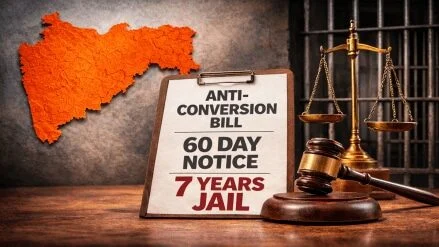
Any person intending to convert must notify the authorities at least 60 days in advance and obtain official permission before the conversion takes place. Individuals found guilty of unlawful religious conversion could face imprisonment for up to seven years and fines of up to ₹4.5 lakh. The offences would also be classified as non-bailable, allowing the police to arrest and detain the accused during the investigation process. These are among the key provisions of the Maharashtra government’s proposed Dharma SwatantryaAdhiniyam, 2026 (Religious Freedom Act), which has triggered significant legal and political debate across the state.
The legislation, introduced by the Mahayuti Government comprising BJP, Shiv Sena(Shinde faction) and NCP(AjitPawar faction), aims to prevent forced or fraudulent religious conversions. However, critics argue that the law raises serious constitutional concerns and could potentially become a tool for harassment and surveillance of minority communities- Muslims and Christians.
Key Provisions of the Proposed Law
Section 5 of the proposed law introduces another controversial provision, stating that a child born out of a marriage involving unlawful conversion shall be deemed to belong to the religion followed by the mother prior to such marriage or relationship in the nature of marriage.
The law further stipulates that the converted person or the institution organising the ceremony must submit a declaration to the competent authority within 21 days of the conversion. This declaration must include details of the converted individual, the date and place of conversion, and the nature of the process followed. Failure to submit such a declaration could render the conversion null and void.
For repeat offenders, including individuals or organisations, the bill proposes stricter penalties, including imprisonment of up to 10 years and a fine of ₹7 lakh.
The competent authority may also cancel the registration of an organisation found to be involved in unlawful conversions.
Another contentious provision allows blood relatives of the person converting to file complaints alleging unlawful conversion. Once such a complaint is filed, the police may register an FIR and initiate a criminal investigation.
Supporters of the law argue that these provisions are essential to protect vulnerable individuals from coercion, fraud, or inducement. State minister Nitesh Rane defended the legislation, stating that the government had promised during the Assembly elections to introduce a strong anti-conversion law to protect citizens from forced religious conversions.
However, opposition leaders and civil society organisations have strongly criticised the proposal. Leader of Opposition Vijay Wadettiwar questioned the necessity of the law, arguing that it diverts attention from pressing socio-economic issues facing the state.
Samajwadi Party leader Abu Azmi argued that individuals have the constitutional right to choose their religion once they reach adulthood. “Anyone can convert their religion after the age of 18. People convert of their own free will,” he said.
Impact on Interfaith Relationships
The proposed law may have far-reaching consequences for interfaith couples. Interfaith marriages in India often face social stigma and opposition from families and communities. While the Special Marriage Act, 1954 allows individuals from different religions to marry without converting, it requires couples to give 30 days’ public notice, which frequently exposes them to harassment and social pressure.
As a result, some couples choose religious conversion as a simpler path to marriage. Critics argue that the Maharashtra bill could further complicate matters by empowering relatives to challenge such conversions through police complaints.
Dolphy D’Souza of The Bombay Catholic Sabha said, “We are very disappointed that the bill was tabled without discussions with various stakeholders who are going to be affected. It takes away the right to one’s conscience to follow the religion of their choice or marry a partner of their choice. We urge the opposition to raise their voices and also demand that it be referred to a select committee for discussion as some of the clauses are draconian, to say the least.”
Constitutional Concerns
At the heart of the debate lies Article 25 of the Constitution, which guarantees freedom of conscience and the right to freely profess, practise, and propagate religion. Constitutional scholars argue that requiring prior government approval before conversion effectively places the state in a supervisory role over an individual’s faith.
Religious belief, they argue, is an intensely personal matter. When the state mandates bureaucratic procedures before a person can change their religion, it may undermine the essence of freedom of conscience guaranteed under the Constitution.
The law also raises concerns related to the right to privacy, recognised as a fundamental right by the Supreme Court in the landmark Justice K.S. Puttaswamy v. Union of India judgment. Critics contend that compelling individuals to disclose their religious intentions to government authorities intrudes into the private sphere of personal belief and identity.Furthermore, allowing relatives to challenge conversions could enable families to interfere in the personal choices of adults.
Experience from Other States
Maharashtra is not the first state to introduce such legislation. At least 12 Indian states, including Uttar Pradesh, Madhya Pradesh, Gujarat, Karnataka, and Uttarakhand, have enacted similar anti-conversion laws.
Critics point out that in several cases filed under these laws, investigations have eventually failed to produce evidence of forced conversion. Yet the accused often face arrest, prolonged court proceedings, and social stigma during the process.
This pattern has led to multiple constitutional challenges before the Supreme Court, which has issued notices to several states and is examining whether such laws violate fundamental rights, including personal liberty, privacy, and freedom of religion.
Rising Communal Climate and Hate Speech
The debate surrounding the Maharashtra bill also comes amid a broader socio-political climate marked by rising communal tensions. Data from monitoring groups indicates a significant increase in hate speech incidents in the state.
Maharashtra recorded 118 incidents of hate speech in 2023, which increased to 210 in 2024, representing a rise of nearly 78%. In 2025, the state recorded 193 incidents.Many of these incidents reportedly occurred during rallies organised by Sakal Hindu Samaj, an umbrella platform of several right-wing groups that held rallies in at least 28 of Maharashtra’s 36 districts.
Civil society groups argue that the spread of narratives such as “love jihad” – a conspiracy theory alleging that Muslim men deliberately target Hindu women for conversion – has contributed to hostility against interfaith relationships. Researchers and scholars have widely described the concept as a political myth promoted by sections of the Hindu right.
In February 2026, a widely reported case in Bhigwan in Pune district highlighted the tensions surrounding such allegations. A young woman initially reported as a kidnapping victim later stated that she had left home voluntarily. However, pressure from right-wing activists reportedly led to the arrest of her fiancé, illustrating how allegations of forced conversion can escalate into legal and social conflict.
International human rights organisations have also expressed concern about the growing use of anti-conversion laws in India. The U.S. Commission on International Religious Freedom (USCIRF) has highlighted instances of violence and harassment against Christian communities and other religious minorities.
The controversy surrounding the Dharma SwatantryaAdhiniyam, 2026 ultimately reflects a deeper tension within India’s constitutional framework: how to balance the protection of individuals from coercion with the preservation of personal liberty and freedom of conscience.
[Ahmed Noor Qureshi is a senior journalist and PTI stringer based in Jalna, (Maharashtra)]