

My question to my host was whether I should carry a sweater or it would result in sweating. The answer was an umbrella instead of a sweater would be required in Kuala Lumpur and that it would be made available to me. I thought the umbrella would be required on account of heavy rains, which I had witnessed some 14 years ago. But when I had reached Kuala Lumpur on 8th March, 2014, I came to know that it had not rained for the last several months and the Malaysians were a worried lot on this account.
Malaysians had one more reason to worry. One Malaysian Airlines (Flight MH 370) flying from Kuala Lumpur to China vanished, as if into thin air, the day I landed safely here! The newspapers, FM radio news, electronic news media, all were buzzing with all possible speculations. The news of the conviction of Anwar Ibrahim got buried in this national tragedy. In fact, some speculative theories linked these two events. One said that bigger news was created to bury another one. Another story was that the Pilot deliberately did this as a protest against the conviction of Anwar. Speculative news gets currency at such times.
Fourteen years ago when I first visited Malaysia, the country was in heated animation over the arrest of Anwar Ibrahim on sodomy charges. Much water has flown since and it appears that the news of his further conviction in the case has not caused much ripples. People have come to realise that it is a political sodomy and that it all goes as usual in a power game. I could not notice any sympathy, as such.
As it is in Delhi and other cities, the green cover in and around Kuala Lumpur has reduced significantly. The awe inspiring beauty which had attracted me during the first visit was affected. However, Malaysia still remains a beauty. Many satellite townships have come up. I was told that the prices of houses have not increased much in this part of the world, in sharp contrast to the trends elsewhere, because the rate of construction of new houses has been more than that of the population. All such townships have been meticulously planned and executed. We Indians talk about Bangalore, Chandigarh and Greater Noida as epitomes of town-planning. Malaysia has done it even better than us. It has to be seen to be believed.
THE HAZE
A major environmental crisis Malaysia faces is that of haze. The Air Pollutant Index (API) readings indicate an alarming level. The air is unhealthy if API is above 100, whereas the actual readings during my visit days were touching the levels of 233 in Port Klang, 189 in Banting and 159 in Petiling Jaya. The whole Klang valley was blanketed in haze. All schools in Klang district were closed on 15th March, 2014, when API index rose to 233 at 5PM last evening. Kuala Lumpur recorded an API of 163. The whole night I was restless with serious cough coupled with phlegm and had to visit a physician the next day and take medicines. As my mind was preoccupied with the presence of heavy rains which I had experienced in my earlier visit, I thought the mist in the atmosphere was fog. Later I realised it is causing uneasiness.
Earlier the people here were blaming Indonesia, their neighbour, for the fires in their woods. Now they have realised that the haze was their own doings. The editorial of The Star [March 15, 2014], a leading newspaper here, has to say the following words:
“….Much of it is caused by plantation owners who employ slash and burn methods to clear land….the current sentences that we have are not just good enough….open burning in Kampung Johan Setia is an annual affair….the owners [of land] that are money hungry and downright greedy that are finding cheap alternatives such as open burning to keep their pockets full at the expense of our health.”
In fact The Environmental Quality Act of Malaysia provides for the punishment of jail up to five years or fine up to RM500,000 if one is found guilty of contravening the environment. [One Malaysian Ringgit, RM, these days is equivalent to 18 INR and the figure would come to around ninety lakh of rupees]. The punishment no doubt is big but then it is the same old story we Indians are accustomed to, that the real perpetrators of crime manage to find ways and means and get-not-caught! Such things give a feeling that the world is one and you are at home everywhere!
Related news noted was the activity of an environmental group concerned about the defacement of the face of the earth. Selangor Forestry Department published public notice proposing to degazette 106.55ha of land from four forest reserves for Kuala Lumpur Outer Ring Road Project. The stakeholders got 30 days of time to register their objections. The green group became active with a resolve to collect at least 100,000 signatures against the project. This scenario too looked similar!
SMOKING
Human follies abound. My assessment is that the number of smokers in Malaysia is much higher than that in India. It may be twenty times higher. Even for a non-smoker like me the lung gets filled with the smoke. It has become a type of national habit for the common youth here. I am reproducing a cartoon by C.W. Kee, courtesy The Star, which is an apt description of the malice. There are two possible explanations for this difference between Delhi and Kuala Lumpur. One is that, thanks God, the youth here are not aware of other Indian habits like gutka or pan-masala or tobacco chewing or scores of other items in this category. So cigarette is their sole indulgence. Another explanation is that the government of Malaysia has not opted for any serious campaign against cigarette smoking as done in India.
THE BEAUTY OF MALAYSIA
Despite aberrations noted above, the country is beautiful and the people are mild in nature and hard working. About 60 per cent of the nationals comprise bhumiputras, the local Malay speaking who are mostly Muslims. The rest 40 per cent come from almost all places of the world with significant lots of Chinese and Indian origins. Indians include Tamilians from South India and Azmis from the North in relatively greater numbers. Among Indians Tamilians are higher in number and their contribution to the society here is noteworthy. All of them have maintained their respective cultures and they together merge into a nation with distinct character. Muslim boys and girls marrying into Malay families is not an uncommon phenomenon. That too is a proof of assimilation. We may call it unity in diversity. Here lies the beauty.
I witnessed a Malay ‘Good Samaritan’ the very first day I moved out in LRT (the Metro Rail of Malaysia). I was finding it difficult to buy a ticket from the computerised teller machine. I was not aware of the correct route and was also not conversant with local currency notes and coins. I sought help from one young man. He asked me to collect changes in smaller notes and coins from the manually operated counter and then use the teller machine. While I was doing that he already purchased my ticket and gave me as a hadya (present). He did not accept money from me, insisting that he did his duty to help a foreigner.
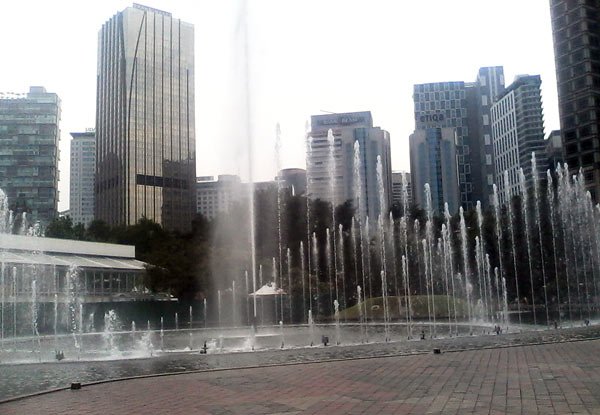
The landscape is also beautiful. Petronas-Twin-Towers keep on attracting a good number of tourists clicking their cameras from different angles. I too was not an exception. KLCC Park in the backside of the Twin-Towers is properly maintained. I said prayer (salat) in different mosques including KLCC Masjid, Nagara (National) Masjid, Masjid India and Masjid Pakistan. The Friday khutba (sermon) in Masjid India is delivered in Tamil and in Masjid Pakistan in Urdu. I preferred Masjid Pakistan for Friday prayer. The khutba on the life of Prophet Muhammad (peace and blessings of Allah be to him) was inspiring.
Shoes have to be kept outside the mosques everywhere. Masjid India displays a notice that shoes may be deposited in the basement to avoid theft. I found no such notice in Masjid Pakistan but one gentleman, noting that I was a new comer, insisted that I do not keep both the pairs at one place. Thieves abound in the area. Everyone maintains his respective character wherever he settles down! I was impressed by the maintenance and management of Masjid India. Our Tamil friends do their work impeccably.
I was delighted to see sparrows everywhere even in the City Centre of Kuala Lumpur in its different parks. I am not a qualified bird-watcher but then I saw many other varieties of birds which I had not seen earlier.
I was surprised to know that, like the Muslims in North India, the Chinese in Malaysia do small artisan works like plumbing and electrical and mechanical fitting and repairing. So much so that during New Year celebration days in China life becomes difficult if some mechanical failure occurs in a family. The Chinese do not work those days. Persons from our sub-continent are content with other jobs including grass-cutting. Jobs in Malaysia, a budding economy, abound and it depends only on a person to ascertain what expertise he develops.
WHAT IS IN A NAME
One may go on describing. One should also know when and where to stop. I prefer stopping after describing the choice of names of shops. I found “Asam Pedas” as names of hotels at two different places. At the former place I entered the hotel, expecting some sweats from Assam. I was disappointed. On seeing the same name at another place I was intrigued and asked my host. He informed me that it means khatti imli (bitter tamarind). As the acidic and sour taste of tamarind has mouth-watering effect, some eateries opt for the name. Another interesting name of an eatery I was told means an Old Abandoned Well because it is believed that vegetables grown in such wells are both nutritious and tasty.
I found Malaysia both nutritious and tasty! I liked the place and its people and would always like to revisit again. And again….