

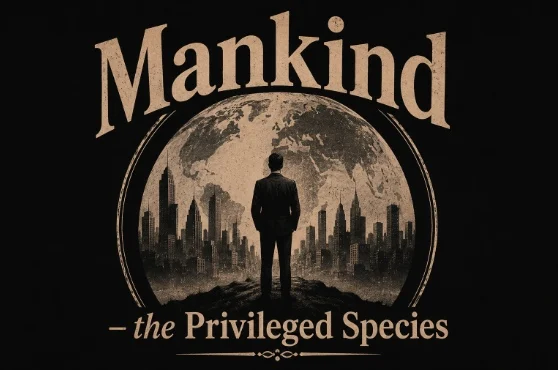
Mankind, the Homo sapiens, enjoys a unique and privileged status on the planet Earth. He is not an evolved ape or higher breed of monkey. He can think, argue and invent. He has travelled a long distance during the last 5,000 years of time. He was living in huts, grazing cattle and tilling land to fill his belly. Today he lives in skyscrapers; he has ready-made packaged food on his dining table, and most of his activities are mechanised. Five thousand years ago he was travelling on foot, later on using horses and camels to travel from one corner of the earth to another. He had to spend months together to cover 2000-3000 kilometres. Now he can traverse these distances in a matter of hours, through the modern modes of travelling at his command.
He, with his weak faculties, is ruling over the planet Earth, reshaping it and manipulating things at his will. He has invented computers, robots and artificial intelligence. He has even broken the boundaries of the outer space surrounding the planet Earth and travelled to the sub-planet Moon. He is now planning to colonise the Moon and making attempts to reach the star Mercury. His achievements seem to be boundless, while monkeys are still inhabiting the branches of trees.
How all these could happen?
The Laws Governing the Universe
The universe that man inhabits is governed by certain laws commonly known as the laws of nature. Man, since the beginning, has been trying to explore these laws of nature but could touch only peripheries despite his marvellous achievements in sciences. Apparent reasons for this limitation are twofold.
- His faculties of perception and understanding are limited in their reach and observation.
- He could use only two sets of methodologies to understand the nature, viz., his observation of the universe by his five senses of perceptions and the experiments that he undertakes in nature.
Apparently, these capabilities have limitations that make his vision of the universe a blurred one. The conclusion that he drives are not absolute, conclusive and ultimate. These shortcomings made his own vision of the universe change with the passage of time as witnessed in the history.
The moot question is what limits man’s efforts in understanding the laws of nature? Why could he not dive deep into the mysteries of the universe? One obvious reason is that he is approaching nature in a compartmentalised fashion, attempting to explore it in part, while the universe is one functional unit and one entity. The history of sciences reveals that man’s approach to the laws of nature remained one-dimensional. He is exploring the laws of nature in segments comprising the various disciplines of sciences like physics, biosciences, geology and the science of chemical reactions that are taking place every moment in the environment and in the bodies of living beings. These disciplines of knowledge appear to be independent, but they are closely interrelated and interdependent that make the universe function as one unit.
The Search for the Unifying Force
The question is what is the harmonising factor that governs various laws of nature and makes it function so uniformly? Man is still not able to discover that harmonising factor, the central law that brings an amazing and complete harmony in nature and that makes the universe not only habitable but also so lovely to live in for man.
Nature functions as one harmonious whole and not a combination of various fragments. It appears that the universe is designed to function as one unit and a single entity, like a human body. As in a human body, there is a live force that is giving direction to everything; every activity and every movement the universe also has a driving force that makes it function as one harmonious whole. Man’s faculties of observation and reasoning are still not able to detect and perceive the ‘live force’, the guiding spirit, or the central law that is governing the universe. This limitation has made man’s approach to nature partial and one-dimensional.
Also, this weakness leads to man’s ignorance of realities prevailing in the universe. He, despite his remarkable progress in all directions, is not able to know the universe in a real sense and failed to discover even his own self. He does not even know the raison d’être of his existence on earth and why his span of life is so short and why he gets weaker and older with the passage of time.
Fundamental Questions of Human Existence
Here, several questions arise that are very basic in nature and need deep reflections. The stark reality is that man could not know himself even at this stage of his history on earth and despite his progress in all directions and in all disciplines of science. These questions are:
- How did he come on earth? Did he evolve by chance on earth by the interplay of forces of nature, or is he a planned and purposeful creation?
- What is the real purpose of his creation?
- Why is his span of life so short?
- Once his life ends, it is all over, or some more purposeful and rewarding life is awaiting him.
These are the existential questions that man and his thinking brains have been trying to answer since time immemorial. All these questions need an answer to solve, in the real sense, the mystery of human existence.
It appears every one of these questions is a separate discipline of enquiry, but in a real sense they are the clues to solve the mystery of human existence. Were the thinking brains of humanity able to answer these questions ever in the history of humanity?And if yes, then how convincingly?
Coming back to the real question mark before humanity, that’s no doubt the universe is functioning as a harmonious whole, a single entity, but how to know the driving force that brings the harmonising effect in the universe?
Here human mind is constrained to realise the presence of a supreme intelligence, an all-powerful and very dominant mind controlling and managing everything from stars and galaxies to minuscules like atoms and quarks.
But how could a mortal being like man know about and discover the Supreme Mind and, more importantly, how to connect with Him?
[The writer, BSc (Hons.), LLB, FCS, is a science graduate with honours in Physics, a law graduate and fellow member of Institute of Company Secretaries of India]