

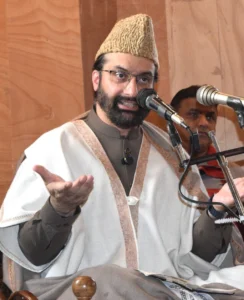
In an interview, Mirwaiz-e-Kashmir, Dr Maulana Muhammad Umar Farooq, Founder-President of the Muttahida Majlis Ulama Jammu and Kashmir spoke with Dr. Khalid Mulla, senior media person, multilingual journalist on an ongoing controversy after the J&K Waqf Board proposed a uniform Juma Khutba across the state, the Waqf Board had to soften its stand in the aftermath of sharp counter from the community.
The 11 October 2026 proposal by J&K Waqf Board Chairperson Dr Darakhshan Andrabi to introduce common themes for Friday (Juma) sermons across mosques in Jammu and Kashmir triggered strong opposition from Muslim religious organisations, Chief Minister Omar Abdullah’s National Conference (NC) government, and the opposition PDP.
The central dispute is not whether imams should address social problems such as drug abuse and suicide. It is who has the authority to determine what is discussed from the mosque pulpit: religious scholars and local imams, or a Waqf Board-linked initiative. Following the backlash, Andrabi clarified on 13 October that no compulsory order had been issued and that imams and scholars would decide the subjects themselves.
Syed Darakhshan Andrabi has been chairperson of the Jammu and Kashmir Waqf Board, since March 2022, and serves with the rank of Minister of State. She is a member of the BJP and serves on its National Executive. She is also the first woman and the first BJP leader to head the J&K Waqf Board. Dr. Andrabi clarified that the overseeing body could be from among the Ulama and the community itself. Neither the Waqf Board nor the central administration wants to interfere in the religious affairs of Kashmiri Muslims, the political leaders and Ulama refused to buy her arguments and decided to go ahead with their decision taken in MMU consultation meeting held in September. Many are sceptical that the BJP is testing the waters and hence a strong counter came from ruling party in J&K, the National Conference and the opposition party PDP apart from the community members.
It may be recalled that in September 2025, Dr. Andrabi became a central figure in a public controversy surrounding the placement of the national emblem on the inauguration plaque of the renovated Hazratbal shrine when the Waqf Board under her chairmanship placed a plaque bearing the national emblem (Trimurti figure) at the famous Hazratbal shrine in Srinagar. The move drew criticism from local political leaders and religious figures, who argued that the use of the emblem at a religious site was inappropriate. Political parties including the National Conference, led by Dr Farooq Abdullah and the Jammu & Kashmir People’s Democratic Party, led by former CM Mahbooba Mufti criticised the decision, and Omar Abdullah, the Chief Minister of Jammu and Kashmir, stated that the national emblem was intended for government functions rather than religious institutions. Unidentified persons subsequently broke and removed the plaque.
The issues are not limited to deciding the themes of Khutba rather religious autonomy, Waqf Board’s authority and political trust meaning whether a BJP-led institutional initiative is viewed as social reform or as political interference in Muslim religious affairs. The local diversity and the limits of the Waqf Board’s direct management of mosques and shrines too are the factors which cannot be ignored while advising uniformity.
Speaking to Radiance, the aide of Mir Waiz, Sayyed Shamsur Rahman Qasmi, Secretary of MMU and editor-in-chief of Nusratul Islam informed that in a first-of-its-kind collective religious initiative, more than 70 major Friday Imams and Khateebsacross Kashmir, Jammu and Ladakh responded to the call of the Muttahida Majlis-e-Ulama Jammu & Kashmir (MMU), by delivering the sermon on the common theme of Imaan (Faith) on Friday, October 16. The coordinated initiative extended across all the districts of the Kashmir Valley Srinagar, Budgam, Ganderbal, Baramulla, Bandipora, Kupwara, Anantnag, Kulgam, Pulwama, Sopore and Shopian besides Jammu, Rajouri, Poonch, Udhampur and the Chenab Valley districts of Doda, Kishtwar and Ramban, reaching further to Kargil, Drass and Leh in Ladakh.
 Ulama, Imams and Khateebs representing the Hanafi, Shia, Ahl-e-Hadith, Barelvi and Deobandi traditions participated in the initiative, marking a significant expression of unity and collective religious responsibility across different schools of thought. Despite their distinct religious style and interpretations, they came together voluntarily to convey a shared message on Imaan, while upholding the independence and sanctity of every Mimbar.
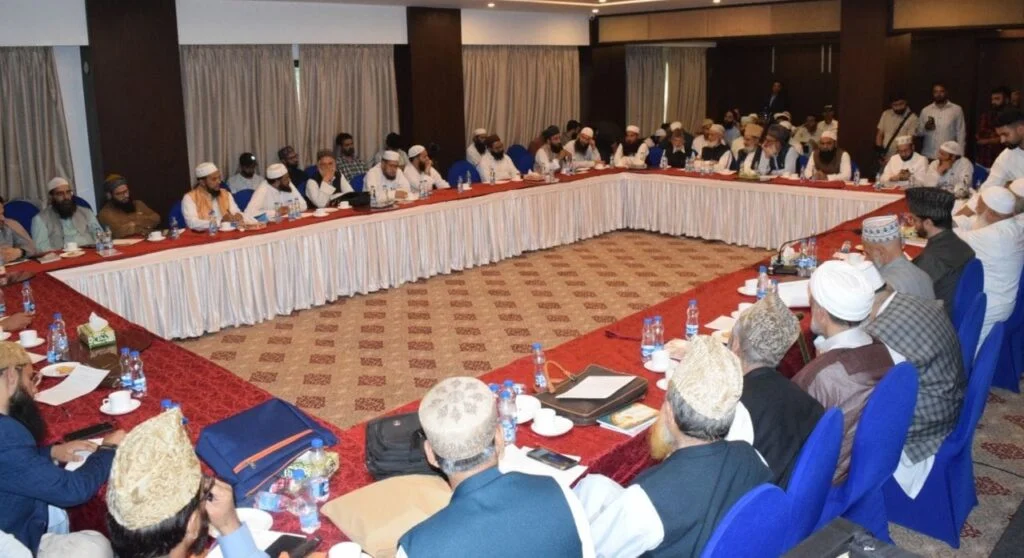
Sayyed Shamsur Rahman said the initiative follows the decisions taken at the MMU’s September 15 Ulama Conference, where representatives of different schools of thought resolved to collectively address pressing religious and social concerns through designated Friday sermons, district-level engagements and sustained community awareness.
The issues outlined in the September meeting, include unity of the Ummah, drug abuse, suicide and mental-health concerns, youth challenges, responsible use of social media, family values and environmental protection. The Friday Sermons on the common themes are to be undertaken usually in a period of a monthly once.
It reiterated that the objective is to translate the collective resolve of the Ulama into sustained public awareness, meaningful community engagement and practical action at the grassroots level, with mosques, Imambargahs, madrasas and religious institutions playing an active role in bringing about the change.
Have a look at what response Dr Maulana Muhammad Umar Farooq had to our questions:
Question: Could you tell us about MMU Jammu and Kashmir? What was the primary objective behind establishing this platform?
Mirwaiz Dr. Umar Farooque:The Muttahida Majlis Ulama Jammu and Kashmir is a common and representative platform bringing together different Islamic schools of thought, religious organisations, ulama and mashaikh, as well as religious and educational institutions. Its primary objective is to safeguard the religious identity, beliefs, cultural values and religious institutions of Muslims, while promoting unity, tolerance and brotherhood. It also seeks to provide collective guidance on major religious and social issues confronting society.
A key feature of this platform is that different schools of thought cooperate on common religious and collective matters despite their jurisprudential and doctrinal differences. Our objective is neither to change anyone’s school of thought nor to eliminate differences. Rather, it is to respect those differences while uniting on issues of common concern that serve the interests of the Muslim community and society as a whole.
We believe that, in the present circumstances, there is little room for internal fragmentation. Our real strength lies in unity, mutual respect, a shared sense of responsibility and practical efforts to address problems seriously.
Question: What do you hope to achieve in society through this platform?
Mirwaiz:Our objective is not limited to issuing statements or organising religious gatherings. We seek to bring about positive and lasting social change through ulama, mosques, imambaras, khanqahs and religious institutions.
Click here to read in full