

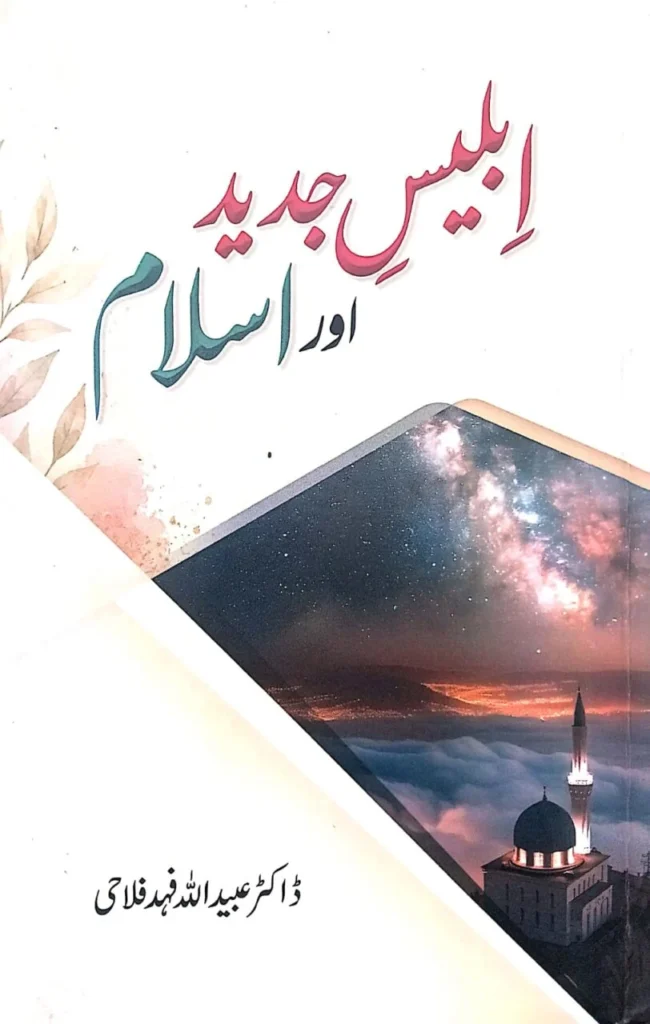
Book: Iblis-e-Jadid aur Islam (Modern Iblis and Islam)
Author: Dr. Obaidullah Fahad Falahi
Publisher: Idara-e-Ilmiyya, Jamiatul Falah, Bilariyaganj, Azamgarh, U.P.
Year: 2026
Pages: 326
Reviewed byDr. Rahmatullah
Department of Islamic Studies AMU
The book under review is a recent scholarly contribution by Professor Obaidullah Fahad Falahi, a distinguished Islamic scholar and retired Professor of Islamic Studies at Aligarh Muslim University. Professor Fahad has contributed significantly to academic discourse on Islam and its relationship with the modern world. His writings bring together traditional Islamic scholarship and modern social sciences, reflecting his engagement with both classical Islamic thought and contemporary social and intellectual issues. The book,Iblis-e-Jadid aur Islam (Modern Iblis and Islam) follows the same approach and discuses the important issues concerning Islam and the modern world.
This book is written in Urdu and published by Idara-e-Ilmiyya, Jamiatul Falah, Bilariyaganj, Azamgarh, U.P. in 2026. It consists of 326 pages and comprises a preface, nine chapters, and an index.
In the preface, the writer clearly emphasises that much of the material presented in the book has been drawn from Talbis Iblis, a work by the renowned Hanbali scholar Ibn al-Jawzi. The writer uses the concept of Iblis to talk about how it shows up in modern days. He connects the modern-day Iblis to Jews, Christians, and Hindu nationalist groups like the RSS.These opinions represent the writer’s personal assessment of the political and intellectual difficulties Muslims face today.
The first chapter, entitled “The Enchantment of Western Science and Philosophy: aStudy of Syed Maududi’sCritiques,” examines Maulana Maududi’s critical assessment of Western scientific and philosophical thought. It talks about his criticism of various political systems and ideologies like democracy, secularism, communism, socialism, and materialism, which he claims are linked to the rejection of Divine revelation and the denial of prophetic authority. In Maududi’s view, these ideologies give greater importance to human reason and authority rather than to Divine guidance. He argues that such beliefs contradict the fundamental principles of Islam and reflect what he describes as Jahiliyyat-e- Khalisah (pure ignorance).
The second chapter, entitled “The Western Onslaught and Islamic Movements: AComprehensive Study of Jamaat-e-Islami and the Muslim Brotherhood,” focuses on two major Islamic revivalist movements of the 20th century: Jamaat-e-Islami and the Muslim Brotherhood (Ikhwan al-Muslimun). It explains how these movements emerged in reaction to the growing influence of Western political ideas and systems. Both sought to revive Islamic teachings and strengthen the role of Islam in the Muslim society. The chapter also compares the two movements, discussing their common goals, ideological similarities, and approaches to Islamic revival, while highlighting the differences in their historical backgrounds, organisational structures, and methods of achieving their objectives.
The third chapter, entitled “The Qur’anic Discourse on the Darkness of Atheism: A Study of Fi Ẓilal al-Qur’an and Its Urdu Translation,” examines Sayyid Qutb’s well-known Arabic Qur’anic commentary and its Urdu translation and commentary by Maulana Sayyid Hamid Ali. It talks about how both works deal with Western doubt and atheism and examine different religious beliefs in the light of the Qur’an. The chapter focuses on issues such as certain Sufi practices, that the authors consider unorthodox, the Christian doctrine of the Trinity, Hindu mythological narratives, and Buddhist beliefs about divinity. It also highlights how the authors use Qur’anic verses to explain and support their views from the perspective of Islamic monotheism.
The fourth, fifth, and sixth chapters examine Western thinkers’ and Orientalists’ interpretations of Islam, its teachings, and its history. The writer argues that these interpretations have contributed to misconceptions about Islam and served colonial interests by reinforcing Western influence over Muslim societies. The chapters also highlight the efforts of Muslim reformist and revivalist movements to challenge these views, clarify Islamic teachings, and promote religious awareness among Muslims.
The seventh chapter, entitled “Islamic Studies and Colonialism in Modern Universities: A Study of the Departments of Islamic Studies at Aligarh Muslim University and Jamia Millia Islamia,” examines the historical development, objectives, and academic evolution of the Departments of Islamic Studies at both universities. According to the writer, during the early years of these departments, progressive ideas had a strong influence on the faculty members. As a result, they paid less attention for protecting the interests of the Muslim community and planning for its revival and development. Instead, they focused on reforming Islamic thought to meet changing circumstances, which, sometimes led to ideas that supported colonial interests. The author also notes that the faculty members soon became aware of this tendency.
The eighth chapter entitled “Ideological Shift or Political Strategy: An Analysis of the Chief’s Statements” examines the ideological shifts in the views of Mohan Bhagwat, the chief of the RSS. It also analyses an article by Professor Tariq Mansoor, former Vice-Chancellor of AMU, in which he advocates dialogue with proponents of Hindutva. The author considers dialogue with followers of other religions a welcome initiative, provided that its purpose is to distinguish truth from falsehood. However, he questions Professor Mansoor’s intentions in light of his subsequent decision to resign as Vice-Chancellor of AMU, accept the BJP’s offer of a seat on the Uttar Pradesh Legislative Council, and enter active politics. The author further argues that, during the 2023 municipal elections, Professor Mansoor openly sought to influence public opinion in Aligarh in favour of the BJP’s mayoral candidate.
The final chapter entitled “A Historic Movement of Resistance: Women’s Protest against Saffron Aggression” examines the historic protest movement launched by women in Shaheen Bagh, New Delhi, in December 2019. It discusses the significance of the movement and explores Qur’anic verses relevant to the women’s struggle for justice, dignity, and their rights. The chapter highlights the courage and determination of the women who participated in the protest, as well as their contribution to public debate on important social and political issues. It also highlights Qur’anic values like patience, fairness, human dignity, and opposition to injustice, offering them as sources of direction for dealing with social and political issues. The author expresses his appreciation for the women of Shaheen Bagh, portraying them as symbols of courage and peaceful resistance.
Overall, the book explores the intellectual, political, and social challenges facing Muslims in the modern world. It highlights the writer’s critical viewpoint on Western ideologies, colonialism, and Orientalist scholarship, while examining the contributions of Islamic revivalist movements. Although some arguments reflect the author’s particular ideological standpoint, the book offers valuable insights into contemporary debates on Islam, modernity, and Muslim identity. It can also serve as a useful reference for students of Islamic Studies in particular and for general readers interested in understanding Islam and its engagement with the modern world.