

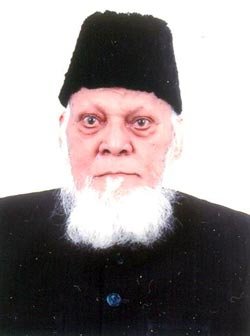
 Maulana Mohammed Himayatul Muqueet Siddiqui, one of the senior most members of Jamaat-e-Islami Hind from Hyderabad breathed his last on 21 Ziquada 1435 (17 September 2014). He had been associated with Jamaat-e-Islami since 1945. He was born on 10 Shabaan 1346 (1928) in Gulbarga (Karnataka). His father, Mohammed Hussain Siddiqui was the Sadar Quazi of Gulbarga.
His family lineage can be traced to Sayyidna Abu Bakr (may Allah be pleased with him). His early education was in Gulbarga. He had the privilege to stay in Pathankot, for a few months with the legendary Abul A’la Maududi, the founder of Jamaat-e-Islami (1903-1979). Then he joined Madrasatul Islah, Saraimeer, Azamgarh UP (www.madrasaislah.org/), where he received education from very eminent scholars including, Maulana Akhtar Ahsan Islahi, Maulana Sadaruddin Islahi, Maulana Abul Lais Nadvi, and Maulana Abu Bakar Islahi. Part of his education was also at Sanvi Darsgah Jamaat-e-Islami Hind, Rampur, UP. In Rampur, his teachers were Abdul Wadood Nadvi, Hafiz Jalil Ahsan Nadvi, Maulana Syed Hamid Ali (Shah Jahanpuri). Then he did BA from Osmania University, Hyderabad and scored the highest in the subject of Islamic History for which he was awarded a Gold Medal.
Jamaat-e-Islami was created in 1941 and he joined it in the early years. After his return from Madrasatul Islah, in 1955, he was appointed Ameer-e-Halqa of Hyderabad South (which then covered regions of Telangana and Karnataka). Later in 1960, he served as Ameer-e-Muqami of Hyderabad City. He was also a member of the Majlis-e-Numaindegan.
Along with the ancestral profession of agricultural farming, Himayat Muqueet also served as a teacher for some time in Hyderabad. He had a command of the Arabic, English and Urdu languages. For about 20 years he took a job of an academic Arabic translator in Saudi Arabia. He was also actively involved in Islamic activities while he was residing in Saudi Arabia. He also spent a few years touring the USA from an Islamic perspective. After his travels, he spent the rest of his life in Hyderabad. In Hyderabad he was actively involved with Dars-e-Qur’ān in different parts of the city.
Himayat Muqueet was very fond of writing and published numerous articles in newspapers and magazines. Starting in 1946, he continued publishing all his life. In 1948, he served as the editor of Urdu weekly Hayat-e-Nau for a few months. During 1966-1971, he was both the Publisher and Editor of the children’s very popular Islamic monthly magazine, The Little Star. Besides Hayat-e-Nau (weekly from Hyderabad), he also contributed his articles to Siasat (Daily, Hyderabad); Rahnuma-e-Deccan (Daily, Hyderabad); Dawat (Sehroza, Delhi); Zindgi-e-Nau (Monthly, Delhi); Radiance Viewsweekly (weekly, Delhi); Afkar-e-Milli (Monthly, Delhi); Rehguzar (Monthly, Hyderabad).
He was also author of several booklets including: Teen Bunyade Baatein (1964); Bahteerin Programme (1960s); Muqaddas Aab-e-Hayaat (1960s); God (in English, 1999). He also authored books like: Aalam-a-Islam: Pandhar wein sadhi kay dahanay per (World of Islam: at the Threshold of the 15th Century, 1981); Kitab Islami Fehristain (Details and meanings of the beautiful names of Allah and Prophet Mohammad, Peace be to him, 2008). His last book was Jamaat-e-Islami: Meri Yadein (Hyderabad, India, 2012). This last book has a lucid account of the early days of the Jamaat.
The last eight years of his life, Maulana Himayat Muqueet Siddiqui was not in the best of health, restricting his movements outside his house. Still, he used to attend the Dars and Ijtema. He breathed his last after Zohar on Wednesday, the 21 Ziquad 1435 (17 September 2014) after a brief illness in his hometown, Hyderabad. He shall be missed by his relatives, friends, students, the Jamaat-e-Islami-Hind and numerous beneficiaries of his philanthropy. In Hyderabad the Jamaat fraternity stated that his death is a big loss to the community and prayed to Almighty Allah to bless him with Jannatul Firdaus and strengthen the family members to overcome the loss, Ameen.