

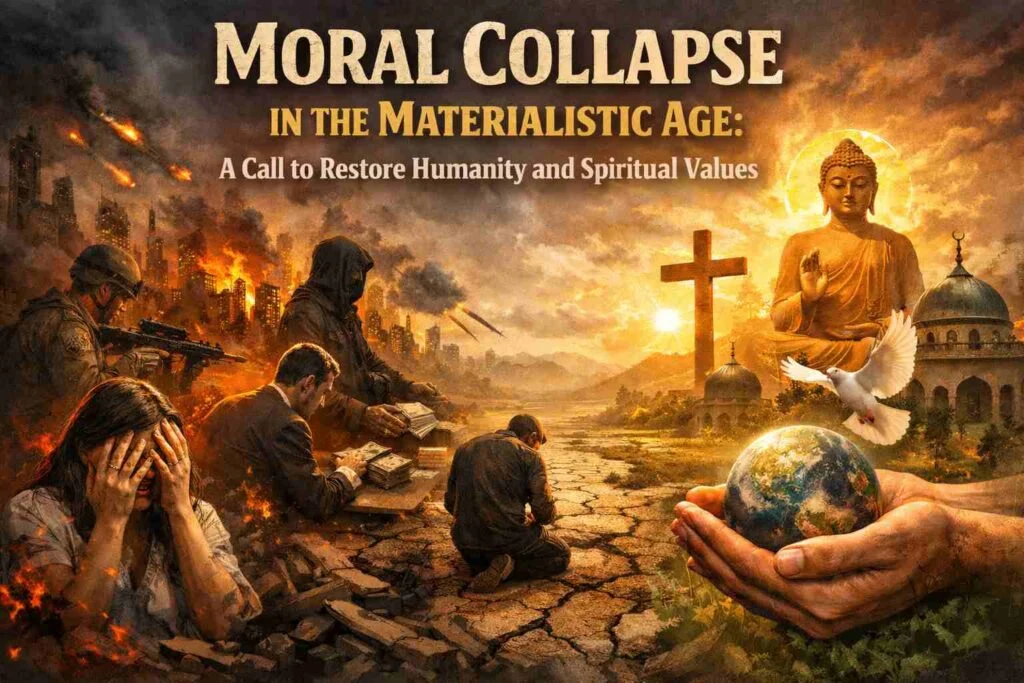
Today most of us have sunk into sins, vices, crimes, corruptions, anti-social activities, including wars. Humanity has touched its lowest ebb. The sanctity it carries has vanished. Existing laws have failed to infuse fear in nefarious elements. Law enforcing agencies have become ineffective. It is unfortunate that the whole world is in a state of turmoil. Materialism has overshadowed the finer aspects of life. Corruption of all kinds has now become a way of life.
Recent spate of rape cases seems that the moral fabric of the society has been torn to shreds. It has become hollow from within; its life-springs have dried up. In this context we may recall T.S. Eliot, one of the greatest poets of the 20th century who composed a famous poem named “The Waste Land” after observing the then prevailing moral degradations, abjections, abasements, and beast-like behaviour in Europe. He described Europe as a waste land on account of the sins committed by its people. He further threw light on the disillusionment of a whole generation pointing out spiritual degeneration and prevalence of lust in contemporary Europe. The poem “The Waste Land” has been divided into five sections:
- The Burial of the Dead,
- The Game of Chess,
- The Fire Sermon,
- Death by Water, and
- What the Thunder Said.
In all five sections, the poet refers to the loss of spiritualism from the world. He explains that the people of the modern world have become materialistic.
It is heartening to note that the Fire Sermon is the third section of the poem. Its idea came to Eliot from the sermon of Lord Buddha. In Lord Buddha’s sermon, the world is seen burning in lust and passion. There are hundreds of sins that accompany it. Lust has been condemned in both East and West but the modern Waste Landers were lost badly in lust. There is no love. Hence they are suffering into immortal and everlasting pain. Eliot explains it through different scenes and images.
Today such is the condition in India. The nation is passing through stage degeneration. It has lost all the respect for spiritualism. Moral values of life are dead. Women have been the victim of masculine lust and exploitation.
Under these circumstances it is religion which instils into us fear of God and moral strength. It lays down for us the marg which we have to conduct ourselves. Besides it teaches us human values and sublime norms. It also leads us towards the path of salvation, progress and prosperity. Human values are more characteristic of mankind. If we don’t have them, we are not real human. It is, therefore, essential for every human being to develop the quality of considerateness, ethical values, kindness and compassion. Without these qualities we are only human animals, narapashu, not more than that.
The sphere of human values is not only confined to human beings but it extends to all the things of the world created for the benefit of mankind. The rights of parents, the rights of children, the rights of husband and wife, the rights of relatives, the rights of neighbours, the rights of orphans, benevolent treatment with widows, the rights of the poor, the rights of patients, the rights of slaves and servants, the rights of guests, the rights of a Muslim upon a Muslim, human relationship, the rights of animals and the like are under human values.
In his book “True Knowledge” Dr.S. Radhakrishnan says: “It is a small dialogue in an Upanishad that a question is put: what constitutes the essence of the good life? The teacher replies: “Didn’t you hear the answer”? There was a thunderclap: da dada. Immediately the teacher explained that these were the essence of good life–dama, dana, daya. They constitute the essentials of the good life. You must have dama or self-control, restrain, which is the mark of human being.”
Jawaharlal Nehru says: “Religions have helped greatly in the development of humanity. They have laid down values and standards and have pointed out principles for the guidance of human life.”(The Discovery of India, P.511)
He further says: “No man can live without religion.”
Gandhiji has written somewhere. “There are some who in the egotism of their reason declare that they have nothing to do with religion. But that is like a man saying that he breathes, but that he has no nose.”
Again, he says: “My devotion to truth has drawn me into the field of politics; and I can say without the slightest hesitation, and yet in all humanity, that those who say that religion has nothing to do with politics do not know what religion means.”(An Autobiography, p.379)
It should be noted that the essence of all religions is humanity which revolves around righteousness, action, creation, sustenance, happiness and ultimate self-realisation as to who I am and who He is. Human is calleda social animal. But he forgets his purpose in life by its overcoming greed and other ills. Animals are more grateful than man. All of you know the story of ‘Alexandra, the slave and lion’. On being treated of his wound, the lion though hungry of days has not eaten Alexandra. Religion everywhere serves the purpose of supporting the moral and social principles which have made men civilized. (Enlightenment through Humanity and Spirituality, p.57)
A noted scholar has rightly said: “As an outcome of the materialistic concept of life mankind today faces crisis, which perhaps has no parallel in history. This crisis, pervading all the spheres of human life, has taken the form of universal revolt against religion. A psychological analysis of this situation reveals that it is the end-product of a basic feeling of insecurity. The world today stands at the edge of destruction. The threat of atomic war hangs over our heads. This humanity, if it wants to survive, has no option but to break away from the concept of materialism and humbly look up to the DivineGuidance for peace and prosperity in the world. Choice between destruction and survival must be made some day sooner or later.”
It is imperative that we must keep away from inhuman and terroristic acts. No religion allows such atrocities and offences. If anyone commits such heinous crimes and wrongdoings, he is not a true follower of his faith. He is reprobate, malevolent and not loyal to his religion.
The need of the hour is that we should abide by the teachings of our respective religion in letter and spirit. Moreover, we must develop humanitarian attitude and come forward to render welfare and charitable services for the poor and downtrodden sections of the society irrespective of caste, creed, colour and region.
In a nutshell, it is time we mould our behaviour and conduct and carry ourselves in the hue of ethical values and moral virtues. Besides we should avoid all sorts of anti-social activities which demoralise us and lead us to the path of devastation and ruin. No doubt only morality can prevent us from committing heinous crimes and unholy acts. It is such an asset which distinguishes between human beings and beasts.
[The writer is a Faculty Member, Darul Uloom Nadwatul Ulama, Lucknow, Uttar Pradesh]