

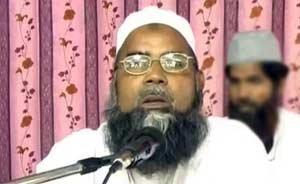
MAULANA KHALID SAIFULLAH RAHMANI, renowned Islamic scholar, General Secretary Islami Fiqh Academy, founder member All India Muslim Personal Law Board and author of more than 50 books, shared the Board’s plan in progress to defend Islamic Shari’ah and called upon the community to form more bodies on the lines of AIMPLB to address the issues within the community and explained the Board’s stand on the Babri Masjid issue, in an interview with MOHAMMAD NAUSHAD KHAN.
Kanchi Sankaracharya recently approached Khalid Rashid Firangi Mahali. Why does the Board think that out-of-the-court solution to the Babri Masjid issue is not possible?
Kanchi Sankaracharya met Khalid Rashid Firangi Mahali in his individual capacity; it was not a formal meeting. Maulana Khalid Rashid was not deputed by the Board as its official representative. He is a respected member of the Board and he clarified the Board’s stand on the Babri Masjid issue to the Sankaracharya. The AIMPLB stand is clear that it is a mosque. It is also available in the government record that an idol was placed surreptitiously inside the mosque and pooja was started. Later on the mosque was demolished. There cannot be any agreement on that piece of land. What is not in our hand as per Shari’ah cannot be negotiated and even if all Muslims say jointly to do so then also it cannot be acceptable.
The stand of Muslims on the Babri Masjid issue should be accepted by one and all. And the land of the mosque should be given back to Muslims as per Shari’ah. At any other place mandir can be built. There are already many mandirs available. In the name of Ramjanmabhoomi or Ramjanmasthan itself there are already mandirs in Ayodhya. If the RSS or other Hindu religious groups or organisations are not ready to accept the stand of the Muslims on the very issue then in a democracy the only option left is the court verdict. If we are not in a position to reach an amicable solution or agreement through dialogue then all stakeholders should wait for the court verdict.
What do you think on the statement made by Justice Markandey Katju on Muslim Personal Law?
I believe the statement made by Justice (Retd.) Markandey Katju on Muslim personal law is wrong. Katju’s earlier statements on various minority issues and Muslims and on safeguarding of secularism have been noteworthy and praiseworthy. But his statement on Muslim personal law is unacceptable. It is man’s ideological rights that he should be allowed to exercise his rights or follow his conscience. Muslim personal law is related to Muslims and in no way paves way for any confrontation with non- Muslims. Therefore, it is for the Muslims, and if Muslims themselves do not want any change and even then changes are imposed on Muslims forcefully then it is certainly against the law of our country, against our democracy and against religious freedom the Constitution guarantees.
What is the Board presently doing to defend the Islamic Shari’ah?
This is a very important question. Even during the British rule, religious laws were not interpreted by the court. Be it a case of Hindu religion or Islam, the court used to accept the views and the interpretation made by religious scholars or experts. But unfortunately, in the Shah Bano case, and thereafter the court began to change particularly in cases pertaining to Muslims. On many occasions, the court followed the views of the Hindu religious scholars but in the case of Muslims they started interpreting the Qur’ān in their own way. We have the highest regard for our esteemed judges and we do not doubt their intention. But the fact remains that they have not studied Islam the way our Ulema do. They are not aware of the tone and tenor of the Qur’ānic language and not acquainted with the possible ramifications of the word and its possible connotations.
Supposedly, if we also start to interpret the Hindu scriptures, and no matter how well educated and qualified we may be, we are most likely to make error and may not be able to reach its logical conclusion. The same is with the Islamic scripture. It would be inappropriate to derive meaning from any second sources as against primary sources or from any unauthentic translation into any language. The earlier translation of Islamic laws into English has got a plenty of errors. Keeping this perspective in view, the Board has decided to get the Islamic laws translated into the English language. Now Justice Syed Shah Mohammed Quadri, former Judge of the Supreme Court and Andhra Pradesh High Court, is translating Islamic laws into English to help check misinterpretation and provide right interpretation for those seeking the genuine interpretation thereof.
Prof. Faizan Mustafa, Vice Chancellor of NALSAR Law University Hyderabad in an interview asked the Ulema to open the door for legal fraternity and academics and to initiate a dialogue in order to stop misinterpretation of Islamic Shari’ah. Will the Board agree to it?
Faizan Mustafa is a good friend of mine and we meet very often. We also seek his guidance and expertise in the translation which is in process. In our country there are some basic rights in our Constitution which cannot be changed while in some other provisions changes do take place. Some laws enacted by Parliament are amended. In Shari’ah too, there are some provisions which cannot be changed while in some other provisions Ulema have accepted changes. For example, in India in 1939 changes took place in the Dissolution of Nikah Act.
The people belonging to legal fraternity come with a kind of mindset and background that bears basic differences as compared with that of Ulema. In Islam, there is concept of justice but in the western world there is thrust on equality between men and women. These are basic differences of thought and opinion. And, if with this thought they want changes in Muslim personal law or Islamic Shari’ah; it will be completely unacceptable to us. Although in what language it is to be presented and how to convey the same meaning with some other terminology or how to make it more acceptable without compromising with the basic idea, we welcome them to help us in our endeavour to defend and protect our Shari’ah. In our legal committee there are more people from the law fraternity than Ulema. Most of them are from law background and Ulema are hardly two or three. We all should take steps to protect and preserve our Shari’ah. If Shari’ah is there, we are; and if Shari’ah is lost, our Milli identity will get lost. So it is our duty to safeguard it at all cost.
Do you think more bodies like AIMPLB is the need of the hour to take up issues jointly?
It was very easy to organise people in the name of Shari’ah. It is All India Muslim Personal Law Board which taught the Muslims to rise up over their sects and sit together for a common purpose and goal. And today its influence is recognised and felt by other organisations as well. But the need of the hour is that there has to be structures for economic, political and all other pertinent issues or for the basic rights of Muslims to address their issues collectively on the patterns of the AIMPLB, which has got representation of all sects and schools of thought and people from all walks of life. In such setups people rising above sects and organisations should collectively think of the welfare of the community. Then only the issues and problems could easily be addressed. It is very much required and efforts should be made in that direction. To safeguard rights and to protect illegal arrests of innocents there must be a platform where these issues can be addressed collectively. Such platforms are the need of the hour.
You advocated media studies in madrasas. How far has it moved on?
The basic objective of the madrasa system is to protect Deen and Imaan of Muslims. Our educational institutions, research institutions and science laboratories remain busy with their work irrespective of what is happening in the country. In the same manner, madrasas were established that the government may come or go but they will continue to do what they are supposed to. When Darul Uloom Deoband was formed and the Ulema were eager to participate in the freedom movement, the greatest freedom fighter of the time Maulana Mahmoodul Hasan Deobandi established Jamiatul Ansar in Delhi and asked the Ulema and students that Darul Uloom has been formed for the sake of education and it must not get disturbed. And those who want to participate in the freedom movement should join Jamiatul Ansar. We are of the view that these madrasas must keep on doing what they are meant for. They should also be prepared to represent the true face of Islam in the media.
Why 20 crore Muslims do not have any national daily or news channel?
The loss the community has suffered because of absence of any national print or electronic media is tremendous. Definitely, it is unfortunate. We have become habitual that for our own fault we keep on targeting our opponents. But the fact is we ourselves are responsible. We could not launch a single national newspaper in English and after the advent of electronic media we kept on debating for years whether or not it is haram. A national media which could present the true picture and represent the community must have come up with the collective efforts of all groups and organisations or in association with the benevolent in the community.
Even if we try to do something with a Muslim name, people get the impression that it belongs to Muslims. Instead, some secular oriented name should be given which can be acceptable to all people. Now the role of social media has increased tremendously. In the revolution that erupted in various parts of the world especially in the Arab world, the social media played a vital role in shaping it up. Muslim organisations should collectively think of utilising the effect of social media to build up society and all that can be helpful for the cause of the community.