

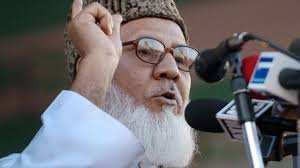
CHARGE-6: DHULAURI VILLAGE KILLING: According to this charge, on 27th November of 1971 at 3:30 am Army personnel and Razakars under the leadership of Maulana Nizami attacked the house of Dr. Abdul Awwal at Dhulauri village. Around 30 men, women and children were killed. After that in the same night 22 other people were killed by stabbing bayonet at the bank of Ichamati River in the presence of Maulana Nizami. All the people who were killed were unarmed – for this allegation Maulana Nizami has been convicted and awarded capital punishment.
Md Shajan Ali was made the key eyewitness of this charge. Mr. Ali had also been taken to the bank of Ichamoti River for killing along with others. Cutting his throat, the army had left him considering him dead but fortunately he was able to survive. Around 70 per cent of his speaking power has gone due to this attack.
According to the prosecution’s witness and the investigation officers, the incident happened during a fight between the Army and the Mukti Yudha; so all the killed persons were unarmed. This version is not true. While based on this ground the ICT awarded him capital punishment.
Md. Shajan Ali was interviewed by many TV Channels whereon he claimed that he never met with Maulana Nizami before 1986 election when he contested the general election as a Jamaat-e-Islami candidate. But during his witness in the Tribunal he denied this. Then the Defence showed the video recordings of his interview where he claimed multiple times that he did not see Maulana Nizami before 1986 General Election.
During the cross-examination of his confessional statements, Md. Shajan Ali claimed that he passed his SSC (Matric) examination in 1972 from Sathia Miapur Haji Jashimuddin Ucha Vidyalaya in Pabna; while in his confessional statements he claimed that he was getting medical treatment in Dhaka Medical College Hospital for four years till 1974 after he was injured in that night’s incident and he also confessed that he returned to Pabna first time after completing his treatment in 1975. These self-contradictory statements are enough to prove him a liar. Now the big question is how the ICT can sentence to death a person based on a liar’s witness.
Again after giving false witness before the ICT, Md. Shajan Ali claimed in a video interview that he was compelled to give false witness against Maulana Nizami. “As a Mukti Yudha we never saw or hear Maulana Nizami as Razakar during the freedom fighting. We are hearing it now. But they told me that you have to mention the name of Maulana Nizami along with Abdus Sattar Razakar in the court. I have been compelled to mention his name but he was not there in the village or on the bank of Ichamoti River during the killing. I had given false witness against Maulana Nizami,” said Mr. Ali in a video interview which is available on YouTube.
Another witness (PW-8) Khalilur Rahaman’s statement is also not reliable. He said that on 27th November Night at 3:30 am he saw Maulana Nizami in the moonlight at the village; but according to the authentic Bangla calendar on 27th November the moon set down at 1:33 am. So to see Maulana Nizami in the moon light is absolutely false.
CHARGE-7: KILLING OF SOHRAB ALI AND OTHER 70 PERSONS
According to charge-7, Maulana Nizami was accused of killing of Sohrab Ali along with other 70 persons at Brishakhila village on 3rd December, 1971. The main allegation in this charge was the Killing of Sohrab Ali. The controversial International Crimes Tribunal (ICT) also sentenced life imprisonment to Maulana Nizami in this charge.
But the death of Sohrab Ali in 1971 is so mysterious. According to the Voter List of Bangladesh Election Commission, the date of birth of Sohrab’s youngest daughter Suriya Sohrab is 31st December of 1976. A person who had been killed in 1971 but ridiculously his youngest daughter was born in 1976. It is enough to prove even for a school boy that the charge was completely false.
On the other hand, Mukti Yudha Abdul Latif Salim, son of Sohrab Ali cannot be a direct witness of this case because as a Mukti Yudha he was in the battlefield outside the village, where his father was killed as they claimed.
CHARGE-8: OLD M. P. HOSTEL, NAKHALPARA, DHAKA
As this charge states, “On 30th August 1971, you as President of Islami Chatra Shangha and head of the Al-Badar Force accompanied by Ali Ahsan Muhammad Mujahid, secretary of East Pakistan Islami Chatra Sangha, visited the army camp at old MP hostel in Dhaka. Where you verbally abused the detained Jalal, Bodi, Juwel and Azad. You told the Pakistani Captain there to kill all of them before the declaration of President’s amnesty. Subsequently except one all of them were killed following your suggestion.” In this charge he was convicted again by the controversial ICT of Bangladesh and sentenced to life imprisonment.
Now we will discuss the facts on which ground Maulana Nizami has been convicted. Jahanara Imam, chief organiser of the “Ghatok Dalal Nirmul Committee” and mother of Rumi who was killed in the MP hostel wrote the book “Akattorer Dinguli” (Days of seventy one). This book is considered a great source of the history of Bangladesh Freedom struggle. Nowhere in her book, Jahanara Imam claimed that Maulana Nizami was involved directly or indirectly in her son’s death.
Jahir Uddin Jalal alias Bichhu Jalal was the only witness for the prosecution in this case. He has given witness in multiple cases against Maulana Nizami and Ali Ahsan Muhammad Mujahid. The information given by Jalal during his witness before the ICT was contradictory to each other. Bichhu Jalal informed the tribunal that after the victory of Mukti Yudha on 16 December, 1971 he went to the house of Jahanara Imam where he met with Jahanara Imam and her husband. This information was absolutely false. Jahanara Imam wrote in her book Akattorer Dinguli that her husband was killed on 13th December and his funeral was held on 14th December. Now a big question is how Bicchu Jalal met with a person who had been killed three days ago. This proves that he was not a reliable witness.
It was mentioned in the charge sheet that Maulana Nizami visited Nakhalpara old M.P. hostel in Dhaka on 30 August in the morning. But according to the prosecution witness Dr. Rathindranath Kundu and Samar Kundu on the same day i.e. on 30th August morning the villagers of Sonatala of Pabna District caught Maulana Nizami and tied him with the wooden pillar of a boat. Now which fact is true: visiting the MP hostel in Dhaka or to be caught by the villagers in Pabna? How a person can be present at two different places at the same time while Dhaka and Pabna stand at a long distance.
CHARGE-16: KILLINGS OF INTELLECTUALS
Under this charge Maulana Nizami was accused of command responsibility of all the killings especially the killing of intellectuals by Al-Badar and the Razakar militia forces as the President of Islami Chattra Shangha (ICS, the Students wings of East Pakistan Jamaat-e-Islami) he was accused as the ex-officio chief of Al-Badar and Razakar.
But, according to the prosecution’s information, Al-Badar Force was set up on 16th May, 1971 in Sherpur of Moymonshing district by a young Major Riyad Hussain Malik Pakistan Army and its first commander was Kamran; so according to the prosecution’s documents it is clear that the founder and the chief of Al- Badar was Pak Army Generals not the Islami Chattra Shangha or Maulana Nizami.
Even if we accept the claim of the police that Al-Badar force was set up by the Islami Chattra Shangha and its president was the ex-officio chief of Al-Badar, it cannot prove the charges leveled against Maulana Nizami; because he was not the president of ICS during the killing of intellectuals. According to the prosecution the killings of intellectuals were executed between 15th November and 14th December. The defence document shows that after 30th September, 1971 president of ICS was Tasnim Alam Manzar not Maulana Nizami.
Al-Badar was a completely armed force and any civilian person cannot be the chief of an armed force. The prosecution’s papers show that Maulana Nizami was an unarmed civilian person during the whole Mukti Yudha. So on this ground Maulana Nizami had no scope of being a commander in chief of Al- Badar. Regarding this Yugoslavia International Crime Tribunal (YICT) has a landmark decision. In the case of Prosecutor vs Timohir Blaskic, (Case No- IT- 95, 14-A, Para-114), the YICT reviewed that “any individual cannot be a civilian and an army official at the same time.” So the facts about Maulana Nizami are contradictory to each other which requires a second thought on it.
General Niyazi, the Easter Command of the Pak Army during the Bangladesh war wrote the book The Betrayal of East Pakistan. In this book at page numbers 78-79 he claimed, “The Al-Badar force was a branch of Razakar Bahini and its establishment and supreme control was in the hand of Pakistan Army.”
The identity cards of the members of Al-Barar force which were submitted before the tribunal by the prosecution show that the chief of Al-Badar was some other person not Maulana Nizami. There were neither his sign nor his name as the head of issuing authority on any of the identity cards showed by the government prosecution in the tribunal.
The prosecution shamelessly failed to prove Maulana Nizami as the commander in chief of Al-Badar Force; then, how he can be punished for the command responsibility.
A SETTLED ISSUE
The ‘’Dalal Aain’’ (also known as ‘The Bangladesh Collaborators Special Tribunals Order, 1972’) was imposed by the then Awami League government headed by Sk. Mujibur Rahman just after the independence of Bangladesh on 24th of January, 1972. More than one lakh people were arrested under this law. Among them 37,471 person were accused but due to lack of proper evidence 34,623 people were acquitted without any charge. Charge sheets were submitted only against 2,848 accused. After a short trial among them only 752 people were convicted and rest 2,096 were set free.
The interesting fact is that after a long process of trial, there was not a single person from Bangladesh Jamaat-e-Islami among the finally convicted 752 persons. Apart from this, among those convicted 752 persons who were not convicted for killing, rape, torching houses and plundering had been released by a general amnesty by Sk Mujibur Rahaman on 30 November 1973. Later on, those 195 Pakistani army officers who were directly involved in mass killing were also given amnesty by Sk. Mujibur Rahaman. So the issue of war crime was settled by Sk Mujibur Rahaman himself. (concluded)