

Muslims of Turkistan Sharqia (Xinjiang)
By SYYED MANSOOR AGHA
Turkistan As-Sharqia or Eastern Turkistan is predominantly a Muslim State. Though the citizens of this State belong to a number of ethnic groups yet they are generally referred to as Uyghurs. It is a part of Central Asia. Manchu rulers of China named the State Xinjiang (meaning “New Territory”) on November 18, 1884 after their troops occupied the Muslim nation. Autonomy of the region was restored briefly and Jamhooria Turkistan Sharqia emerged in 1944 with the support of the then USSR.
But as soon as the Chinese civil war came to an end in favour of the Communists, Stalin lost interest in the free Muslim nationalist regime. In 1949 Communist China took over the region once again. An effort to make a political settlement with Communist China crashed with a dubious plane crash in August 1949 in which all nationalist leaders of East Turkistan were killed on their way to Beijing for negotiations. However, nationalist resistance continued. To overwhelm natives, the Communist China initiated a policy of large-scale migration of Han Chinese in the area. As a result, their population rose sharply from 6 per cent in 1949 to over 41 per cent by the time of Mao’s death in 1976. According to Chinese census 2010, the total population of East Turkestan or Xinjiang is 21.81 million, including 8.75 million ethnic Han Chinese (40.1%).
GEO-POLITICAL POSITION
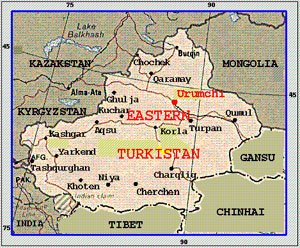
The importance of East Turkestan lies in its geo-political position. It borders Mongolia on the northeast, Russia on the north, Kazakhstan, Kirghizstan and Tajikistan on the west, Afghanistan, Pakistan and India on the southwest. Its boundary line is 5,600 kilometres long, about one-fourth of China’s boundary line on land. (see map)
Rich in minerals, the region has diverse geography. It has grand deserts, magnificent mountains, and beautiful rivers, grasslands and forests. Much of the land is inhabitable being desert or gravel like terrain. It links China to Arab and Central Asian countries and served as a trade route known as Silk Routes. Islam was introduced through Arab traders in the 11th century in the region. The language Uyghur, also known as Eastern Turkic, is written in the Arabic script.
The natives of Xinjiang never fully reconciled with the Chinese occupation. There were 44 revolts against Manchu rulers and fire is still burning. During the Mao rule, Communist China imposed strict control and censorship of religious activities, and suppressed Muslim nationalist sentiments with heavy hands. The strategy to change the demography was part of the policy. After Deng Xiaoping’s adopted policy of reforms, some restrictions were relaxed. Mosques were restored, some others were built, cultural traditions that had gone underground resurfaced, and individual economic activities started once again.
The policy was coupled with a combination of economic and land ownership incentives. Under this policy, Beijing engineered large scale ethnic Chinese influx in Xinjiang in 1990s. It was found in a study that ethnic Chinese migrants are cornering far greater fruits of economic development schemes than the natives, a great cause of heart burning for Uyghur Muslims. Profound socio-economic disparities between the Uyghur and the Chinese are reflected in the fact that the former have about 10 years less life expectancy than the Chinese settlers in the region.
“According to the 1990 census, the infant mortality rate among the national minorities in Xinjiang was 3.6 times higher than that among the Han and their life expectancy was 62.9 years as against 71.4 for the Han.”
Though in majority, Muslims fear that balance of population may shift soon in favour of the Han Chinese and make the Uyghur strangers in their own land. As reported by Human Rights Watch Report 2005.
“At a more mundane and routine level, many Uighur experience harassment in their daily lives. Celebrating religious holidays, studying religious texts, or showing one’s religion through personal appearance are strictly forbidden at state schools. The Chinese government has instituted controls over who can be a cleric, what version of the Koran (the Qur’ān) may be used, where religious gatherings may be held, and what may be said on religious occasions.”
DIMENSION OF CONFLICT
The prime cause of conflict is curbing of political, cultural and religious freedom. Large scale settlement of alien Chinese aimed to change ratio of population and total environment of the region. There is a sea of differences in the cultural and traditional values of Native Muslims and ethnic Chinese migrants. They speak different languages. Locals feel disastrous effects on their mother tongue, culture, and traditions. They are also being drowned economically. Many Uyghur assert that this is the aim of Chinese state policy.
TERRORISM AND MUSLIMS OF XINJIANG
Repression of civil liberties and religious sentiments invites resentment and sometimes it may be violent. Incidents of violence are also reported from Xinjiang. Chinese media categorised these incidents as “terror attacks”. There is no universally accepted definition of terrorism and the Chinese media uses very liberal definition. Any activity of religious or political nature may be depicted as terror activity. However some recent reports of convictions and killings on charges of terrorism are alarming. Unfortunately reports called the incidents “Islamist terrorism”. The Business Standard published a report: “Xinjiang’s Islamic militants posed realistic threat: China / The East Turkestan Islamic Movement (ETIM), an al Qaeda-backed group, is fighting for the separation of Muslim majority Uygur Xinjiang from China.”
It is an internationally acknowledged fact that Muslims of East Turkistan practised a moderate form of traditional Sunni Islam. A Human Rights Watch report clearly mentioned that there is no evidence of so-called “radical ideology” in the region; therefore the possibility of finding root of terror tactics in Xinjiang Muslims is remote.
Therefore main dimensions of the conflict are purely political, economic, ethnic and linguistic. The conflict in Xinjiang is sometimes identified as “religious”. It is religious in the sense that there is a threat to religious freedom. Adherence to religious practices is under scanner of an alien power. There is no report of conflict between Islam and Buddhism. Buddhism has completely lost its momentum of propagation and preaching the faith. The same is the case for Muslims of East Turkistan. The local population is either hereditary Buddhists or traditionally Muslims. Neither faith is threatened by another. The problems arise because the native population is deprived of civil liberties, political and human rights and fear their identity threatened, which is certainly embedded with Islamic values.
LINGUISTIC DIMENSION
Threat to the mother tongue is also a factor of unrest. The World Uyghur Congress (WUC) organised a conference in collaboration with the Unrepresented Nations and Peoples Organisation (UNPO), recently in Paris. The agenda was, ‘Uyghur Mother Tongue Rights in China – Perspectives, Challenges and Policy.’ The date was chosen to coincide with the 15th Anniversary of UNESCO’s International Mother Tongue Day. This event highlights the linguistic aspect of the Uyghur conflict.
It is natural that natives of the region have an urge for self-rule. International Journal of Conflicts published a study, “Boundaries, Discrimination, and Inter- ethnic Conflict in Xinjiang, China” by Enze Han of Woodrow Wilson School, Princeton University, USA and summarised:
“Rigid interethnic boundary between the Uyghur and Han Chinese has been constructed and strengthened in Xinjiang. Perceived differences have generated mutual distrust and discrimination between the two groups that make intergroup communication and understanding difficult and therefore very limited. In situations such as that in Xinjiang, where a rigid intergroup boundary is in place and civic engagements across groups are lacking, intergroup conflict is extremely hard to avoid.”
Naturally all peace and freedom loving people, especially the Muslim world should feel sympathetic with the people of East Turkistan. They are being deprived of their dignity as human beings. I conclude with the eternal message of Prophet Muhammad (peace and blessings of Allah be to him).
“O People, listen to me in earnest – All mankind is from Adam and Hawwa. An Arab has no superiority over a non-Arab, nor does a non-Arab have any superiority over an Arab; white has no superiority over black, nor does a black have any superiority over white; [none has superiority over another] except by piety and good action.
“All those who listen to me shall pass on my words to others and those to others again; and it may be that the last ones understand my words better than those who listen to me directly. Be my witness, O Allah, that I have conveyed your message to your people.”
With due respect to my brothers of Xinjiang, I will say, to look inward for purification is an essential part of our faith and practice. But purification of the soul and achievement of pleasure of Allah ushers from the practice of وتواصو بالحق و تواصو بالصبر. To invoke practice of Zikr-o-Fikr is great, but not enough to turn the tide. (to be continued)