

The Case of Rohingya – Stateless Muslim Minority of Burma
By SYYED MANSOOR AGHA
The problem faced by Muslim Minority in East Turkistan and in Myanmar has one painful common factor. At both places, people are suffering at the hands of those who swear to Buddhism. There is no place of violence in the teachings of Gautama Buddha and his immediate disciples. From this aspect the incidents taking place in Myanmar are more awful. In scores of reports monks play a leading role in arson, killing and other heinous crimes against humanity.
However, there is one basic difference. East Turkistan Muslims are natives of the state for centuries and ruled independently. Their persecutors are invaders, while most Muslims in Myanmar are decedents of migrant Muslims who started to arrive since the 9th century and served the nation in a great manner. From the day one they have been peaceful and law abiding residents of the country, but now in the 21st century the rulers are demanding them under a law of 1982 to show proof to be Myanmar inhabitants from prior to British occupation of Arakan State in 1823.
As UN Refugee Agency UNHCR reported: “Provisions in the 1982 law perpetuate the citizenship crisis by denying citizenship to children born to non-citizens….
“The stipulations of the Burma Citizenship Law governing the right… of Burmese citizenship effectively deny the Rohingya the possibility of acquiring a nationality. Although the Rohingya have history which links them to Burma since the eighth century, Burmese law does not recognise the ethnic minority as one of Burma’s national races. Many Rohingya families migrated to and settled [down] in Arakan during the British colonial period, which under the 1982 law, directly exclude them from citizenship. Even for those Rohingya whose families settled [down] in the region before 1823, moreover, the onerous burden of proving it to the satisfaction of the Burmese authorities has made it nearly impossible for all but a handful to secure their Burmese citizenship. Rohingya who cannot provide “conclusive evidence” of their lineage or history of residence find themselves ineligible for any class of citizenship. And because of their formal legal status as resident foreigners, Rohingya are subject to restrictions on their freedom of movement, denied access to higher education, and restricted from holding public office.”
Burmese Citizenship of Rohingya was never questioned until 1982, when the arbitrary law was imposed by the military government to effectively forfeit their citizenship on the pretext that their forefathers settled down in the country only after the British occupation.
It is true that after the British occupation of Myanmar, many Indians including Muslims were brought in mainly from India to assist the British administration and they served in various fields of life. Many of them married Burmese women and settled down there. According to international rules, they cannot be categorised as illegal immigrants. They enjoyed full rights of citizenship even after the independence of Burma in January 1948. Muslim migrants, who were generally merchants, grow fast and have great business. The history of Muslims arrival in Myanmar / Burma goes back to the 9th century, prior to the establishment of the first Myanmar (Burmese) empire in 1055 C.E.
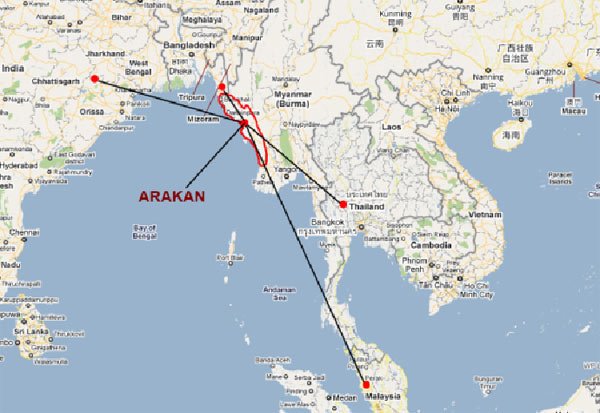
The dawn of Islam and arrival of Muslims was widely documented by the Arab, Persian, European and Chinese travellers of the 9th century. These Muslims are the descendants of Arabs, Persians, Turks, Moors, Indians, Chinese and Malay Muslims. The main problem persists in Arakan which was recently named Rakhine State. Rakhine is the name of the dominant Buddhist tribe of the region. The State of Arakan (now Rakhine State) was not a part of Myanmar or Burma till 1948. Since the area borders Bengali-speaking Chittagong district (Bangladesh, formerly Bengal), naturally local culture and dialect is influenced from the Bengali language and culture. Borders are pores and hilly; therefore it is easy to cross over. But the conditions in Arakan are not better than neighbouring Bangladesh; therefore there is no possibility of mass migration from Bangladesh to Myanmar.
Arakan was made part of Burma at the time of creation of new state known as “Independent Union of Burma”. This did not go well to the local population of which nearly 42 per cent are Muslim. So from the 1950s, there was a growing undercurrent for restoration of Arakan independence. The Socialist government of military ruler General Ne Win did three things. First in 1974 he changed the historic name of Arakan and constituted Rakhine State to appease local Buddhist tribes. This created a wedge between Muslims and the Rakhine tribe. Secondly, he snatched citizenship rights of Muslims who are called Rohingya Muslims. Thirdly, persecution of Muslims was made a state policy.
The Buddhist ethnic Rakhine tribe constitutes overall majority in the newly created state. Other minorities like Chin tribe of Protestant Christians have been absorbed in the Buddhist culture. Muslims are followers of traditional way of Islam which is prevalent in the region.
The Muslims constitute over 96% of the population near the border with Bangladesh. Myanmar rulers blame that they are illegal Bengali migrants. Most stateless Rohingya speak the local Burmese language, which indicates of their being native.
The Arakan witnessed scenes of stiff fighting between Japan and British forces during the WW II. The Buddhists were more sympathetic to Japanese invaders while Muslims supported the Allies. This became a cause of heart-burning between the two tribes and ethnic violence erupted in 1942, when the British forces strategically retreated from Arakan. Many Rohingya Muslims fled to Indian State of Bengal, which was still under the British control. Some 22000 Rohingya are believed to have crossed over the non-depict border during that period.
Another source reported: “40 thousand Rohingya eventually fled to Chittagong after repeated massacre by the Burmese and Japanese forces.”
We cannot refute the possibility of Rohingya coming back to the native land after Japan’s defeat and re-emergence of British rule in Burma. In any case they cannot be blamed to be illegal immigrants.
To restrict their population they are subject to a government rule of only two children per family. However, some surveys conducted after riots of 2012 found that the Rohingya Muslims constitute about 40.75% of population of the state, making them the second largest ethnic group after the Rakhine people.
Since they have been deprived of their civil rights, prospective candidate for President, the Nobel Prize Winner Aung San Suu Kyi feels shy to say a single word about the plight of poor minority in the country. However, former president of South Africa, Nelson Mandela and Desmond Tutu and Dalai Lama have spoken up against the plight of Rohingya.
Of late, there has been an anti-Muslim hate movement led by a monk named Ashin Wirathu. “The saffron clad monk is attributed to stick the tactic of spreading rumours and preaching hatred against Muslims. He claims his movement is not anti-Muslim but protective for vast majority of Buddhists. He also blames Rohingya Muslims of terrorising Rakhine Buddhists. The movement is called 969 and has a strong line-up of monks and allegedly huge followers in administration. Time Magazine depicted him as “The Face of Buddhist Terror”.
“According to Amnesty International, the Muslim Rohingya people have continued to suffer from human rights violations under the Burmese junta since 1978, and many have fled to neighbouring Bangladesh as a result.”
“OIC Secretary-General Ekmeledin Ihsanoglu (former) taking note of the of mass killing and renewed repression of Rohingyas since June 2012, which has resulted in deaths of innocent civilians, burning of their homes and mosques, and forcing them to leave their homeland.
“He added that over the past three decades, Rohingya Muslim citizens had been subjected to gross violation of human rights including ethnic cleansing, killings, rape, and forced displacement by Myanmar security forces.
“As of 2005, the UNHCR (United Nations High Commissioner for Refugees) had been assisting with the repatriation of Rohingya from Bangladesh, but allegations of human rights abuses in the refugee camps have threatened this effort.
“Despite earlier efforts by the UN, the vast majority of Rohingya refugees have remained in Bangladesh, unable to return because of the regime in Myanmar. Now they face problems in Bangladesh where they do not receive support from the government.”
The situation is almost as bad as it was way back in 2009. At that time Thai Prime Minister Abhisit Vejjajiva, in an interview, endorsed the allegation of mass exodus of Rohingya Muslims to neighbouring countries. He said: “Over the years thousands of Rohingya also have fled to Thailand. There are roughly 111,000 refugees housed in camps along the Thai-Myanmar border.”
Instances of pushing them out in deep water and death due to sinking boats have also been reported. The Thai P.M. accepted, “There are attempts, I think, to let these people drift to other shores. […]