

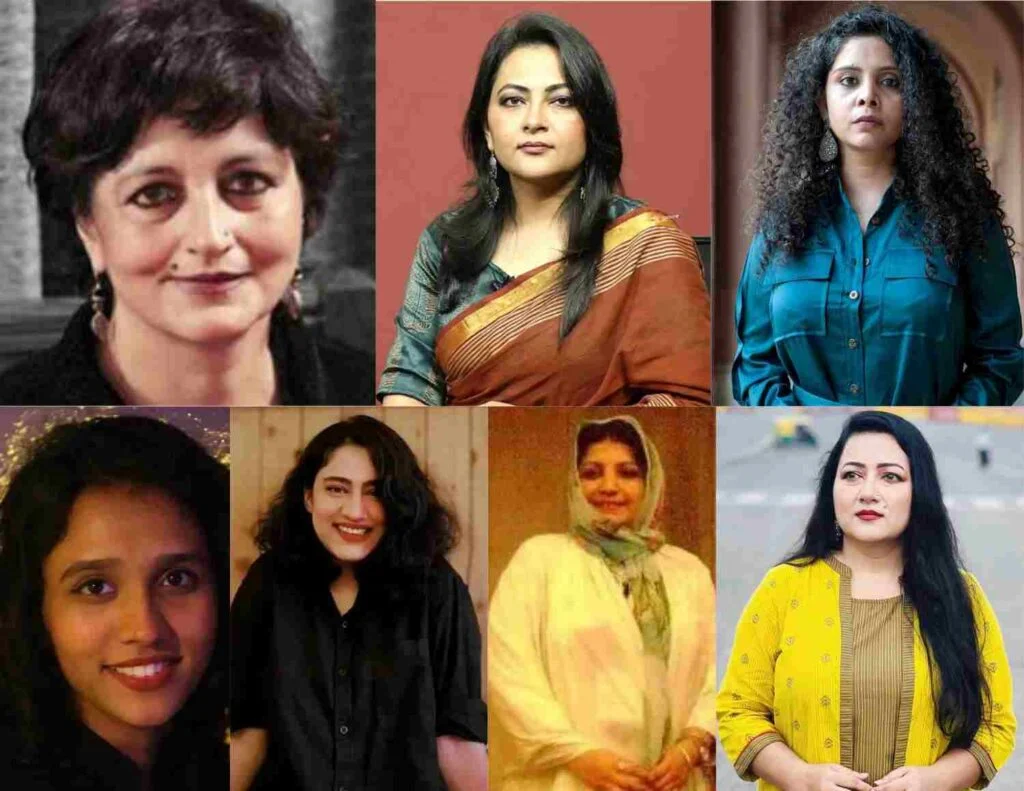
Indian journalism is witnessing the emergence of a remarkable group of Muslim women who are challenging conventional narratives, questioning those in power and bringing neglected stories into the public domain. From established television journalists and investigative reporters to independent digital correspondents with thousands of followers, they are carving out a space in a profession that remains deeply influenced by political power, corporate interests and social prejudices.
Their growing visibility represents more than individual professional achievement. It challenges the stereotype that Muslim women are absent from public life and demonstrates their capacity to participate in difficult conversations about democracy, constitutional rights, communal relations and social justice.
Among the prominent names are Seema Mustafa, Arfa Khanum Sherwani, Rana Ayyub, Fatima Khan, Ismat Ara, Dr Sheeba Aslam Fehmi, Bushra Khanum Fahad, and the younger generation of independent reporters, including Shaheen Khan and Nafisa Khan. Although their professional trajectories and platforms differ, their work illustrates the changing relationship between journalism, identity and public accountability in contemporary India.
From Newsrooms to the Digital Public Square
Seema Mustafa is among India’s most experienced political journalists. Over a career spanning several decades, she has reported on national politics, communal violence, armed conflicts and the changing relationship between political power and the media.
She began her career with The Pioneer in Lucknow before moving to The Patriot in 1979. She subsequently worked with major publications, including The Indian Express, The Telegraph, The Economic Times and The Asian Age. Her experience includes reporting from conflict zones and covering political developments in Kashmir, Punjab and Assam.
One of the defining moments of her career came in 1999, when she received the Prem Bhatia Award for Excellence in Political Reporting and Analysis for her coverage of the Kargil War. Her reporting on conflict and communal violence has contributed to a body of work concerned with the consequences of political decisions for ordinary people.
Mustafa has also written books, including Azadi’s Daughter: A Memoir and The Lonely Prophet, a political biography of former Prime Minister V. P. Singh. These works offer perspectives on her political thinking and her experiences as a journalist.
Arfa Khanum Sherwani has established herself as a recognisable face of political journalism through her reporting, interviews and discussions on national affairs. Associated with The Wire, she has covered contentious political developments and examined questions concerning minorities, democratic institutions and the constitutional foundations of the Indian republic.
Her reporting and public commentary have made her a prominent voice in the digital news environment, where interviews and ground reports can reach audiences far beyond traditional newspaper readerships.
Rana Ayyub, an investigative journalist and author, has achieved international recognition for her work on political violence, human rights and accountability. Her book, Gujarat Files: Anatomy of a Cover-Up, grew out of an undercover investigation into the 2002 Gujarat violence and related allegations concerning state officials.
As a columnist for The Washington Post and an active participant in international public debate, Ayyub demonstrates how Indian journalists can use digital platforms to bring domestic issues before a global audience. Her work has also made her a prominent target of online abuse, including threats and gendered attacks.
Marya Shakil is a prominent political journalist whose career has encompassed election coverage, political interviews, television anchoring and editorial leadership. Her professional trajectory offers an example of a Muslim woman reaching senior positions in India’s highly competitive English-language television news industry.
She built a substantial career at CNN-News18, where she worked for approximately 18 years and became a senior political editor and special bureau chief.
Her reporting has included parliamentary elections, political developments and interviews with leading figures in public life. She has received the Ramnath Goenka Excellence in Journalism Award in the Politics and Government category, including recognition for her coverage of the 2014 Lok Sabha elections. She was also awarded the Chevening South Asia Journalism Fellowship in 2016.
Rana Siddiqui Zamanis known for her writing and interviews on cinema, culture and the performing arts, including work associated with The Hindu. She broadens the picture of Muslim women in Indian media. Her work demonstrates that cultural journalism is not merely celebrity coverage; it can preserve artistic histories, document changing social values and introduce audiences to the people shaping India’s cultural life.
Her interviews with celebrated artists, including A.R. Rahman, helped establish her reputation as a cultural journalist who approached artistic work with seriousness and curiosity.
Fatima Khan, associated with The Quint, represents another important strand of contemporary journalism. Through political reporting and fact-based coverage, she has contributed to public discussions about elections, governance and contentious social issues. Her work illustrates the importance of reporters who combine digital fluency with conventional journalistic methods.
Ismat Ara, associated with The Wire, has reported on politically sensitive developments, including questions of minority rights and the treatment of vulnerable communities. Her work belongs to a wider tradition of independent reporting that seeks to document experiences often neglected by dominant political narratives.
Naghma Sahar represents a distinctive combination of television journalism, international-affairs analysis and academic training. A bilingual journalist proficient in English, Hindi and Urdu, she has worked on both domestic public-affairs programmes and coverage of India’s international relationships.She joined NDTV in 2003 and became known for anchoring prime-time programmes and producing journalism that sought to make complex issues accessible to television audiences.
Among her notable programmes was Salaam Zindagi, which addressed social questions through human stories. She also presented Hum Log and produced and anchored International Agenda, a Hindi-language programme examining international affairs. Her work on Election Express took her across India during parliamentary elections, while her reporting career has encompassed major events ranging from the tsunami to the 2008 Mumbai attacks.
Atika Farooqui occupies a distinctive place at the intersection of television, entertainment, language and literature. A presenter, creative director, trained actor and Urdu poet, she has spent approximately two decades working in television and related media.
Farooqui began her television career with Star in the early 2000s. She subsequently worked with a number of channels, including IBN7, E24/News24, Bhaskar News and News Nation, before moving into entertainment programming. Her career has included launching television channels, presenting programmes and developing content.
SCAN to Read in Full