

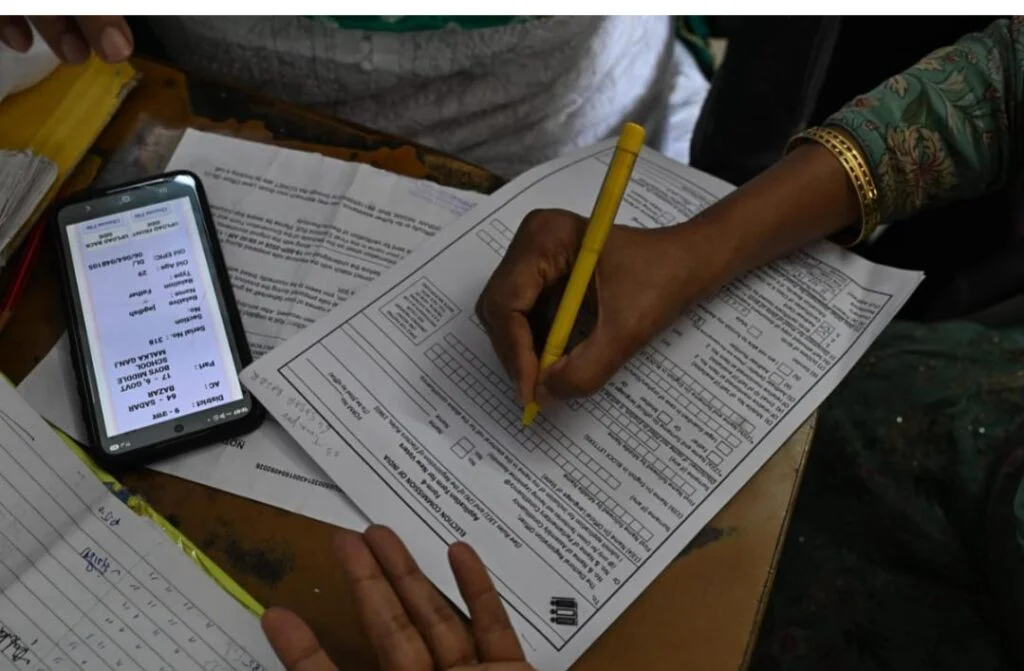
Allegations of selective targeting of Muslim voters during Delhi’s SIR exercise raise serious questions over electoral transparency, verification procedures and accountability of the Election Commission
The Special Intensive Revision (SIR) of electoral rolls in Delhi has come under fresh scrutiny following revelations of alleged irregularities in the filing of Form 7 applications in the Mustafabad Assembly constituency of northeast Delhi. An investigation published by The Hindu has exposed a disturbing pattern of applications seeking the deletion of Muslim voters from electoral rolls, with several people whose names appeared as objectors denying that they had filed the applications. The controversy has now taken a significant turn, with election officials registering a police complaint seeking an FIR against a booth-level agent (BLA) allegedly involved in submitting false Form 7 applications.
According to a report published by Scroll, the Electoral Registration Officer (ERO) of Mustafabad filed a police complaint on Oct. 30, seeking action against a booth-level agent for allegedly submitting false declarations to remove voters who were actually residing at their registered addresses. District Election Officer Ajay Kumar told The Hindu that, following verification of the newspaper’s Oct. 30 investigation, officials found that 36 out of 37 Form 7 applications filed by the agent were false.
The complaint has been filed under the Representation of the People Act, 1950, invoking Section 31, which provides for action against individuals making false statements or declarations in connection with the preparation or revision of electoral rolls.
The latest development has brought the Mustafabad constituency into sharp focus and raised questions about how applications seeking the deletion of eligible voters could be submitted, processed and recorded without adequate verification.
The controversy emerged during the ongoing SIR exercise, when a total of 1,021 Form 7 applications seeking deletion of names from the electoral rolls were filed in Mustafabad.
Form 7 is used to object to the inclusion of a person’s name in the electoral roll or seek the deletion of an existing entry. Such applications can be submitted by eligible individuals or through the prescribed procedure by authorised representatives, subject to verification by election officials.
However, an analysis of the applications available on the Delhi Chief Electoral Office’s website revealed that 787 of the 1,021 applications were attributed to BJP booth-level agents. This represented approx. 77 per cent of all deletion applications filed in the constituency.
More significantly, these 787 applications accounted for around 94 per cent of the third-party deletion objections. Third-party objections refer to applications filed by someone other than the voter concerned or an eligible family member seeking the removal of that vote’s name.
The investigation also highlighted that the objections were directed against Muslim electors, raising concerns about possible selective targeting of a particular community in the national capital.
The reasons cited in the applications included claims that voters had permanently shifted, were absent or had died. These categories are commonly referred to as ASD (Absent, Shifted or Dead). While genuine cases of death or permanent relocation can justify corrections to electoral rolls, the allegations in Mustafabad suggest that such provisions may have been misused to challenge the voting rights of eligible residents.
One of the most disturbing findings of The Hindu investigation was that several individuals whose names appeared as objectors denied having submitted the applications.
Out of 20 BJP booth-level agents whose names appeared in the applications, 16 reportedly denied filing the Form 7 objections. Some said they had no knowledge of the applications, while others claimed that their names had been used without their consent.
The investigation also found instances of incorrect or unreachable telephone numbers and difficulties in locating the persons at the addresses mentioned in the applications.
The case of Ankit Yadav was particularly revealing. His name appeared in connection with 32 Form 7 applications seeking the deletion of voters’ names. However, Yadav reportedly told The Hindu that he had not filed any such complaints. Instead, he said he was preparing to lodge a complaint against the person who had allegedly used his name and announced his resignation as a booth-level agent.
Another individual, identified as Shashi, was named as the objector in approx. 59 applications. When contacted by the newspaper, the telephone number provided in the records was found to be incorrect.
These revelations raised a fundamental question: if the individuals whose names appeared on official applications were denying any involvement, who had actually submitted the objections, and how had the election machinery accepted them?
The investigation also brought attention to the claims of another BJP booth-level agent, Robin Singh Dhama, who reportedly acknowledged filing approx. 500 Form 7 applications.He claimed that the voters concerned did not live in the area. However, such a large number of applications raised serious questions about compliance with the Election Commission’s prescribed limits and verification requirements.
The rules restrict the number of Form 7 objections that can be submitted by an individual. The prescribed limit has been cited as a maximum of 10 applications, with additional restrictions applicable under the relevant instructions.
The alleged submission of hundreds of applications by a single individual therefore warrants a thorough investigation into how the applications were accepted and whether the mandatory requirements were followed.
The investigation also recalled an earlier incident in the Dayalpur area, where 28 Muslim residents were reportedly identified as deceased or otherwise ineligible despite being alive and residing in the locality.
Such cases reinforce concerns that incorrect declarations about death, absence or relocation could potentially deprive genuine voters of their constitutional and democratic rights.
The latest action by Mustafabad election officials is particularly significant because it indicates that the allegations are no longer confined to newspaper investigations or political claims.
According to the Scroll report, officials verified the findings published by The Hindu on Oct. 30 and concluded that 36 of the 37 Form 7 applications filed by the concerned agent were false.The newspaper had earlier reported that, in polling part 129 of Mustafabad, voters named in 28 deletion applications were found living at their registered addresses.
The applications had been attributed in Election Commission records to a booth-level agent registered under the BJP. However, the person had reportedly denied being associated with the BJP, acting as a booth-level agent or filing the applications.Even more significantly, nine additional applications naming the same individual as the objector were filed on Oct. 29 and 30.
Following verification, the election authorities invoked Section 31 of the Representation of the People Act, 1950, against the alleged false declarations.The action represents an important development in the Mustafabad controversy and raises the question of whether similar scrutiny will be extended to other applications filed during the SIR exercise.
The Mustafabad revelations also bring back concerns raised during the earlier revision exercise in Karnataka.According to previous investigations by The Hindu, 45,878 Form 7 applications were filed by third parties before the SIR exercise in Karnataka. The newspaper reported that third-party objections accounted for a substantial proportion of the deletion applications, with Muslim voters and constituencies considered politically significant emerging among the areas of concern.
The controversy was further complicated by 61,059 Form 7 applications reportedly filed by Election Commission officials themselves.
Questions were raised about applications that allegedly lacked proper reasons for deletion and were generated through digital processes using officials’ digital signatures. Some officials reportedly claimed that the forms had been automatically generated by the system.
Such allegations raise serious concerns about accountability. If an application is generated electronically without a proper explanation or authorisation, it becomes difficult to establish who should be held responsible when an eligible voter is wrongly targeted.
The Election Commission’s procedures require verification by the designated electoral registration authorities. Physical verification and examination of the reasons cited in deletion applications are essential safeguards against arbitrary removal of names.
The controversy assumes additional significance because Mustafabad is an electorally important constituency. In the 2025 Assembly elections, the BJP defeated the Aam Aadmi Party by a margin of less than 17,600 votes.
Delhi is among the 19 states and Union Territories covered under the third phase of the electoral roll revision. The exercise has already generated concerns about the possible deletion of genuine voters and its implications for electoral outcomes.
The Supreme Court, on Oct. 30, reportedly asked the Election Commission in Uttar Pradesh to take corrective steps against bulk Form 7 applications submitted to delete voters’ names. Earlier, the Telangana and Karnataka Chief Electoral Officers had also directed officials to act against the misuse of the form.
Although the Supreme Court upheld the legality of the SIR exercise in May, it clarified that the revision did not authorise the Election Commission to determine whether an individual was an Indian citizen.
Concerns have also emerged over the consequences of deletion from electoral rolls, with reports of people facing difficulties accessing welfare benefits and passport-related services after their names were removed.
The Mustafabad episode therefore raises questions extending beyond one constituency. If 36 out of 37 applications attributed to a particular booth-level agent are found false, the Election Commission must explain how such applications entered the system and why adequate safeguards failed to prevent them.
The BJP booth-level agent’s alleged involvement, the denials by individuals whose names appeared as objectors and the subsequent police complaint demand a transparent investigation. At the same time, responsibility must be established through evidence and due process rather than assumptions.
Ultimately, the integrity of electoral rolls is central to the credibility of elections. Every eligible citizen must be protected from arbitrary deletion, regardless of religion, political affiliation or geographical location.
The Mustafabad findings have made it imperative for the Election Commission to conduct a wider examination of Form 7 applications, identify those responsible for false declarations, and ensure that no genuine voter loses the right to participate in the democratic process because of fraudulent objections or failures in the verification system.