

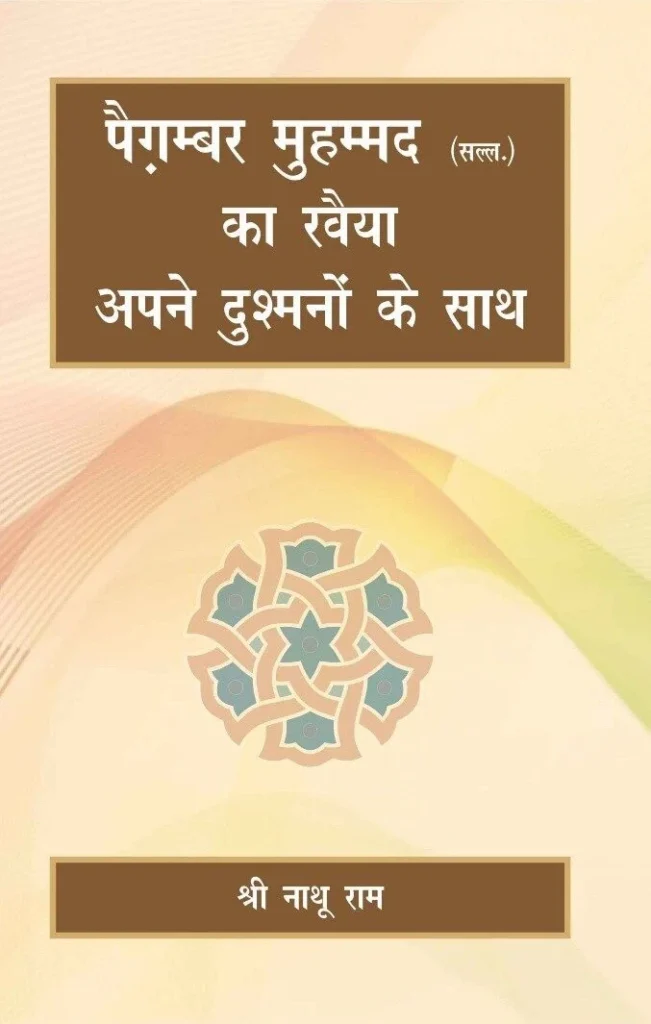
Paighmbar Muhammad ﷺka RawayyaApneDushmanokeSath (The Attitude of Prophet Muhammad ﷺTowards His Enemies), an Urdu monograph by Nathu Ram, a Hindu intellectual from Punjab who lived in the Middle East and studied Islamic civilization closely. Originally serialised in Karachi’s monthly Faran and later published as a book, the work offers an extraordinary homage to Prophet Muhammad ﷺ, portraying him not as a conqueror but as a moral and spiritual reformer.
The work later appeared in Hindi from M.M.I Publishers, New Delhi in 2016, and was republished in 2017 under the title Hazrat Muhammad (pbuh) ka Aadarsh by the same publisher. Nathu Ram also authored, Islam and Women, another widely read work. Drawing upon Ibn Hisham’s Sirat Rasul Allah, Al-Tabari’s Tarikh al-Rusulwaal-Muluk, and canonical Hadith collections such as Sahih al-Bukhari, Nathu Ram dismantles Orientalists’ misrepresentations, and reinterprets Islam’s early history as a narrative of ethical governance, magnanimity, and reconciliation.
In an age marked by communal polarisation, it becomes essential to revisit moral exemplars who transcended vengeance with compassion. One such figure is Prophet Muhammad ﷺ, whom even non-Muslim scholars have recognised as the Embodiment of Mercy. Among these voices, the contribution of Shri Nathu Ram, remains an overlooked gem.
His work, as the publisher notes, was motivated by “a profound sentiment for communal harmony, urging leaders to resolve misconceptions and promote unity” (p. 4). Through his book, Nathu Ram sought “to foster fraternal relations among religious communities, emphasising the national imperative for impartial religious studies” (p. 4).
The Prophet as a Moral Reformer, Not a Conqueror
In Paighmbar Muhammad ﷺka RawayyaApneDushmanokeSath, Nathu Ram portrays the Prophet Muhammad ﷺ as “a moral and spiritual reformer whose life modelled patience, forgiveness, and magnanimity”. Drawing meticulously from Ibn Hisham, al-Tabari, and Sahih al-Bukhari, he dismantles Western and Orientalist claims that Islam spread through coercion. Instead, he illustrates that the Prophet’s noble character “transformed enmity into reconciliation”, establishing a paradigm of ethical leadership profoundly relevant to India’s pluralistic society.
Mercy Amid Persecution: The Makkan Trials
Nathu Ram opens with the Makkan period (610–622 CE), emphasising Prophet’s endurance under persecution. He recounts how early Muslims were tortured for professing monotheism – Hazrat Bilal (RA) burned under the desert sun, Hazrat Khabbab (RA)and Hazrat Ammar (RA) beaten brutally. Even when his own clan Banu Hashim faced a three-year boycott in the Shi’b Abi Talib valley that reduced them to eating tree bark. Yet, the Prophet ﷺ bore these trials: “Despite the tormentors’ stoning, he prayed for their well-being instead of revenge, symbolizing unflinching patience.” (p. 31)For thirteen years in Makkah, the Prophet ﷺ endured persecution of every kind – mockery, boycott, torture, and exile.
When mocked by Abu Jahl, the Prophet ﷺ remained silent. When stoned at Taif, he prayed, “O Allah, guide my people, for they do not know.” For Nathu Ram, this restraint was not weakness but divine moral strength: “Your responsibility is only to warn them.” (The Qur’an 88:22)
Through this lens, Nathu Ram reads persecution as moral triumph – the transformation of suffering into spiritual authority, converting adversaries like Hamza not by sword, but by character.
Forgiveness and Inclusive Governance: The Charter of Madinah
Upon migrating to Madinah (622 CE), the Prophet ﷺ became not only a spiritual leader but a statesman. His first act, Nathu Ram writes, “was not to wage war but to establish peace through the Charter of Madinah, a covenant of mutual rights and responsibilities between Jews and Muslims”.
The document declared: “The Jews will live with the Muslims as citizens… If Madinah is attacked, both will defend it together.” (p.39)
Even when certain tribes like Banu Qaynuqa, Banu Nazir, and Banu Qurayzaviolated this covenant, the Prophet ﷺ responded with measured justice. As Nathu Ram observes:“The Prophet ﷺ permitted exile over execution, allowing them to depart with their wealth and families.” (p. 55)
When judgment fell upon the Qurayza, he adds, “it was not by the Prophet’s will, but by their own law.” (p. 51).
Thus, for Nathu Ram, the Prophet’s governance embodied what he calls “strategic mercy – justice infused with compassion”, rooted in moral law that respected human dignity.
Refuting the “Sword” Theory
Nathu Ram devotes considerable attention to refuting the Orientalist “sword” theory. He writes:“Western writers have given many reasons, which seem far-fetched; only one reason is such that circumstances support it.”(p.35)
He argues that Islam’s early battles were purely defensive:“If Islam spread by the sword, the battlefields would have been near Makkah, not Madinah. In all three battles, the Mushriks attacked, and the Muslims fought in self-defence.” (p. 35)
Discussing the Treaty of Hudaybiyyah, he notes:“The Makkans repeatedly violated the agreement, while the Muslims did not violate any promise. Ultimately, Makkah was conquered without bloodshed.” (p. 35)
These excerpts show Nathu Ram’s clear approach: he uses time and place-based evidence to disprove the “sword” myth, showing that Islam spread not by force, but through patience and moral strength.
Dispelling Misconceptions About the Prophet’s Treatment of Enemies
Addressing misconceptions about Islam’s treatment of non-Muslims, Nathu Ram contextualizes the Prophet’sactions against treacherous tribes and hypocrites. Regarding the Qurayza episode, he writes:“There is no doubt this decision was harsh and bloody… but the punishment was for treason in a military situation. Those who have read in Lord Willingdon’s travelogue of bandits being hanged on trees will not be surprised.”(p. 52)
For Nathu Ram, even in moments of political crisis, the Prophet’s humanity prevailed.“Jews still lived in Madinah; in fact, the Prophet ﷺ pawned his armour with a Jew at the time of his death. They had full permission for trade and independent transactions.” (p. 53)
Similarly, when dealing with hypocrites (Munafiqeen) like Abdullah ibn Ubay, who repeatedly conspired against him, the Prophet ﷺ chose inclusion over exclusion. He even led Ubay’s funeral prayer, praying for him more than seventy times despite others’ protests. As Nathu Ram observes, “He gave generosity until the door of repentance was closed from the other side.” (p. 64)
These observations dismantle caricatures of intolerance and reaffirm the Prophet’s profound humaneness even in political adversity.
Magnanimity in Victory: The Conquest of Makkah
Nathu Ram’s prose glows with admiration, depicting the Prophet ﷺas very embodiment of mercy – patient, generous, and visionary – elevating him above temporal leaders. At the Prophet’s triumphant return to Makkah, Nathu Ram’s prose swells with reverence:“The day of victory could have been a day of revenge, but the Prophet ﷺdeclared: ‘‘Do you know what I will do with you?’… ‘Today, no revenge from you; go, all of you are free.’”(p.33)
Reflecting on this, Nathu Ram writes with awe: “This is the attitude of the Embodiment of Mercy towards his Mushrik enemies….When Allah gave His opponents into the hands of His prophet, along with life and property, Allah’s Messenger ﷺnot only did not take revenge but did not even mention their misdeeds to them.” (p. 34)
He then marvels at the Prophet’s unparalleled moral greatness:“What generosity, forgiveness, brotherhood, sympathy – has any leader in human history presented such a high example? There was not a single person in Makkah who did not harm Islam and Muslims.” (p. 34)
Even the Prophet’s enemies, he observes, “were filled with his bounty.” In this climactic vision, Nathu Ram identifies the Prophet ﷺ as dayamurti – “the image of divine compassion” – and concludes:“The Messenger ﷺ was not for revenge but to present the ideal of Allah’s mercy.”(p. 34)
As India continues to live with its rich religious diversity – 79.8% Hindu, 14.2% Muslim, and 2.3% Christian – the Prophet Muhammad’s message of mercy and justice, as explained by a Hindu scholar, offers valuable lessons for peaceful coexistence. Nathu Ram writes:“Misunderstandings about religions must be resolved. There is a need for impartial study of religions.” (Publisher’s Note, p. 4)
His words remind us that India needs to replace religious pride and prejudice with moral understanding and compassion. The Prophet’s example – showing mercy when wronged, forgiveness when betrayed, and humility in victory – shows us that kindness and fairness are not just ideals, but essential values for all societies.
Nathu Ram’s study goes beyond defending any one faith. Instead, it builds a moral bridge between religions. His image of Prophet Muhammad ﷺ as the “Embodiment of Mercy” – patient, just, and generous – invites all people to rediscover compassion as the true foundation of civilization. As the Qur’an says:“We have not sent you but as a mercy to the worlds.” (21:107)
Through Nathu Ram’s understanding, this verse becomes more than a religious statement; it becomes a universal message of mercy and humanity.