

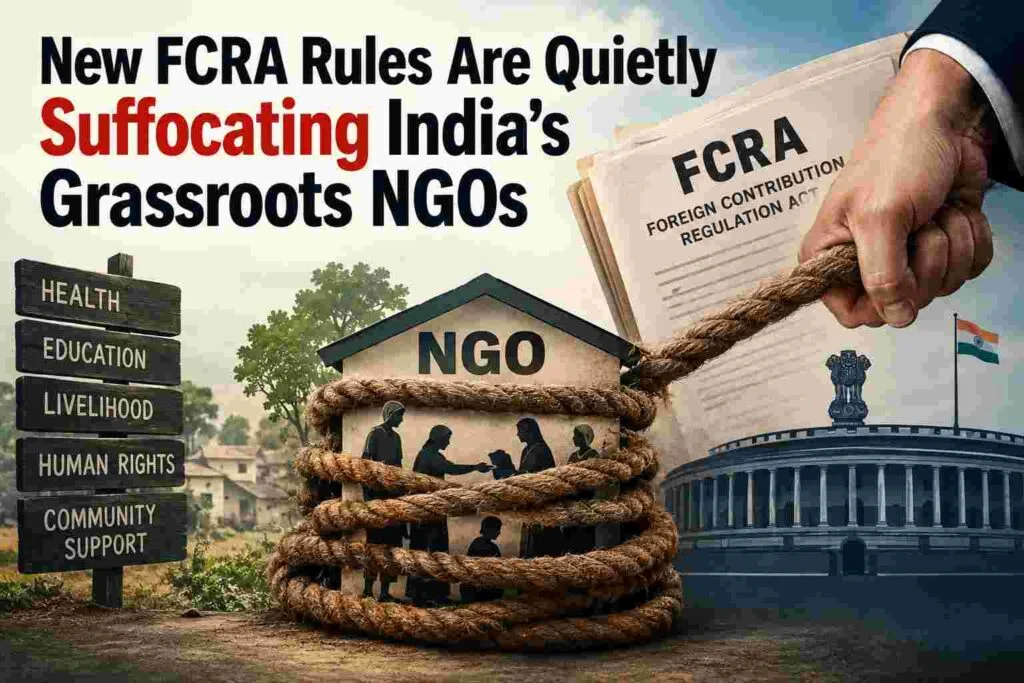
Democracy does not live only inside a voting booth. It also lives in quieter, less noticed places. A two-room health clinic in a tribal village in Jharkhand. A bridge course classroom that gets a slum child ready for a regular school in Bihar. A small office in a border district where three or four social workers spend years earning a community’s trust. Theseare the glimpses of India’s non-governmental organisations. For decades, they have gone where the state’s own machinery has struggled to reach, offering healthcare, education, and a voice to people who are otherwise easy to ignore. Theseglimpsesare now under real pressure, and the pressure is coming from the law that was meant only to keep an eye on foreign money.
On 22 June 2026, the Ministry of Home Affairs notified the Foreign Contribution (Regulation) Amendment Rules, 2026. These rules build on the big changes already made to the Foreign Contribution (Regulation) Act, or FCRA, in 2020. At almost the same time, a separate Foreign Contribution (Regulation) Amendment Bill, 2026 has been sitting in Parliament since it was introduced in the Lok Sabha on 25 March 2026 by the Union Minister of State for Home Affairs. Put the rules and the bill together, and a pattern becomes hard to miss. What began, years ago, as a reasonable effort to track foreign donations has slowly turned into something closer to a licence system that lets the government decide, almost at will, which organisations get to survive and which do not.
A Law Born in Suspicion
To understand where things stand today, it helps to remember where this law came from. The FCRA was first enacted in 1976, during the Emergency, at a time when the government was anxious about foreign powers influencing India’s internal politics. It was repealed and replaced with a stricter version in 2010, and tightened further in 2016, 2018 and 2020. Each round added a new layer of paperwork and a new reason for the state to look more closely at who was funding whom. The government has always described the law as a national security measure rather than a purely financial one, and the Ministry of Home Affairs, not the Finance Ministry, has run it from the start.
Let us be fair about the starting point. No country is wrong to want transparency about where foreign money is coming from and what it is doing inside its borders. There have been real cases of funds being diverted, or of foreign money being used to try and shape Indian politics, and these deserve scrutiny. The Supreme Court itself, in a 2022 judgment in Noel Harper versus Union of India, upheld the FCRA as a reasonable restriction on the constitutional right to form associations, ruling that receiving foreign contributions cannot be treated as an absolute right and that the state has a legitimate interest in knowing how such money is used. But the FCRA was originally meant to be a disclosure law. Organisations tell the government what they received and how they spent it. Over three rounds of tightening, in 2010, 2020 and now 2026, it has slowly turned into something else. A tool that gives the executive branch enormous discretionary power over civil society groups, with very little independent check on how that power is used.
More Rules, Less Room to Work
The 2026 rules add a new layer to this control. NGOs must now register for very specific activities and very specific states or union territories, and stick to them. The rules sort every activity into a small number of broad categories, among them religious, cultural, economic, educational and social work, each with further subcategories underneath. A basic registration fee covers only one purpose and one state or union territory. Every additional purpose or additional state now attracts its own separate fee, and existing organisations have been given only one year to declare exactly which purposes and which states they wish to keep. Anything outside that declared list requires a fresh approval from the government before it can be touched.
This sounds tidy on paper, but real welfare work rarely stays inside neat boxes. Picture an NGO that has spent ten years responding to floods and cyclones in Odisha. If a health emergency breaks out just across the border in West Bengal tomorrow, that NGO cannot simply send its people and its funds there. It must first go through a fresh, time-consuming approval process, exactly when speed matters most.
The new rules go further still. Organisations must now spend at least 75 percent of the foreign funds they already have before they are allowed to draw down their next instalment. The definition of who counts as a key functionary, meaning trustees, directors, partners and office bearers who exercise real control over an organisation, has been widened considerably, and foreign nationals holding such positions are now generally barred from an organisation’s registration unless the government specifically permits it. Where money passes through an intermediary, organisations must now disclose the identity of the original, ultimate donor. Every registered body must also make public its official websites, its social media accounts and any publications, books or reports it puts out during the year, and it is barred from producing anything resembling news or current affairs content. On religious activity, the rules permit foreign funds to be used for worship, religious education, heritage preservation and community kitchens, but explicitly forbid their use for religious conversion. Compliance experts tracking these changes have also pointed out that the rules widen the government’s access to audit records, increase how often organisations must report their spending, and tighten monitoring of every fund transfer between accounts. The government describes all of this as making sure foreign money is used strictly in accordance with approved objectives and designated geographical areas. NGOs describe it, more simply, as being watched at every step while getting less room to actually work.
A Sector Cut Down to Size, Wave After Wave
None of this is happening for the first time. Even under the previous United Progressive Alliance (UPA) government, roughly 4,138 organisations lost their FCRA licences in 2012 alone after failing to file mandatory annual returns, according to official Ministry of Home Affairs (MHA) disclosures. But the pace has quickened sharply since 2014. In April 2015, the MHA cancelled the licences of nearly 9,000 non-profits in one stroke for non-compliance, pushing the cumulative total of cancellations under the then-new NDA government past 10,000 within a single year, as subsequently confirmed in Parliament.
The purge continued unabated by late 2019, an MHA order struck down registrations for more than 1,800 institutions including prominent universities bringing the total number of cancellations since 2014 past the 14,800 mark. On New Year’s Day in 2022, nearly 6,000 more organisations were effectively deregistered overnight after their renewals were rejected or allowed to lapse. By March 2023, data tabled in the Lok Sabha by the Home Ministry revealed that the count of active FCRA licences had shrunk to 16,352, down from 16,727 just seven months earlier.
The pace has not slowed since. According to the Ministry of Home Affairs, 13,520 organisations together received ₹55,741 crore in foreign contributions between 2019 and 2022, money that reached hospitals, schools, shelters, and relief programmes across the country. Yet by 15 July 2026, only 14,449 FCRA registrations remained active, while 22,498 had already been cancelled and another 15,212 had simply been allowed to expire. In plain terms, for every NGO still legally permitted to receive foreign funds today, more than two others no longer can. India is home to well over 200,000 registered nonprofit organisations of every kind, and only a small fraction of them have ever held an FCRA licence at all. What is happening now is not a small technical adjustment. It is a sector that has shrunk to a fraction of what it once was, cancellation notice by cancellation notice.
Names Behind the Numbers
Real, well-known names sit inside these statistics, and their stories help explain what the numbers actually mean for people on the ground. In December 2021, the government initially declined to renew the licence of Missionaries of Charity, the organisation founded by Mother Teresa, which runs homes for the elderly, the sick, and abandoned children. The decision was later reversed within weeks after widespread public criticism, though the episode left the organisation’s shelters in genuine uncertainty during the gap.
Oxfam India, which works across 16 states on humanitarian relief and social justice, had its licence lapse at the end of 2021 and has been unable to get it restored since, even as a federal investigation into the charity continues. Amnesty International India had its bank accounts frozen in 2020 over allegations of illegally receiving foreign funds, a charge the organisation has denied, and was forced to halt its work in the country as a result. Greenpeace India’s foreign funding was suspended as far back as 2015, on the grounds that its work was harming the country’s economic interests, the same year the government placed the American philanthropy Ford Foundation on a watch list, meaning Indian banks needed special government permission before releasing any of its funds to Indian organisations. World Vision India, one of the country’s larger child welfare charities, has also seen its foreign funding access curtailed in the years since. Even the Rajiv Gandhi Foundation and the Rajiv Gandhi Charitable Trust, both headed by leaders of the principal opposition party, had their FCRA status cancelled or suspended in 2022, a reminder that this net has fallen on organisations across the political spectrum, not on one side alone.
More recently, in 2024, the well-regarded think tank Centre for Policy Research had its licence cancelled for six months. Its own director publicly called the reasoning behind the decision unclear and disproportionate to the institution’s actual work. In that same year, five faith-based welfare organisations, the CNI Synodical Board of Social Service, the Voluntary Health Association of India, the Indo Global Social Service Society, the Church Auxiliary for Social Action, and the Evangelical Fellowship of India, lost their FCRA registrations together, several of them decades old bodies working in rural development and public health.
Older but no less telling, on a single day at the end of 2021, roughly 6,000 organisations lost their licences in one stroke, a list that included not just activist groups but also mainstream, respected institutions such as IIT Delhi, IIM Bangalore and Kolkata, the Azim Premji Foundation, and even Jamia Millia Islamia. When an IIT and a children’s shelter can end up on the same list of casualties, it is worth asking whether the process sorting them out is really doing what it claims to do.
[The writer is a Doctoral Candidate and Senior Research Fellow, Jamia Millia Islamia, New Delhi]
Read in fullhere