

In the fading grandeur of British India, amid the minarets of Hyderabad, Nishikanta Chattopadhyaya emerged as a notable intellectual voice from India. Distant kin to Sarojini Naidu and active in major literary circles, he engaged deeply with moral and spiritual questions across world religions.
Among his significant contributions is the lecture “Muhammad: The Prophet of Islam,” delivered on 25 November 1904 in Hyderabad and published shortly thereafter. In this work, Nishikanta presents a thoughtful and well-reasoned portrayal of the life and character of Prophet Muhammad ﷺ. Drawing from Western history books and traditional Islamic texts, the main section of the booklet (22 pages, pp. 14-36) is a detailed, appreciative biography of the Prophet ﷺ.
The text addresses common criticisms, particularly regarding the Prophet’s ﷺ marriages, and refutes them through reasoned analysis and references to European scholars like Edward Gibbon and Bosworth Smith. Ultimately, Nishikanta’s work makes two core contributions:
- Portraying the Prophet ﷺ as the Complete Human – compassionate, just, courageous, and transformative.
- A rational and historical defence of the Prophet’s ﷺ
A Scholar in Search of Truth
Nishikanta was born in July 1852 in Calcutta (now Kolkata). He had served as Principal and Professor of History at Hyderabad College. He wrote a number of books in German and English, including: The Jatras or the Popular Dramas of Bengal, Some Reminiscences of Old England, The Study of History, Lecture in Zoroastrianism, etc.
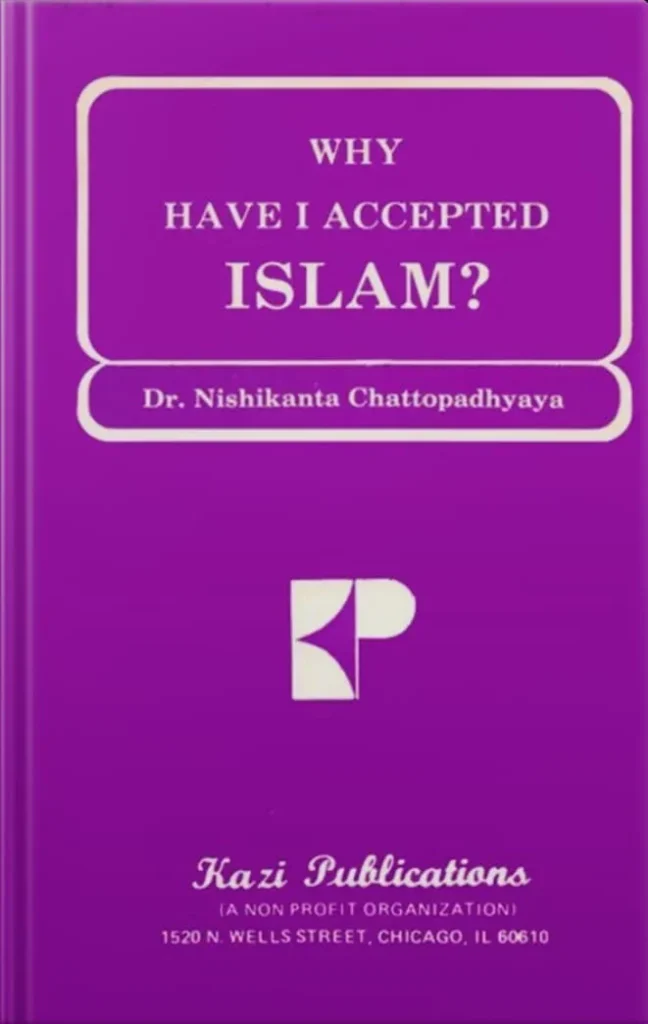
He is also the author of Why Have I Accepted Islam? in which he explains the intellectual journey that led him to embrace Islam. Despite his wide learning and deep study of world religions, he remained spiritually unsatisfied – until he encountered Islam. He writes:“I was astonished to discover that Islam’s teachings have remained preserved in their original form to this day, and that its religious personalities are entirely historical.”(p. 19)
Having explored many world religions, he found in the life of Prophet Muhammad ﷺ a uniquely authentic and historically grounded example: “What a relief to find a truly historical Prophet to believe in!” (p. 19)
Nishikanta then explains the core reason for his admiration:“The reason for my attraction to Muhammad ﷺ is that he exemplified the perfect model of humanity. You will not find a figure like Muhammad ﷺ anywhere in the pages of history.” (pp. 29-30)
Encountering Western Misrepresentation
In the opening pages, Nishikanta recounts visiting the Museum in Edinburgh, where he saw two contrasting statues: Jesus Christ depicted with tenderness, affectionately embracing a child, and Prophet Muhammad ﷺ portrayed as severe and frightening. For him, these images represented the deep-rooted biases of European Christendom. He argues that no Prophet has been as misunderstood or misrepresented in the West as Muhammad ﷺ. Yet, rather than merely condemning this distortion, Nishikanta offers a historical and cultural analysis of how such misconceptions developed – building upon the reasoned critique he had earlier articulated in his lecture Why I Accepted Islam (26 August 1904).
In Muhammad: The Prophet of Islam, Nishikanta directly engages with the works of Luther, Voltaire, Gibbon, Rousseau, Goethe, Richard, and Carlyle. He states: “I silently studied the ideas of all these thinkers. And now, regarding Muhammad of Islam, my conviction is that he was a man of noble character.” He pays special attention to Thomas Carlyle, who, in Heroes and Hero Worship, famously defended the integrity of the Qur’an:“After reading the Qur’an, one is compelled to admit that its foremost qualities are its genuineness, originality, and uniqueness. Its greatest merit is that it is true in every sense.” (pp.21-22). While Carlyle and Herbert Spencer attributed the greatness of historical figures to social or geographic causes, Nishikanta disagreed:“I differ from both. I rely upon tradition and the accumulated scholarly heritage of centuries.” (Muhammad: The Prophet of Islam, p. 5) For him, the greatness of Muhammad ﷺ was not merely social, historical, or incidental; it was moral, spiritual, and universal.
The central portion of Nishikanta’s work presents a clear, chronological, and historically grounded narrative of the Prophet’s ﷺ life – from his birth, moral reputation as al-Sadiq (The Trustworthy) and al-Amin (The Truthful), early meditative life, and first revelation, to the struggles of Makkan persecution, migration to Madinah, and the building of an ethical, spiritual, and political community.
In his narration of the Prophet’s ﷺ time in Madinah, Nishikanta pays particular attention to the foundations of Islamic governance, community-building, and international diplomacy. The Prophet ﷺ was not only a spiritual guide but also: a statesman, a military leader, a legislator, and a moral educator. Yet, even in political power, he remained gentle, forgiving, and humble. The Conquest of Makkah is described as the most striking example: Rather than vengeance, the Prophet ﷺ granted complete amnesty, reciting:“Truth has come, and falsehood has vanished; indeed, falsehood is ever bound to perish.”
Thus, Nishikanta shows that in Islam, power is never for domination; it is a vehicle for justice, reconciliation, and moral upliftment.
Polygamy, Ethics, and Social Responsibility
Responding to European criticism of the Prophet’s ﷺ multiple marriages, Nishikanta systematically dismantles the assumption of sensual motivation. He presents three historical facts:
- The Prophet ﷺlived a life of moral purity in youth.
- Many of his later marriages served social, humanitarian, or diplomatic purposes.
- Many marriages were to widows of martyrs needing protection.
The first argument concerns the Prophet’s ﷺ marriage to Khadijah (RA). The author notes: “He lived with his trustworthy and elderly wife until she passed away at the age of sixty-five.” (p. 32)
Khadijah (RA) was older than the Prophet ﷺ and their marriage lasted approximately 25 years – a period marked by loyalty, devotion, love, and shared struggle. The writer argues that a man who spent his youth and maturity in such a stable and monogamous marital life cannot rationally be accused of sensuality later in life:
“Is it reasonable to assume that a chaste man, whose youth shone as a model of purity, would suddenly become overtaken by voluptuousness in old age?” (p. 33)
This line of reasoning is deeply rooted in historical psychology – a methodology often absents in polemical critiques.
“Muhammad married widows of his companions who had died in battle, to protect them from destitution and honour their memory.” (p. 36)
The author provides clarification on two marriages frequently targeted by critics.
First, Maria al-Qibtiyya (RA) was not taken through conquest or coercion, but was formally presented as a diplomatic gift by the Christian ruler of Egypt. As the author notes:“Maria al-Qibtiyya was presented as a gift by the Christian king of Egypt; according to Islamic law, unions with such individuals were permissible.” (p. 38)
The marriage to Zaynab bint Jahsh (RA) challenged unjust pre-Islamic customs regarding adoption:“By marrying the divorced wife of his adopted son, Muhammad established a new ethical principle regarding lineage and family law.” (p. 40)
This was not personal indulgence; it was legislative reform. Indeed, the Qur’an itself mentions this event (33:37), revealing its public nature – not a private secret. The author cites Bosworth Smith: “I see no truth in the accusations made by certain Christians on this matter.” (pp.29-30).
This scholarly cross-reference strengthens the argument’s credibility.
The author further strengthens his argument by citing Western historians, showing that admiration for the Prophet Muhammad ﷺ has transcended cultural and religious boundaries. He refers to Edward Gibbon and Bosworth Smith, who praised the Prophet’s eloquence, gentleness, humility, compassion, and forgiving nature:
“His personality captivated hearts; his speech flowed with grace, his smile was radiant, and his character combined majesty with tenderness.” (p. 48)
These remarks emphasise the balanced integration of strength and mercy in the Prophet’s ﷺ leadership. In this light, Nishikanta argues that the Prophet’s ﷺ marriages were expressions of moral and social responsibility, not acts of sensual desire.
Prophet Muhammad ﷺ as the Model of Complete Manhood
The heart of Nishikanta’s admiration appears in one of his most powerful statements:“What attracts me to the person of Muhammad is that he manifested complete manhood. He was not a recluse, nor a world-renouncing ascetic. He was a complete human being, in whom strength and gentleness were perfectly harmonised.” (p.32)
Nishikanta then draws a striking comparison the Prophet with Brutus, Caesar:“Brutus said we shall never see another like Caesar, but I see greater truth and power in Muhammad.” (p. 58) Napoleon’s acknowledgment is recalled:“If even half of Muhammad’s zeal could be instilled in my soldiers, I could conquer the world.” (p. 59)
Yet even Napoleon recognised he lacked the moral and spiritual appeal of the Prophet ﷺ.
Nishikanta’s work stands as one of the most compelling interfaith homages to the Prophet Muhammad ﷺ from colonial India. It blends: intellectual rigour, emotional sincerity, historical clarity, and spiritual admiration. It shows us that to study the Prophet ﷺ is not merely to study history; it is to encounter a model of the human being at his highest ethical potential.
In a time marked by misunderstanding and misrepresentation, Nishikanta’s voice remains urgently relevant, reminding us that the life of the Prophet Muhammad ﷺ is not only a subject of belief, but a subject of scholarship, admiration, and human inspiration.