

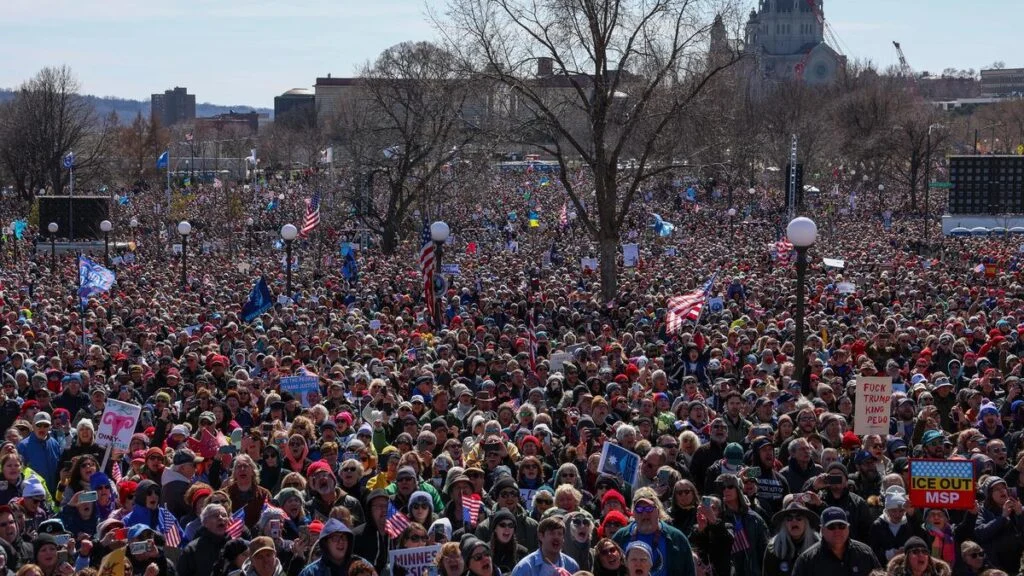
Humans have a natural aversion to war. However, it is not easy to transform that sentiment into a collective form and especially into gathering on the streets to protest against war. The global ‘No Kings’protests symbolise resistance against the neo-colonial, neo-imperial world order being imposed by the US and Israel and sends a glimmer of hope to those who align themselves with those who “command good and forbid evil.” Across the United States itself there were more than 8 million people who took to the streets in a single day. This could possibly be one of the largest protest mobilisations in modern history.
The slogan ‘No Kings’ is simple but has ideological depth. Not only does it reject the idea of a singular ruler, royalty and monarchy, it also rejects the entire logic of concentrated power in all its forms and manifestations. Sometimes it may take the form of a president, general, martial law dictator or even a multinational corporation, or a military-industrial complex. Protest organisers echoed this concept by saying, “Trump wants to rule over us as a tyrant. But this is America, Power belongs to the people – not to wannabe kings or their billionaire cronies.”
A Nationwide Global Uprising
The sheer scale and spread of the protests shows the growing anger in American society about the unprovoked and unnecessary war on Iran. According to a BBC report, “demonstrations took place in nearly every major US city,” while “crowds also gathered in smaller cities and towns across the country – and also in areas outside the US, like Paris and London”.
In Washington DC, the report notes that “throngs of people marched through the nation’s capital,” as protesters “lined the steps of the Lincoln Memorial and packed the National Mall,” turning symbolic national spaces into arenas of dissent. The same report highlights that in New York City, “thousands crowded Times Square, marching through Manhattan’s Midtown neighbourhood,” forcing police to shut down normally busy streets. These large protests were coordinated mass mobilisations.
Their scale was such that they disrupted everyday life and drew national attention. Most importantly, the protests were not confined to the United States. The BBC also reported that “American expats abroad also gathered for protests in cities such as Paris, London and Lisbon.” All these patriotic Americans demonstrated against the war on Iran and expressed anger against their President and his administration.
Speaking Truth Against War and Power
Speaking to the media, veteran actor and director Robert De Niro minced no words against the American President, “I think more people are starting to see that with this guy, it gets worse and worse and worse every day… Now we’re in a war. The next thing is, what he’ll do is put troops on the ground. He’s crazy”. There were many who said, “This is not America’s war. It’s Trump’s war.”
Any serious study of the reports on the war on Iran shows how President Trump was led into this war by Israeli Prime Minister Benjamin Netanyahu. In the same interview, De Niro asserted, “It’s that simple, and we have to stand up to him, to the regime, fight it with everything. We just got to fight, you know, peacefully, but we have to resist. We have to. We have no choice”.
Another prominent “No Kings protest” took place in Minnesota. A state where two American citizens, Renee Nicole Good and Alex Pretti were killed by federal immigration agents in January. Their deaths had sparked huge outrage and nationwide protests at that time against the Trump administration’s immigration tactics. Bruce Springsteen took the stage and performed his anti-immigration enforcement song titled, “Streets of Minneapolis”.
The Deeper Implication of Protests
It was indeed gratifying to see people in their millions showing their opposition to the war through these mass gatherings. However, the protests also carried a deeper intellectual and historical critique. In a New York Times article, “5 Takeaways From the ʻNoKingsʼ Rallies as the Midterms Heat Up,” Tim Balk states 5 things that can be inferred by these protests. One – The war appears to galvanize younger voters. “Our generation has grown up with this idea of endless war in the Middle East,” said one young protestor. “And the idea of getting into yet another is something that people are rightfully really angry about.” Two – People are very angry at Trumpʼs immigration crackdown. Three – Vociferous protests unfolded near Mar-a-Lago, the resort owned by Trump in Palm Beach County, Florida. Four – Midterm candidates came out in force, and Five – Democrats found fresh fuel for their ʻNoKingsʼ slogan.
Spain and 35 Countries Push Against War
Many other countries have also opposed the war on Iran. There are reports indicating that around 35 countries have either opposed or expressed serious concern over the conflict. Spain has emerged as one of the most vocal critics of the war. The Prime Minister of Spain, Pedro Sánchez, has repeatedly emphasised the need for diplomacy over escalation. He has stated that “there is no military solution” to the crisis and called for “an immediate de-escalation and return to dialogue.”
Although it is not stated publicly, it is very obvious that European leaders have understood that this is Israel’s war with its long-term agenda of a Greater Israel. America is just a “mohra” (pawn) in this unjust and inhuman war. This anti-war sentiment is not confined to Europe.
Many civil society organisations and political parties in Asia have voiced their opposition to the war. The Leader of Opposition, in India, Rahul Gandhi said, “The conflict has reached our backyard, with an Iranian warship sunk in the Indian Ocean. Yet the PM has said nothing. At a moment like this, we need a steady hand at the wheel. Instead, India has a compromised PM who has surrendered our strategic autonomy.”
One is reminded of what Egbearor Favour said, “When thinkers rise, empires are challenged. When they fall silent, tyrants win.”