

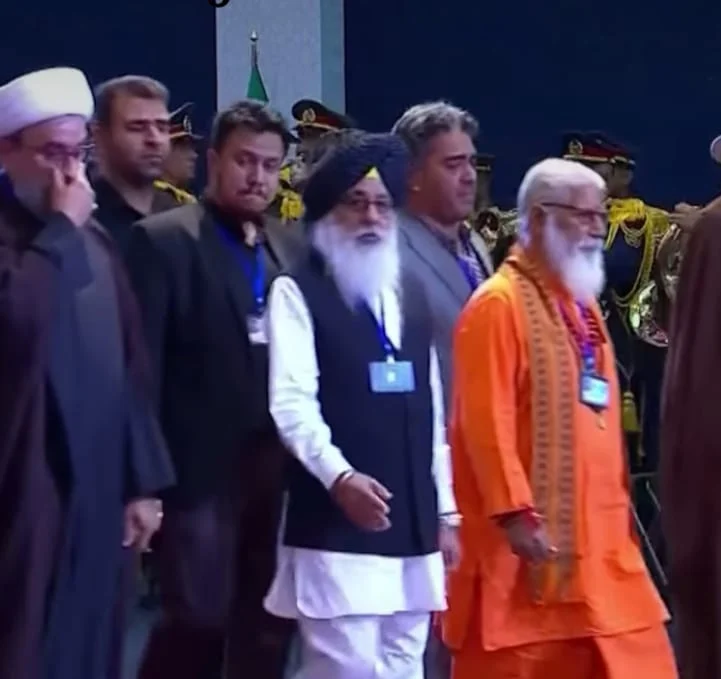
Returning from Iran after attending the funeral of Iran’s Supreme Leader, Ayatollah Ali Khamenei, Goswami Sushil Ji Maharaj, National Convener of the BharatiyaSarvDharm Sansad, has described his visit as one of the most remarkable experiences of his life. In an interview with Mohd Naushad Khan, he spoke at length about Iran’s hospitality, the country’s image, India-Iran relations, Israel’s war on Gaza, world peace, and the role of interfaith dialogue in resolving global crises.
Clarifying at the outset that he was not part of the official Indian government delegation, Goswami Sushil Ji Maharaj said he travelled to Iran at the invitation of the Iranian Embassy as a representative of religious leaders committed to interfaith harmony. He stressed that the honour extended to his delegation was not based on religion but on their status as spiritual leaders representing humanity.
“We were invited by Iran, not sent by the Government of India. The government delegation was separate. They respected us because we are religious leaders, and they believe spiritual leaders hold a special place in society,” he said.
One of the strongest impressions he carried back from Iran was the extraordinary hospitality shown by the Iranian people and authorities. “I have travelled to many countries, but I can honestly say that I have never experienced hospitality like I experienced in Iran,” he said. “Every minute of our visit was planned with care. They constantly ensured we faced no inconvenience. Even when we told them we were comfortable, they continued looking after us with great affection and respect.”
According to Goswami Sushil Ji Maharaj, senior Iranian leaders personally met the delegation. The President of Iran invited them separately, religious leaders hosted them for meals, and they were taken to places associated with Ayatollah Khamenei’s life so they could better understand his legacy.
One of the most striking moments of the visit, he recalled, came when his delegation had to leave Iran earlier than planned because of prior interfaith commitments in India. “We had informed them that we could not stay until the scheduled date because of earlier programmes. We were worried about our return journey, especially given the circumstances. They simply told us, ‘Leave that responsibility to us.’”
He revealed that the Iranian authorities arranged a chartered aircraft for eight members of the delegation to Mumbai, describing it as an unforgettable gesture.
“This was perhaps the biggest surprise of the trip. Never before has any country arranged a chartered plane for us. Saints don’t travel for luxury. But the way they honoured us showed how deeply they respect spiritual leaders, irrespective of whether they are Hindus, Muslims, Sikhs, Christians, Jains or Buddhists.”
He said the gesture reflected Iran’s respect not merely for individuals but for religious harmony itself. Responding to widespread perceptions of an Orthodox country about Iran, Goswami Sushil Ji Maharaj said the reality on the ground was very different from the image often portrayed internationally. They were very humble, polite and above all very caring with due respect.
“I did not find Iran to be a frightening country at all. We travelled nearly 150 to 200 kilometres across different areas, and nowhere did we feel afraid. Life was functioning normally. There was discipline, dignity and warmth.”
He said that despite regional tensions, ordinary citizens appeared calm and carried on with their daily lives.
“I never felt I was in a war zone there. The atmosphere was peaceful. If people can remain so composed during a period of national mourning, one can imagine how welcoming they would be in happier times.” He also rejected the notion that Iran was an excessively orthodox society.
“I saw a cultured and organised country with deep historical roots. We visited historical sites where the long history of cooperation between Christian and Muslim communities has been preserved for generations. Such examples demonstrate that coexistence has been part of Iran’s civilisation for centuries.”
Throughout the interview, Goswami Sushil Ji Maharaj repeatedly emphasised that his visit was guided by the principles of interfaith harmony rather than politics.
“We did not go there as representatives of one religion. We represented all faiths. We spoke about peace, unity and coexistence. That is why they gave us such importance.” He argued that religion should never become a cause of violence.
“A person’s religion is shaped by the family and culture into which they are born. Violence in the name of religion is one of humanity’s greatest tragedies. Every individual has the right to follow their own faith while respecting the faith of others.”
According to him, humanity must come before religious divisions. Commenting on the continuing tensions in the Middle East, Goswami Sushil Ji Maharaj strongly argued that military conflict can never produce lasting peace. “There is no solution to war except dialogue. Eventually, every conflict ends at the negotiating table. Why not begin there?”
He said his delegation witnessed no widespread panic despite the conflict. “We did not see people living in fear. But that does not mean war is acceptable. Every nation must sit together and resolve differences through dialogue.” While acknowledging Iran’s resilience, he said he admired the country’s determination to defend its people even after losing its top leadership.
“Even after losing their leader, they are working courageously to protect their country and humanity. Their courage deserves recognition.”
Goswami Sushil Ji Maharaj also disclosed that during his earlier visit to Iranian Embassy in New Delhi he had made an appeal to Iranian officials and religious leaders regarding India’s energy needs. He said that with rising tensions in the region, there were growing concerns about possible disruptions in the supply of gas, petrol and diesel to India. “We requested them that India should not suffer because of the conflict. If gas and petroleum supplies are affected, ordinary Indians will face great hardship.”
According to him, Iranian representatives assured the delegation that they understood India’s concerns. “They told us that governments make their own decisions, but they appreciated the fact that representatives from India’s different faiths had come together to express solidarity. They assured us that India would continue to be treated with goodwill.”
He further claimed that after their discussions, assurances were given that Indian shipping with Indian flag carrying energy supplies would not be targeted. “We requested them to protect India’s interests, and they honoured their commitment. I appreciate them for that.”
Speaking about future engagement, Goswami Sushil Ji Maharaj said the relationship between India and Iran extends far beyond politics. He recalled that the Director of the Iranian University in Greater Noida had proposed expanding academic and interfaith exchanges.
According to him, discussions are underway to organise a major interfaith dialogue bringing together scholars of the Qur’an, the Bhagavad Gita and the Guru Granth Sahib.
“The idea is to highlight the common values shared by all three traditions. We want people to understand that despite differences in worship, the teachings on humanity, compassion and peace are remarkably similar.”
He said such initiatives could strengthen people-to-people ties between the two countries. The BharatiyaSarvDharm Sansad leader also expressed deep concern over the humanitarian situation in Gaza. “Innocent people should never become victims of war. Whether they are Muslims, Jews, Hindus, Christians or followers of any other faith, no religion permits the killing of innocent civilians.”
He argued that violence against civilians contradicts the teachings of every major religion. “If we truly believe in God, we must also believe that every human life has equal value.”
Throughout the conversation, Goswami Sushil Ji Maharaj repeatedly returned to one central message, that humanity must rise above political and religious divisions.
Quoting an ancient Sanskrit prayer, he said India’s civilisational message has always been one of universal peace and coexistence. He also referred to India’s G20 theme, ‘VasudhaivaKutumbakam’ (One Earth, One Family, One Future), saying it perfectly reflects the country’s philosophy.
“India has never believed in glorifying war. Our civilisation teaches us to walk together, respect one another and resolve conflicts through dialogue.”
Concluding the interview, Goswami Sushil Ji Maharaj reaffirmed his commitment to strengthening India-Iran friendship through interfaith engagement.
“The relationship between India and Iran is centuries old. It cannot be broken. It will only grow stronger. Iran and India together should continue working together for world peace. Humanity must survive, and peace must prevail over conflict. That is my message.”