

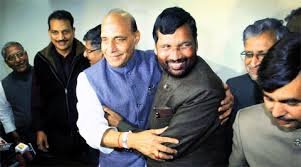
MOHAMMAD NAUSHAD KHAN takes stock of the fast changing political scenario in the country wherein opportunistic politics is being played at the cost of political morality.
Politics is the art of possible. The nature and guidelines for political parties during troubled times fluctuate and are defined by the perception and the possibility of electoral benefits or with the intention of hampering another party to settle political scores. The so-called secular parties are secular in need but not so secular in deed and are always ready to flip flop with their political understanding, affiliation and belief to match their opportunistic stance and fulfil their political aspirations.
The formation of one political bloc over the other or drifting from one segment to ally with others or splitting apart or joining other party has been the hallmark of our Indian polity over the decades. The Samajwadi Party that helped save the Congress or the UPA from the political onslaught of the Communist Party during voting in Parliament on nuclear deal is at the moment weighing option and is leaning towards the new third front formation where 11 parties have formed a bloc against the BJP and the Congress. The irony of secular polity is that no one can say for sure that a so-called secular party will remain secular and for how long. The parties that join the secular group do so under some principles or political ethics or they become secular just to join the group which is overtly or covertly secular. For Ram Vilas Paswan what has really changed in these 12 years? Twelve years ago he was with the NDA. Have the fundamentals of secularism changed in these years or has Paswan changed himself depending on his calculation or out of anger over seat distribution.
Lok Janshakti Party had been an ally of the NDA when BJP-led NDA government was in power but Paswan was the first to break away from the NDA fold protesting against Gujarat riots 2002. Paswan was then Union Minister when he walked out of the Vajpayee-led government. At that point of time he was considered by many secularists to be a secular warrior for a cause. It became even more evident when in the run up to the expected hung assembly in Bihar in 2005 Paswan with his numbers by his side was seen in the role of a kingmaker when he insisted that he would support only that formation which agrees to declare a Muslim as chief minister. But, for the sake of only two seats the language has changed much beyond expectation. The difference of only two seats has changed the rules of the game for the LJP. RJD and others offered 5 Lok Sabha seats to LJP which was rejected by Paswan for he believed it was less than what he expected and was not in line with his choice. BJP, which is desperate to win allies, offered 7 seats to him and of his choice. It is for him to decide as to what he would gain out of this gamble.
Abdul Khaliq, Lok Jan Shakti Party’s general secretary and Muslim face of the party, is deeply hurt over Paswan’s decision but has ruled out decision to quit for the sake of his friendship with Paswan. Zakir Hussain Khan, an LJP MLA, has already left the party in protest. Seema Mustafa in her article in The Statesman on 28 February has opined that it is going to be a tough journey for Paswan, as he will be presiding really over the decimation of his own party. Till now he had few seats in Parliament but a party of supporters. He has now placed himself on the cutting edge, where he might have a seat of two in parliament but very soon no party to lead as most of his members will be absorbed in the BJP after the Lok Sabha polls.
Nitish Kumar, who had been with the BJP until a few months ago, has, in his reaction to Paswan’s alliance with the BJP, said that there is no such thing like ideology in politics and the alliance of BJP and LJP is unprincipled. RJD chief, in an exclusive interview to Srinand Jha in The Hindustan Times on 1 March, said that Paswan’s secular credentials have always been suspect. The entire world knows he had quit the NDA in April 2002 not in protest against Godhra, but because he had been divested of the telecommunications portfolio by then prime minister AB Vajpayee. We were the people who gave Paswan a secular image.
However, the turn of events in the politics of Bihar took a dramatic turn when some legislators of the RJD split from the party. The development came as a shock for the stressed Lalu, who was already in trouble after losing a key ally in Paswan to the NDA. Notable in 2004 when Congress, RJD and LJP fought general elections in an alliance in Bihar they had won 29 out of the 40 seats. In 2009 the alliance broke up because RJD was not willing to give Congress more than three seats. The collapse of the tie-up in between them harmed them all in one way or the other.
Even the third front has made a confusing start as two parties Biju Janata Dal and Asom Gana Parishad who were part of the 11 did not turned up in the last meeting. As per report available on the CNN-IBN website, “Even as the Third Front manages to grab many eyeballs, the sustainability of this bandwagon of regional parties and Left Front remains to be seen… only time will tell if they will stick together post poll to provide stability at the centre.”
Mamata Banerjee, who has found new support base in the form of Anna Hazare and endorsement of Shahi Imam of Delhi’s Jama Masjid Syed Ahmed Bukhari, is also trying to create her own bloc for the national role or at least to be on the deciding factor in post-poll equations. The possible tie-up in between Congress and the BSP is doing rounds in UP political circles. DMK has kept its all options and looking towards BJP.
There is utter confusion in the political circles and all parties are weighing all possibilities and the mood. People are desperately looking for any other credible alternative against the existing political equation tried and tasted many times in the past. The new entrants have emerged as an alternate for many and there is growing perception to experiment the new alternative. But those who are looking forward want clarity and eager to know whether AAP will eradicate the roots of communalism and corruption the polio way. Because they think communalism and corruption threaten the developmental fabric of India. Both these menace have got firmly entrenched in the mindset and eating into the vitals of the system and have gradually polluted democratic and constitutional machinery one after another. A united India under AAP above caste, religion and without prejudices and hate, with social responsibility and accountability may be answer to this provided AAP remains united for selfless service along with distinct identity and purpose and of course above the nitty-gritty of dirty and treacherous politics. At least AAP has recognised that Communalism is a bigger problem than corruption in the country. It is never about people fighting each other. It is political parties who pit communities against one another for vested electoral gains. But the fact remains that neither BJP has ever done anything for Hindus nor Congress for Muslims. Kuldip Nayar in his article, Indian polity under strain in The Statesman on 27 February has rightly said corruption looks like becoming the poll issue. The Congress with numerous scams will be the target. Perforce, the party has made communalism the main issue. Both corruption and communalism have to be confronted with a plank of cleanliness and pluralism. The AAP can plug these lines, provided it stays together.