

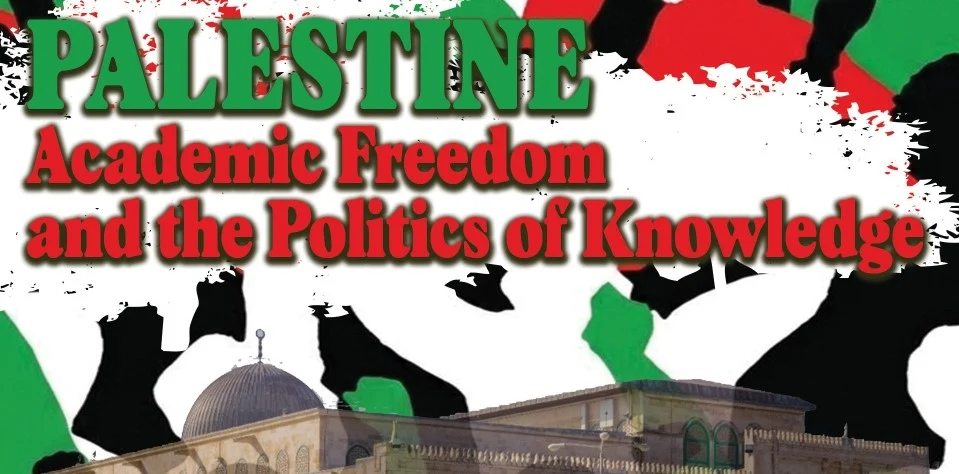
Two recent incidences have reignited the debate surrounding knowledge politics firstly, decision by Springer Nature to retract a peer-reviewed chapter on Palestinian mental health shortly after its publication and the second The Harvard Education Publishing Group cancelled a planned special issue of the Harvard Educational Review (HER) titled “Education and Palestine”. These two incidences have raised deeper questions that extends far beyond a single book chapter or a special issue.
Officially, the publishers argued that the contribution resembled an opinion piece more than a scientific study in the former case and ‘disagreements over copy-editing’ and an ‘overall lack of internal alignment’ in the latter case. However, to quote, The Harvard crimson “authors and editors revealed that the publisher had unexpectedly requested a last-minute legal review by Harvard’s Office of the General Counsel, leading to accusations that political pressure and a ‘Palestine exception’ drove the cancellation.
These episodes raise deeper questions: who determines what qualifies as legitimate knowledge, and under what conditions? Who decides what should be known and what shouldn’t? who controls what can be termed as a bit of new knowledge?
At first glance, this appears to be a dispute about editorial standards. (For the sake of clarity, readers must understand that a retraction in academic world almost all the time results from the fabrication of data or flagging of research design or ethical misconduct, etc. none of the case was reported for the retracted paper).But viewed through a broader intellectual lens, it reveals something more profound about the relationship between knowledge and power in contemporary societies.
The French philosopher Michel Foucault famously challenged the conventional assumption that knowledge exists independently of power. For Foucault, knowledge is never merely a neutral reflection of reality. Rather, knowledge and power are intertwined. Institutions do not simply discover truths; they also participate in defining which truths are recognised, circulated, and legitimised. Every society, Foucault argued, establishes what he called a ‘regime of truth’, a set of procedures, institutions, and practices that determine which voices are considered credible and which are rendered marginal and which needs to be silenced.The controversy surrounding Palestine-related scholarship invites reflection through precisely this lens.
Across many academic institutions in recent years, scholarship dealing with Palestinian experiences has frequently encountered extraordinary scrutiny, which goes beyond conventions. Journal special issues have been cancelled, invited lectures withdrawn, conferences disrupted, and publications subjected to reviews beyond ordinary academic procedures. The issue is not that such scholarship should be exempt from criticism. Academic inquiry thrives on criticism. The concern is whether Palestine has become a subject for which the normal rules of scholarly evaluation no longer apply.
Foucault would likely encourage us to shift attention away from the content of individual publications and toward the mechanisms through which certain forms of knowledge are authorised while others are questioned. The central issue is not whether a particular article, chapter, or argument is flawless. No scholarly work is beyond critique. The more significant question is why certain topics repeatedly become sites of exceptional institutional anxiety.
As the long-held belief of knowledge neutrality, off late, is no more immune to revision and the all three domains of knowledge production, knowledge dissemination and knowledge application are no more a value neutral intellectual exercise. It is now being increasingly embedded within networks of funding, publishing, professional incentives, media attention, political pressures, and institutional reputation. Universities and publishers often present themselves as neutral arbiters of truth. Yet Foucault reminds us that neutrality itself can conceal underlying structures of power. Decisions about publication, circulation, and legitimacy are not made in an intellectual vacuum; they occur within broader social and political contexts.
The Palestine question occupies a particularly sensitive position within global politics. It touches upon competing historical memories, questions of colonialism and nationalism, human rights concerns, geopolitical alliances, and the enduring legacy of historical trauma. Such complexity inevitably generates passionate disagreement. But it is precisely because the subject is contentious that scholarly inquiry becomes indispensable.
Yet a subtle transformation appears to be taking place within contemporary academic culture. Increasingly, the threat to academic freedom does not always emerge through direct censorship. Instead, it operates through anticipation. Scholars begin to internalise institutional sensitivities. Researchers avoid certain topics. Editors become cautious. Publishers calculate reputational risks. Over time, self-regulation achieves what explicit prohibition once sought to accomplish. These are subtle ways to govern and regulate knowledge production and what knowledge is allowed to be produced.
Here again, Foucault’s insights prove remarkably relevant. In his analysis of modern power, he argued that control often functions not through visible coercion but through the creation of norms that individuals voluntarily internalise. The most effective forms of power are those that no longer need to silence people directly because people learn, often unconsciously, which subjects are safe and which are dangerous. This is now evident in the global knowledge landscape particularly in the domains of humanities.
The consequence is not merely the suppression of particular viewpoints. More fundamentally, entire areas of inquiry, risk becoming intellectually impoverished. Alternative epistemologies are marginalised or discouraged. Deeper questions are pushed under the carpet. Certain types of questions remain unasked. Non-Eurocentric perspectives remain unexplored. Subjective experiences challenging the dominant narratives remain undocumented. The result is not the production of knowledge but the narrowing of the field from which knowledge can emerge.
This should concern everyone, regardless of where they stand on the politics of knowledge and of course the politics of Palestine. Probably it’s time to acknowledge ‘Palestine exception’ or ‘cancel culture’ in academia when it comes to intellectual activism surrounding Palestine.
History demonstrates that many ideas now regarded as legitimate scholarly subjects were once considered controversial or unacceptable. Research on colonial violence, racial discrimination, gender inequality, and state repression frequently faced institutional resistance before becoming established areas of inquiry. Academic progress often depends upon the willingness to investigate realities that existing power structures find uncomfortable.
For this reason, the response to controversial scholarship should ordinarily be more scholarship. Weak arguments should be challenged through stronger arguments. Methodological flaws should be exposed through rigorous critique. Evidence should be answered with evidence. The academic community possesses established mechanisms for precisely this purpose.
What should worry us is the growing perception that some subjects are increasingly governed by political calculations rather than scholarly procedures. Once institutions begin to evaluate research according to anticipated power or public reactions rather than intellectual merit, they risk transforming themselves from centres of inquiry into managers of acceptable discourse.The debate over Palestine is therefore not merely a debate about the Middle East. It is a debate about the future of knowledge itself.
Foucault warned that every society produces boundaries between what can be said and what cannot, between recognised knowledge and excluded voices. The responsibility of academia and universities is not to reinforce those boundaries uncritically but to interrogate them. Academic institutions exist precisely because societies require spaces where prevailing assumptions may be questioned.
The ultimate test of knowledge production and academic freedom is not whether institutions protect ideas that enjoy broad approval. It is whether they remain committed to procedural fairness when confronted with knowledge that generate discomfort, controversy, or political risk.
When scholarship on Palestine repeatedly becomes the object of exceptional scrutiny, the issue extends beyond one people, one conflict, or one publication. It becomes a question about whether knowledge production remains committed to the pursuit of truth, free from unnecessary power interference or fear of backlash. Question is whether the boundaries of knowledge are increasingly being drawn by the invisible workings of power or they remain independent?
That, in the final analysis, is the question that should concern us all.
[The writer holds a PhD and currently is Director Centre for Study and Research (CSR) New Delhi whose vision is to evolve a purposeful holistic and Value-based knowledge ecosystem. He researches on science, technology, religion and society and how knowledge ecosystem works.]