

 By THALHA HUSSAIN
Indian Centre for Islamic Finance (ICIF) – headed by its General Secretary Mr. H Abdur Raqeeb and guided by its trustees, who are pioneers in Islamic Finance – had been persistently striving to present interest-free Islamic Finance system as an alternative to the conventional finance system for the past several years. Its relentless efforts and pleas finally got some official recognition.
The Rajya Sabha Select Committee on Insurance Amendment Bill 2008, headed by BJP MP and editor of The Pioneer mentioned ‘Takaful’ (Islamic Insurance) and its benefits if introduced in India, quoting the representatives of ICIF, in its final report tabled in the Parliament during the winter session.
The report couldn’t be taken for discussion due to the chaos and interruption. The bill had been pending since 2008 and was basically meant for raising the FDI cap in Insurance sector from 26% to 49%. It is expected to bring 50,000 crore INR as foreign investment. In Takaful which is a kind of Mutual Insurance risk is shared unlike conventional insurance in which risk is transferred.
This endeavour for this remarkable achievement started with a newspaper ad that appeared in many national newspapers in September 2014. The ad was meant for inviting suggestions and comments from individuals and organisations regarding Insurance Bill. Dr. Sharique Nisar and Mr. Thanveer Mohiyudheen (Both Trustees of ICIF) drafted a representation on behalf of ICIF and mailed the same to the Committee.
Simultaneously, ICIF General Secretary urged other stakeholders and Islamic Finance experts to make their own submissions. Responding to this call, Syed Zahid Ahmad of Economic Initiatives, Dr. Tahir Beg of Muslim Economic Forum, Dr. Abdu Samad from Hyderabad and many other individuals and groups made their representations on ‘Takaful’ before the committee.
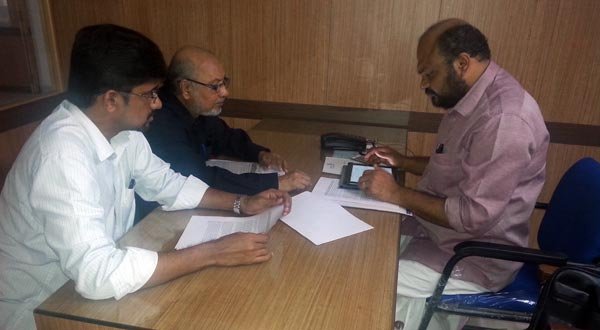
Subsequently, a delegation consisting of Mr. Abdur Raqeeb and Mr. Thanveer Mohiyudheen called on Mr. P Rajeev MP, member of the Select Committee, at Cochin on 30 September 2014. Attracted by the novel concept of Takaful and its potential to bring financial inclusion, he arranged a hearing of ICIF before the Select Committee.
Eventually on 14 October a delegation of ICIF consisting of Mr. H Abdur Raqeeb, Dr. Sharique Nisar and Mr. Masud Wahab appeared before the Rajya Sabha Committee and presented the case of Takaful. Mr. MK Sinha, a nationally known expert in conventional finance was also supposed to join the team but couldn’t reach due to some last minute inconvenience. A hardcopy of the presentation was handed over to all members present. It should be noted that around 700 representations were submitted by various organisations and only five were invited for appearing before the committee in Parliament Annex. ICIF was one of them.
The next strategy was to meet influential MPs within the committee and try to persuade them. As a result, there were two meetings with Mr. KC Tyagi, MP (Secretary General JDU) and a discussion with Mr. Naresh Gujral, MP. Mr. Rajeev Chandreshekar, the influential MP from Bangalore, assigned his analyst Mr. Vikram Bhattacharya to have a detailed deliberation with ICIF. It was really heartening to know that Mr. Chandreshekar had even done a research on Takaful before the hearing sitting in Parliament Annex.
Efforts of eminent journalist Mr. AU Asif needs special mention in this regard. It was he who arranged the meetings with Mr. KC Tyagi, MP, which turned out to be very fruitful. Despite his busy schedule, he found time to accompany the ICIF delegation to meet the MP and took part in the long deliberations.
Meanwhile, Mr. Chandan Mitra had asked to submit a brief summary of the submission made before the committee. Dr. Sharique Nisar, with his explicit drafting skills, once again prepared a concise report and mailed it to every member of the Committee.
At the end of the day, after all these efforts the suggestion made by ICIF was prominently mentioned in the report which was tabled in Parliament. The future of the report may be uncertain. But it doesn’t degrade the significance of this achievement. The lesson we draw is that in a democratic country, in order to present our case, multidirectional and multidimensional efforts with proper documentation and political support are needed.
An extract of the report tabled in Parliament is hereunder:
14.5.2 A representative of the Indian Centre of Islamic Finance apprised the Committee about the benefits of the ‘Takaful’ system of insurance as compared to the conventional system of Insurance. He stated that the ‘Takaful’ system is based on the mutual co-operation, responsibility, assurance, protection and assistance between groups of participants and across the globe 26% to 33% of insurance comes from such mutuality and cooperation. He suggested that in addition to the conventional system, the other systems of insurance viz.‘Takaful’ should be also allowed to promote competition, diversity and to stop fraudulent activities that has been reported in conventional insurance business. He submitted that homogenization of insurance industry is not good for the country and all kinds of structures and products that are possible to help financial inclusion of people must be looked into. The representative pointed out that the GIC is offering Islamic Insurance in the middle-east countries and is doing good business there. He however added that before its introduction, the aspect of regulatory gap may also be looked into, as many insurance companies are offering products without registration. He suggested the hybrid model of Islamic insurance existing in almost 75 countries, especially in the middle-east, which can bring huge investments in the country from a large number of Islamic Insurance Companies, must be explored.