

 The student movement that began as a demand for accountability over the alleged leakage of the National Eligibility-cum-Entrance Test (NEET) examination papers evolved into one of the most significant youth-led protests in recent years. For 49 days, thousands of students and young people, supported by the Cockroach Janata Party (CJP), staged demonstrations demanding the resignation of Union Education Minister Dharmendra Pradhan, arguing that the integrity of India’s competitive examination system had been severely compromised.
The agitation reached a dramatic turning point on July 20, when protesters attempted to march towards Parliament after accusing the Narendra Modi government of ignoring their repeated appeals. What followed has become the most significant chapter of the movement. Protesters alleged that the Delhi Police and Rapid Action Force (RAF) used unprecedented force, including pellet guns, nail-studded lathis, electric shock batons, tear gas, and physical assaults by unidentified men in plain clothes, to disperse an unarmed crowd. While the police maintained that only around 60 people were injured, students and volunteers claimed that well over 100 protesters required medical treatment at hospitals across the national capital.
The student movement that began as a demand for accountability over the alleged leakage of the NEET examination papers evolved into one of the most significant youth-led protests in recent years. For 49 days, thousands of students and young people, supported by the Cockroach Janata Party (CJP), staged demonstrations demanding the resignation of Union Education Minister Dharmendra Pradhan, arguing that the integrity of India’s competitive examination system had been severely compromised.
The allegations go beyond the question of excessive force. Videos and photographs circulated widely on social media appeared to show plainclothes individuals operating alongside uniformed police personnel and allegedly assaulting demonstrators. Their presence has raised troubling questions about legality, accountability, and transparency. If these individuals participated in law-enforcement operations, under what authority were they acting? If they were not police personnel, why were they allowed to use force against civilians?
The controversy has also revived memories of Jammu and Kashmir, where pellet guns were first deployed extensively for crowd control following the unrest of 2016. Human rights groups have long documented the devastating consequences of those weapons, including deaths and permanent blindness. The alleged use of similar methods against students protesting in the national capital has therefore generated fresh debate over the limits of police powers in a constitutional democracy.
Drawing upon eyewitness testimonies, medical records, hospital documents, media reports, and statements from political leaders and civil society groups, this investigation reconstructs the events of July 20, examines the allegations surrounding the police operation, and explores the legal and constitutional questions raised by the use of force against peaceful demonstrators. It also tells the stories of those who suffered serious injuries during the crackdown – young citizens whose only demand was accountability in India’s education system.
Although the student and youth movement led by the CJP ultimately succeeded in securing the resignation of Union Education Minister Dharmendra Pradhan on the 49th day of its agitation, July 25, the victory came at a considerable human cost. Five days earlier, on July 20, the police used force to stop a march towards Parliament after the Narendra Modi government continued to reject the protesters’ demand for the minister’s resignation. The demonstrators held Pradhan politically accountable for the alleged leakage of the NEET examination papers, arguing that the incident reflected serious failures in the conduct and integrity of one of the country’s most important competitive examinations.
 While the police maintained that around 60 students were injured during the crackdown, student organisers disputed the figure, claiming that more than 100 protesters were admitted to various hospitals across the national capital, including Dr. Ram Manohar Lohia Hospital, Lady Hardinge Medical College and Hospital, and other government medical facilities. If these accounts are accurate, they suggest that the number of those injured in the police action was significantly higher than the official estimate.
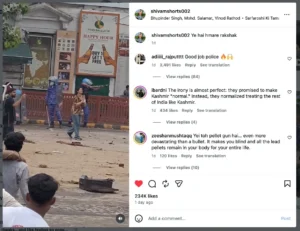
According to protesters and several eyewitness accounts, the July 20 crackdown marked the first reported use of pellet guns, nail-studded lathis, and electric shock batons against youth and student demonstrators in Delhi. Protesters also alleged that individuals in plain clothes took part in the operation, assaulting demonstrators and causing serious injuries. Videos and photographs that circulated widely on social media appeared to show several men in civilian clothing standing alongside police personnel and, in some instances, allegedly attacking protesters while uniformed officers looked on. Although the identities and official status of these individuals could not be independently verified, their reported presence raised serious questions about the conduct of the police operation.
If such individuals were indeed involved in crowd-control operations, important questions arise regarding the legal basis of their deployment. Under what authority were they operating? How could members of the public distinguish authorised law enforcement personnel from private individuals? The participation of unidentified plainclothesmen in policing protests raises serious concerns about transparency, accountability, and the rule of law.
The alleged use of plainclothes individuals generated widespread anger not only among the protesters but also among the general public. It sparked public outcry, with protesters accusing the police of allowing anti-social elements associated with certain groups to attack unarmed demonstrators in an attempt to suppress the agitation against the BJP government.
Similar allegations had surfaced earlier in Kashmir following the abrogation of Article 370 in August 2019, when plainclothes personnel were reportedly deployed to assist in controlling public protests. Cockroach Janata Party warned that the use of ‘officers’ in civilian clothing could enable criminal elements or individuals affiliated with political groups to assault protesters while masquerading as law enforcement personnel. Responding to these concerns, the Delhi Police Commissioner publicly stated that no police personnel in plainclothes would be deployed at Jantar Mantar or at locations where CJP volunteers organised demonstrations.
The alleged deployment of plainclothes individuals also drew sharp political criticism. Samajwadi Party president and former Uttar Pradesh Chief Minister Akhilesh Yadav who condemned the practice, comparing such groups to Adolf Hitler’s Sturmabteilung (SA), commonly known as the Storm Troopers. Questioning the government’s actions, he asked, “Has the BJP formed such gangs?”
The Kashmir Precedent
Pellet guns were first used in Jammu and Kashmir in 2016 as a crowd-control measure, leaving hundreds of civilians with injuries, including permanent blindness in many cases. At the time, however, there was little nationwide public outrage or debate over the use of pellet guns because the victims happened to be Kashmiri Muslims. The issue did not receive the attention it deserved because of the highly polarised political atmosphere, which discouraged debates on police excesses. Public discourse across much of the country was marked by intense communal divisions, with anti-Muslim rhetoric becoming increasingly common in political debates and public conversations. In such an atmosphere, voices questioning the state’s use of force in Kashmir remained very limited.
However, the issue gained international attention after the Jammu and Kashmir government released official figures on deaths and injuries caused by pellet guns. According to government data, 17 people died from pellet injuries between July 2016 and January 2017. Data from the Jammu and Kashmir Human Rights Commission showed that 1,726 people were injured by metal pellets in 2016. In January 2018, then Chief Minister Mehbooba Mufti informed the Jammu and Kashmir Legislative Assembly that 6,221 people had been injured by pellet guns between July 8, 2016, and February 27, 2017. Of these, 728 suffered eye injuries, while 54 reportedly lost their eyesight.
Why the Allegations Matter
If metal pellets were indeed used against protesters in Delhi, it would be deeply disturbing because the demonstrators were peaceful. The protesters, mostly young men and women concerned about their future in the wake of alleged irregularities in national-level examinations, deserved sympathy, not force.
According to accounts of the protest, the demonstrators were unarmed, did not attack the police, and caused no damage to public or private property. They were marching peacefully towards Parliament in the Gandhian tradition to draw the government’s attention to what they viewed as the growing crisis facing the country’s youth and the Centre’s failure to address their concerns. The march was organised after repeated appeals went unanswered, even as environmental activist Sonam Wangchuk had been on a hunger strike for more than three weeks in support of the students’ demands.
Shock Batons and Mystery of Plainclothes Men
According to multiple accounts of the protest, personnel from the Delhi Police, the Rapid Action Force (RAF), and several individuals in plain clothes accompanying the police used shock batons to beat protesters, including young men, women, and even minors. Witnesses alleged that some of the plainclothes individuals were not attempting to disperse the crowd but were directly assaulting protesters while uniformed police personnel looked on.
These allegations also raise concerns about the presence and role of unidentified individuals during the police operation. In the landmark D.K. Basu v. State of West Bengal (1997), the Supreme Court laid down guidelines requiring police officers carrying out arrests to be clearly identifiable, wear name tags, and display their identities so that they can be held accountable.If plainclothes individuals participated in the use of force, questions naturally arise regarding their authority, accountability, and compliance with these principles.
Three Youths Sustained Pellet Injuries, One Rubber Gunshot
As many as three youths, namely 25-year-old Irshad Shaikh, a resident of Jabalpur in Madhya Pradesh and an MBA from Indore; Vikas Patwal, a photo-journalist working with Outlook magazine; and a 19-year-old youth Sahil Lochrab are reported to have sustained pellet injuries. A 32-year-old Nootan Toppo was hit in her right ear lobe by something like rubber gunshot.
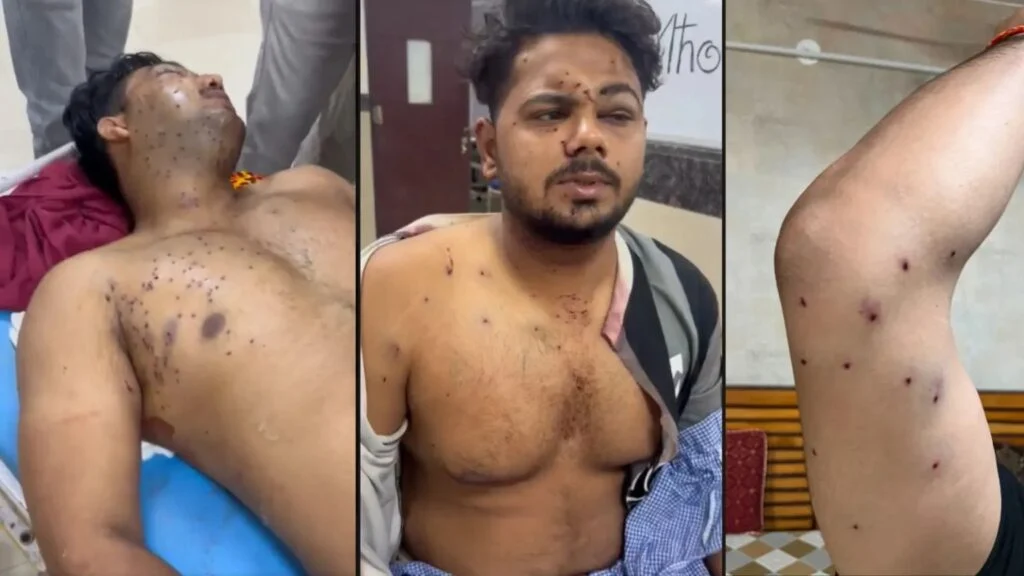
Irshad Shaikh: Irshad told a leading English daily that he was among the participants in the CJP’s Sansad Chalo (march to Parliament) on July 20. According to him, he sustained multiple pellet injuries after being shot by a personnel of the RAF during the police action. Following the incident, he was admitted to Lady Hardinge Medical College and Hospital, where he underwent treatment for his injuries.Irshad said he reached the protest site near Kerala Bhawan at around 9 a.m. and remained there until about 11 a.m. He then left to attend an online office meeting from 12:30 p.m. to 3:30 p.m., returning to the protest venue after it concluded.
Describing the events that followed, Irshad told The Indian Express: “I was walking with other protesters near Jantar Mantar when security personnel suddenly began lathi-charging the crowd. We stepped back, but the police then started firing tear-gas shells. My eyes began to burn, and for a moment everything went blank. When we turned around, we found that the police had blocked our way, so we stopped. I walked up to the police and pleaded with them, saying, ‘Sir, please do not beat us. We are students. We are citizens of this country. We are not terrorists.’”
According to Irshad, an RAF personnel then stepped in front of him carrying what appeared to be a pellet-firing weapon. He said the officer initially displayed the weapon, leading him to believe it was merely intended as a warning and would not be used. However, moments later, the uniformed personnel allegedly aimed the weapon directly at his face and fired.
Irshad said he was struck by multiple pellets. According to his account, pellets hit his face, piercing the area around his right eye, cheek and nose, while others struck his chin, neck, shoulder and chest. He recalled tasting blood in his mouth and, when he touched his face, finding blood streaming from several wounds. Around him, he said, he heard the sound of lathi-charge and the cries of fleeing protesters.
Despite his injuries, Irshad said he managed to remain conscious and composed. He walked away from the scene on his own before a bystander came to his aid, placing a cloth over his bleeding face and helping him out of the crowd.
According to Irshad, he sustained the pellet injuries at around 3:30 p.m. and reached Lady Hardinge Medical College and Hospital at approximately 5 p.m., nearly an hour and a half later. Doctors informed him that he had suffered pellet injuries to his face, eye and neck. As surgeons were not available that evening, he was given painkillers and kept under observation. He underwent surgery on July 21 afternoon.
Doctors told him that one pellet was lodged near the muscle controlling the movement of the left eye, another was lodged in his neck, close to a major nerve and blood vessel and a third pellet was near his nose.
Irshad said Union Health Minister J. P. Nadda visited him at the hospital on July 21, a day after media reports, including one published by The Hindu, published news stories that RAF personnel had used pellet guns during the protest. According to Irshad, the minister assured him that the government would ensure he received proper medical treatment. During the interaction, however, Nadda also asked him why he had chosen to participate in the protest. Irshad said he replied that he considered it his responsibility to join the demonstration because he believed in the cause.
Irshad described his participation in the protest as consistent with his commitment to helping others. Just a week earlier, on July 13, he had donated blood for a 10-year-old cancer patient undergoing treatment at a hospital in Gurugram.
Vikas Patwal:Photojournalist Vikas Patwal of Outlook magazine was another person who reported sustaining pellet injuries during the police action. Recounting the incident to media persons, he said he was standing near the Statesman building in Connaught Place when security personnel began firing tear-gas shells. As the gas spread, he experienced a burning sensation in his eyes and moved away from the area. Out of curiosity, he turned back to see what was happening and was suddenly struck by an object. It was only afterwards, he said, that he realised he had been hit by pellets.
His medico-legal certificate (MLC) recorded that Vikas had been ‘assaulted’ by a pellet gun at approximately 4:00 p.m. on July 20. The MLC documented multiple symptoms, including pain at the injury sites, abdominal pain, vomiting, and seizures. It also noted the presence of small puncture wounds on his arm, injuries consistent with pellet gun impact.“It looked like metal pellets to me, which was later confirmed by the medical reports from Safdarjung Hospital,” Vikas told The Indian Express.
Exhausted after the incident, Vikas returned home and sought treatment at a private hospital the following day. Due to the nature of his injuries, he was referred to Safdarjung Hospital where doctors informed him that surgery to remove the pellets lodged in his arm was not medically necessary, as they were unlikely to cause permanent harm, although they could continue to cause pain. He said that doctors at Lady Hardinge Medical College and Hospital gave him the same advice.
Sahil Lochrab: A resident of Najafgarh on the Delhi-Haryana border, 19-year-old Sahil sustained pellet injuries in his right eye. Like others, he had come to participate in the protest for educational reforms in the country. He was standing near Palika Bazar when a pellet was fired at him, hitting him in his right eye. He was first rushed to the Lady Hardinge College and Hospital, which is nearest to the place of the incident. However, he was shifted to AIIMS and operated upon the next day. The pellet was removed, but doctors said some damage has been done to the eye and it requires a second surgery after some time. Sahil comes from a poor economic background. His father drives a taxi, and his mother does odd jobs to meet the family expenditure. He is the eldest of three brothers.
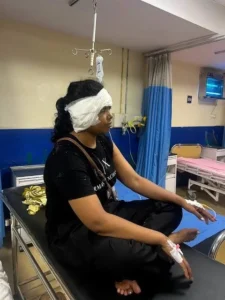
Nootan Toppo: Another victim of police crackdown was a 32-year-old woman, Nootan Toppo, who was admitted to Ram Manohar Lohia Hospital after a gunshot injury in her right ear. Her medico-legal certificate(MLC) mentions suspected gunshot injury. The MLC says that her injured ear was treated by a plastic surgeon team. The MLA says she was suffering from chest pain, bleeding and vomiting when she came to the hospital. She told mediapersons that she was at the protest site since 10 in the morning. The protest was going on peacefully but the police started attacking protesters at around 5 pm. The police also fired tear gas shells. According to her, there was also firing from some kind of gun. She looked for a safe place to hide. In the meantime, she was hit by something like a rubbergunshot in her right earlobe. She was taken to RML Hospital, where doctors performed ear surgery. She says she has suffered hearing loss in her right ear.