

Physics is all around us. It is in the electric light we turn on in the morning; the car we drive; our wristwatch, cell phone, CD player, radio, and so on. It makes the stars shine every night and the sun shine every day, and it makes a football soar into the field. Physics is the science of matter, energy and the interactions between the two. Within this framework, physics encompasses essentially all of nature: the laws and properties of matter and the forces acting upon it.
The term physics comes from the Greek words: φύσις (phúsis) meaning nature and φυσική (phusiké) meaning knowledge of nature. Physics explains the structure of matter. It describes the different forms of energy and how one can be converted to another. It also explains the astronomical phenomenon such as the phases of the moon and the eclipses, shining of the stars and so on.
There are many fields of physics, for example: mechanics, thermodynamics, electricity, heat, sound, light, condensed matter, atomic physics, nuclear physics, and elementary particle physics. Physics is the foundation of all the physical sciences – such as chemistry, material science, and geology – and is important for many other fields of human endeavour: biology, medicine, computing, space travel… the list goes on and on.
Energy technologies are deeply rooted in the science of physics. Physics provides the theoretical foundation for essentially all of the technologies and processes involved from resource exploration and extraction, conversion, transmission and distribution, to providing the energy services demanded by our societies. Physics has made numerous contributions to the global economy in areas such as electronics, materials and computer technology, and to health through x-rays, synchrotron radiation, magnetic resonance imaging and nuclear medicine.
The Arabs made numerous contributions to science on the medieval era (8th to 13th centuries). Among the various physics disciplines the most significant contributions were made in the field of optics. Abu Ali al-Hasan Ibn al-Haytham (965-1039, the Latin name is Alhazen) made the first significant contributions to optical theory since the time of the Alexandrian astronomer Ptolemy in the second century. Ibn al-Haytham changed the course of optics by establishing experiments as the norm of the proof of the field. His optical theories rested on qualitative laws and quantitative rules derived from experiments, which he performed with an instrument that he designed and built himself.
In order to settle the long-standing debate over how vision worked, Ibn al-Haytham pioneered an experimental set-up of surprising simplicity: the pinhole camera (camera obscura). The pinhole camera became a standard method for generations of physicists after Ibn al-Haytham. Isaac Newton, for example, used it to conduct his famous prism experiment in which he analysed the decomposition of white light into basic colours. The pinhole camera is the basic principle behind all photography from the earliest to modern-day digital cameras.
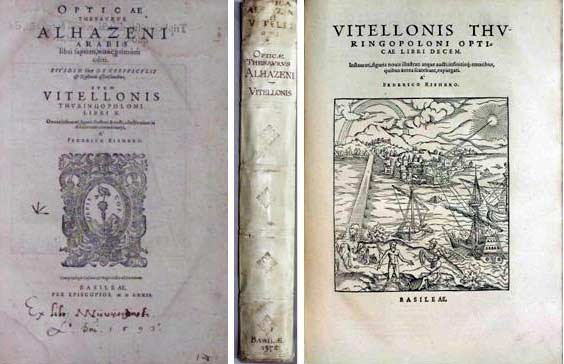
Ibn al-Haytham “enunciated that a ray of light, in passing through a medium, takes the path which is the easier and quicker.” In this he was anticipating the “Fermat’s Principle of Least Time” by four. Ibn al-Haytham also explained the working of lenses and, formation of the rainbow and numerous optical phenomena. His magnum opus Kitabl al-Manazir (Book of Optics) earned him the title of father of optics. Ibn Haytham’s book was translated into Latin in around 1230 as Opticae Thesaurus Alhazen, and many prominent European scientists including, Roger Bacon (1214-1292), Leonardo da Vinci (1452-1519), Johannes Kepler (1571-1630), René Descartes (1596-1650), Isaac Newton (1643-1727), and many others benefited from his theories in optics and other fields.
As reported in this magazine earlier, Ibn al-Haytham is being celebrated during the United Nations designated Year 2015 as the International Year of Light and Light-based Technologies. As part of this celebration, UNESCO is holding a two-day conference entitled, “The Islamic Golden Age of Science for Today’s Knowledge-based Society: The Ibn Al-Haytham Example”. It is from 14-15 September 2015 at the UNESCO Headquarters in Paris, France.
[The writer teaches at Department of Mathematics and Sciences, Dhofar University, Salalah, Sultanate of Oman. rohelakhan@yahoo.com]