

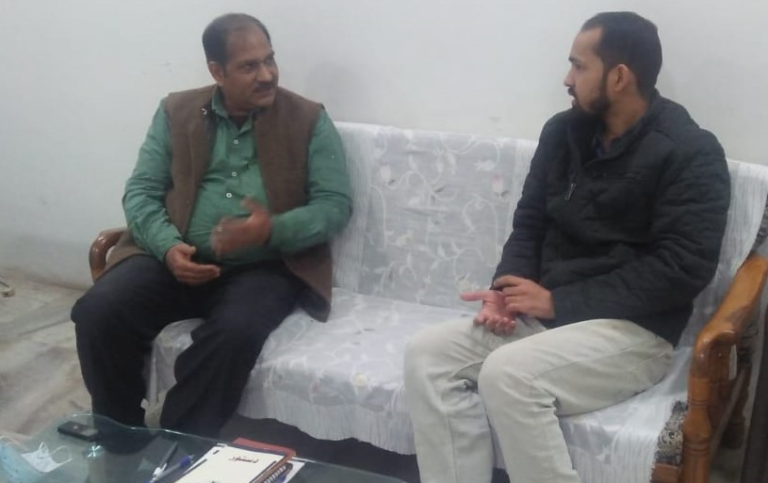
MOHAMMAD SALMAN AHMAD is the newly elected national president of Students Islamic Organisation of India. Earlier, he was state president of SIO South Maharashtra during 2017-2020. He was president SIO Mumbai (2015-2016) and State Campus Secretary, SIO South Maharashtra (2013-2014). He did his B.E (Civil) from Pune and M.E (Construction Engineering and Management) from Mumbai. In an interview with MOHD NAUSHAD KHAN, he said the very idea of dividing people on religious or geographical lines may give short term political benefit but in the long term it will break the ethos of the country.
In view of the present atmosphere in the country, what do you think are the challenges before SIO?
I think there are so many challenges. The biggest one is polarisation, communalism and Islamophobia. Second is the moral crisis, which is rampant in the country; and degradation of educational values and ethos. Most of our youth do not have vision of opportunities. Moral crisis is also there. These are the major challenges we are facing right now.
What would be the focus area of SIO under your leadership?
I think major focus area will be Human Resources Development, which will help develop the society as well as the community. Second is to develop ideological soundness, Islamic understanding and engaging with different domains and issues with Islamic perspective. Along with that we are focusing on engaging with the issues of privacy and technology as well as the environmental crisis. These are the two new policies which we are introducing.
As a student leader representing students, how do you think the potential and energy of youth can be channelised towards nation building?
A far as our country is concerned, I think around 60-65 per cent people are below 30-35 years of age; so we are the youngest nation. Youth have so much potential but the basic crisis is that they don’t have clarity about their lives. Most of the people don’t realise the importance of time. They don’t have opportunities. The very question of idea of existence is not there. People don’t know who created them, why He created them and what is the purpose of life and what they are going to do. There are so many petty political issues becoming dominant while the real issues are getting neglected. I think the biggest challenge before us, youth and everyone is that they must realise the idea of existence and what is the purpose of their life.
Most of the people don’t bother about the question of religion. Religion, as far as our ideology is concerned, is not a ritual but a complete way of life. We believe that if people engage with the religion of Islam, they will realise that it is a complete way of life and by practising Islam in all walks of life – not just in the context of spirituality but on economic, social and political fronts – we can develop a better society. I think one major challenge as far as youth is concerned is that they don’t see religion as the key factor; they see religion as a tool for fanning polarisation and politics. But we want to create a space for religion and religious dialogue and thereby we can have a basic paradigm shift that can help build a positive narrative and channelise the energy of youth.
Youth are now a dominant political force in the country. What, according to you, should be done to make them a powerful social force as well?
I think when we talk about politics, people think that only electoral polity is politics. But I believe non-electoral politics is more important than electoral politics. Electoral politics can be a part of politics but the very idea of politics is about having an idea that can make the world an abode of peace. So I think when our engagement with politics is concerned, we must think that apart from electoral politics, we should engage in non-electoral politics as well.
When we talk of non-electoral politics, it can be grassroots social work, public relations, lobbying, advocacy, working for human dignity, human rights, working on the very basic issues of access and equity as far as education is concerned, public distribution system, fundamental rights, etc. Each and every individual, in his own capacity, can work in his surrounding and campus and through that we can move forward. People need to be mobilised for a cause. They need to associate themselves. We see that most of the youth are becoming self-centred, self-obsessed and technology is playing a very vital role. We believe that the sense of belonging and accountability must be developed and through that we can mobilise them for a political cause also.
As President of a students organisation, are you satisfied with the New Education Policy?
I think there are so many positive things. However, there are a few issues that need corrective measures. For example, when you talk about introducing the Indian culture, the question is how you define the Indian culture. Also, the vey project of rewriting history is very problematic. Similarly, the question of morality and ethics is lacking in our education system. The very basic question is how it is going to be implemented. We don’t have infrastructure, support mechanism, proper training mechanism. There are so many posts still lying vacant. So many teachers are working on contract basis. The Government is continuously reducing the funds allocated for education.
Even IITs and IIMs are facing financial hurdles. I think in this particular scenario, the bigger question is whatever policy has been made what efforts would be made to implement it. Similarly, it appears that our entire education system is market-driven. The very idea of HRD or Education Department is that of corporate houses and you want to create a workforce for them. The entire education system is being designed to fulfil their needs. This very idea of education is problematic. We need to rethink that idea too so that education is not only for job creation; it must have humane touch.
Would you like to make any specific demand in the upcoming budget for educational sector?
Our Centre for Educational Research is working on that; thereafter we will be able to make specific demands. But by and large we believe that the first and foremost the government must increase the budget. Kothari Commission and other commissions have recommended that 6 per cent of the GDP must be spent on education. Fellowship for research and development and higher studies must be ensured. It is more than 10 years that RTE was implemented but in most of the institutes and in most of the states there is no provision of teacher-students ratio or about infrastructure or quality of education. So RTE is also problematic in terms of specifications as far as its execution is concerned. Maulana Azad fellowship issue is there. Our centre is working on that and I think very soon we will be rolling out our demands.
Keeping in mind the pandemic and post-Covid challenge, do you think the government should focus more on healthcare?
Yes, sure. I think for the last 6 to 8 years we are making a demand that each government hospital must be converted into a government medical college and that is what I think is the basic need. Throughout the pandemic we have seen that we need doctors in rural areas. Now what the government has done is that after the completion of PG, one has to serve the rural areas. But I think it is not enough. Our education system is getting privatised; it is becoming a commercial commodity and people are looking at it as a commercial commodity. And to ensure that, the government is slowly killing the public sectors and they are privatising everything. But we think that at least education must not become a commodity and for that the government has infrastructure, budget and they have district hospitals in each district. We believe that if every district hospital is converted into a medical college, in the next 10 to 20 years we will have a sufficient number of doctors who can serve the entire country.
Finally, what do you think are the challenges before our country?
The issue of polarisation is the biggest challenge we are facing today. The government and the government agencies are continuously pushing their agenda of hatred and fascism. I think in the long term it is harmful to both. It is harmful not only for minority but majority also. We talk about making India a Vishwa Guru or we want to make our country great, but they are pushing the entire 20 to 25 crore minorities to the wall. And see right now the issue of farmers’ protest and so on. The very idea of dividing people on religious or geographical lines may give short term political benefit but in the long term it will break the ethos of the country. In this regard, each and every one of us must be conscious and try to build communal harmony. And through dialogue we must come together and move forward to make India a better country.