

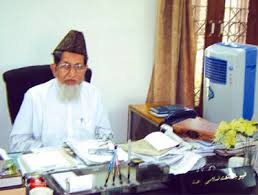
MAULANA SYED JALALUDDIN OMARI, Amir Jamaat-e-Islami Hind, in an interview with Urdu monthly Zindagi-e-Nau (August 2014), dwelt upon the scenario prevailing in the country following the recent Lok Sabha elections and suggested the course of action for the citizens, especially the Muslims in the present circumstances. The first part of this interview was published in the last issue dated 17-23 August 2014. – Ed.
What are the grave challenges to Indian Muslims in the present scenario?
The challenges facing the Indian Muslims are not new; the present situation has simply increased its intensity. Two of them are mentioned here:
1. Generally Muslims are unaware of Islamic teachings. The efforts being made by Muslims in this regard are insufficient. Islamic unawareness is keeping them from Islam. Besides, there is no mention of Islam in the present education, literature and media; if ever, it is mentioned in a negative way. This is why even if a Muslim is not alienated from Islam, he does not feel any attraction towards Islam, and he has only customary association with Islam. The need is to make the teachings of Islam public among the entire Muslim community and the association of Muslims with Islam also needs to be consolidated. This work demands long term planning; moreover, possible strategy should be made for this.
2. The western culture is prevalent all over the world. It is ruling the roost everywhere. Indian Muslims too have adopted this civilization. Efforts are being made to promote a particular culture of Hindutva in the present scenario. Its thrust is more on religion and belief than on the ways of dressing, appearance and food habits. Muslims too are being impressed with it. The need is to be careful about it. Islam has its own viewpoint on culture and civilization. It does not destroy the civilization and traditions of any country or region; but it does keep its followers subservient to its beliefs and teachings. Indian Muslims too adopted the ways prevalent here but remained firm on their belief.
What is the attitude the political parties in the country espoused toward Muslims?
It is a fact that the political parties in the country take Muslims as mere vote bank. They have no interest in their problems. Even if they take interest therein, it is only to the extent that they want to come to power with their support. For this too, they read the pulse of the majority so that the latter might not get away from it. The Sachar Committee has said with statistics that in certain respects Muslims are more backward than OBCs. If political parties had any interest in the problems of Muslims, perhaps the condition of Muslims might not have been that appalling. It is hard to say about any party that it takes the problems of Muslims with sympathy and is making sincere efforts to better its condition.
What course of action should Muslims take for their educational and economic progress?
Education is the natural right of every person. But for it neither he can progress nor can he attain status in society. It is a fact that Muslims lag far behind others in the field of education. The former government passed Right to Education Bill; Muslims should benefit from it. Our problem is that students do not get Islamic education at government schools; rather Deen becomes alien to them. There are a number of great madrasas where Islamic education is imparted. In general, the graduates of these madrasas render the duties of representing the Deen. Apart from it, they render other services too. But, as the statistics says, only 4 per cent of Muslim students benefit from these madrasas; the rest of them get education in secular schools. Morning and night madrasas and Makatib are running at different places to impart Islamic education for them. They do provide basic knowledge of Deen, but the demands of Deeni education are not fulfilled. It needs a very detailed programme.
The institutions to be established, or those already present, for modern education should not have the facility for Deeni education in a casual manner as it is seen till now; rather it should be given due place in course. Students as well as teachers should not take it as something casual rather give it the status it deserves. There is no doubt that some institutions do make efforts for it. The institutions established by Jamaat-e-Islami Hind care for it; but its demands are more than this. The entire Ummah will have to pay attention to it. If it wants, it can establish a network of such institutions all over the country, in which Deeni education gets due place along with modern education.
But in spite of this, it cannot be expected that the direction of Muslim students will change with it and such institutions will produce representatives of Deen. The entire education system will have to be changed according to Islamic guidance and modern demands and a new education system will have to be established. This is a long term planning; it has not been experimented anywhere which can benefit us. In the present scenario, we are not in a position to implement any new education system. So, whatever we can do is to give Islamic education due place in the present education system and some of the graduates therefrom should be prepared for the service of Deen. This issue needs deep thinking and planning.
Economy is also related to education. But for it economic development can hardly be imagined. The concept of government and non-government employment comes along with education. Its opportunity is limited. Besides, the sources of earning are open more for the educated than for the uneducated. There are talented and educated Muslim youth, who, if given financial assistance, can stand on their feet; moreover, they can help others. Islam has given importance to both health and finance and enjoins us to make full use of them. It encourages individuals for economic struggle and creates in them the passion for tireless strivings so that they should do possible struggle with proper means for himself and those dependent on him. It recognises it as a pious and rewarding work. Sometime, there is negligence on the part of an individual towards doing what is required of him or what he can do; therefore, he gets economically weak rather stands in need of help from others.
Moreover, Islam creates an atmosphere of sympathy in society that those who are unemployed should be provided with employment. There is no doubt that some persons and institutions are struggling for it, but in view of the intensity of the issue, the efforts being made in this regard are very little.
If the entire Ummah decides that its able persons will not remain unemployed, then the ways for its financial betterment will open. But, there is no such broad and comprehensive plan before the Ummah. It must be contemplated on.
What comes in the way of unity among Muslims? How can it be overcome?
Allah the Almighty has created all Muslims as an Ummah. The Prophet of Allah (peace and blessings of Allah be to him) called it a ‘single body’ that if one part of the body gets harmed, the whole body feels its pain and becomes restless. The belief of this Ummah is one, its prayers are common and its loss and benefit are also common. Therefore, it has been enjoined to stand united and keep from conflict and clash. But with the passage of time, it kept on being divided into different lingual, jurisprudential and sectorial groups. The differences among them have intensified to the extent that it is hard to eradicate them. Despite this, the realisation is there that we should stand united. No distinguished personality or organisation has any difference on the issue. Everyone realises that division has weakened us and that our weight is not being realised.
The basis of unity of this Ummah is its purpose of life. The Holy Qur’ān clearly said that this Ummah has been created for enjoining good and prohibiting evil. It has to accomplish the duty of standing witness to the Truth. If this purpose is in view and we work broadmindedly and make sincere strivings, the ways for unity can be paved despite differences and divisions.
There are also jurisprudential differences. There is also intensity in these differences although these differences are superficial and there is no room for immoderation therein. If the mission of the Ummah is in view and the passion for unity is present, despite these differences we can walk together. Jamaat-e-Islami has tried in its own circle to unite the Ummah on its purpose of life, keeping jurisprudential differences aside, and is successful to a great extent. People belonging to different sects such as Hanafi, Shafai and Ahl-e-Hadees are striving together for the cause of Islam and Islamic Dawah.
A united stand should be taken on the Muslim issues of national importance. It has been experimented in the form of Muslim Majlis-e-Mushawarat and Muslim Personal Law Board. People from different schools of thought are associated with them. The positive results of it are also there. The need is to widen the scope of these organisations and consolidate them. For the issues that fall out of the pale of these organisations, another common platform can be contemplated. The Jamaat welcomes united struggle in these issues and is ready to extend cooperation in every manner.
(concluded)