

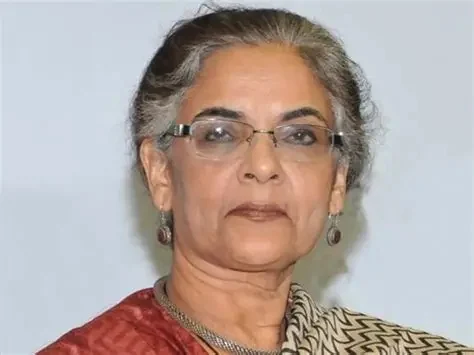
A lecture by Prof. Zoya Hasan, professor at Jawaharlal Nehru University (JNU), on the importance of pluralism in India was cancelled at Sardar Patel Vidyalaya in New Delhi after VHP men reportedly gathered outside the school and demanded that she should not be allowed to address the students.
Hasan had been invited as the chief guest for the school’s Independence Day function. However, according to an account accompanying the speech, the programme was disrupted after dozens of VHP members assembled outside the school and created a commotion, eventually forcing the school authorities to change the chief guest at the last minute.
Unable to deliver the address in person, Hasan later released the speech, saying she wanted her message to reach the children, their parents and families.
The controversy came at a time when the country was preparing to celebrate its Independence Day, with the national flag and patriotic programmes marking the anniversary of India’s independence. Hasan’s proposed speech titled “Why Pluralism Matters”, focused on what has enabled India, despite its extraordinary diversity, to remain a single political and democratic community.
At the heart of her released speech was the argument that India’s unity has historically depended not on uniformity but on the accommodation of differences. Hasan described India as “the world’s most diverse and comprehensively plural society”, pointing to its multitude of religions, languages, castes, tribes, communities, customs and ways of life.
She argued that diversity is visible in everyday Indian life, noting that many households routinely use two or three languages. She also referred to the national anthem, which brings together the names of different regions of the country, as an expression of India’s plurality.
A key distinction in Hasan’s speech was between diversity and pluralism. Diversity, she argued, is a social fact because different communities, languages, religions and cultures exist within India. Pluralism, however, is more than simply acknowledging that differences exist.
For Hasan, pluralism is a political and ethical commitment to equal rights, dignity and opportunities for every citizen. It means that no religious, linguistic, caste or cultural identity should receive a privileged status over another in determining a citizen’s place in the republic.
She argued that India’s ability to remain united has been closely linked to this understanding of citizenship. Rather than requiring citizens to abandon their individual identities, the constitutional framework allows people to retain their differences while belonging equally to the Indian nation.
Hasan’s speech placed the Constitution at the centre of India’s pluralistic framework. She linked pluralism with the constitutional principles of liberty, equality, justice and fraternity.
According to her, the Constitution created an understanding of citizenship that is civic rather than religious or ethnic. Every Indian, regardless of religion, caste or language, is supposed to enjoy equal membership of the republic.While acknowledging that Indian secularism has been interpreted in different ways, Hasan argued that its central principle is that citizens belonging to different faiths should receive equal respect and protection from the state.
At the same time, she recognised that the constitutional ideal has never been perfectly realised. Social and economic inequalities continue to exist, but these shortcomings do not diminish the importance of the constitutional commitment to equal citizenship.Hasan connected the constitutional idea of pluralism with India’s freedom struggle. She argued that the anti-colonial movement brought together people from different regions, religions, castes and classes around a common political objective.
In her interpretation, Indian nationalism developed around the idea of bringing diversity together rather than eliminating it. The experience of Partition in 1947 further demonstrated that dividing territory could not remove India’s social and cultural differences.
Religious plurality, she pointed out, was only one part of India’s diversity. Linguistic, caste, ethnic and regional differences remained even after Partition.The founders of independent India therefore chose to build a democratic republic capable of accommodating these differences instead of pursuing cultural or religious homogeneity.
Hasan also argued that India’s democratic institutions have played a crucial role in holding the country together. She pointed to elections, political competition, constitutional institutions and the functioning of courts as elements of India’s democratic resilience.She highlighted the introduction of universal adult franchise in a country that was poor, unequal and extraordinarily diverse as a particularly significant achievement. Democracy transformed citizens’ understanding of themselves by allowing them to participate in determining the country’s political future.
Hasan argued that India’s federal structure gave linguistic and cultural communities political space while keeping them within a common constitutional framework.States are not simply administrative units. They also provide democratic recognition to India’s regional and linguistic diversity. Federalism and pluralism therefore reinforce each other by allowing different identities to coexist within a united India.
The most critical section of Hasan’s speech dealt with what she described as the growing challenge posed by majoritarian politics.She argued that India is increasingly being reimagined by some political forces as a nation defined primarily by a single religious identity rather than as a diverse constitutional republic. She warned that this represented a significant departure from the conception of India developed during the freedom struggle and embodied in the Constitution.
She distinguished majoritarianism from democracy, arguing that democracy cannot simply mean that the numerical majority gets its way. It must also protect equal citizenship and allow genuine political competition.When the identity of the majority becomes the defining identity of the nation, minority communities can gradually find themselves treated as less natural or less legitimate members of the political community.
She also warned against equating nationalism with cultural uniformity. The nationalism that emerged from the freedom struggle drew strength from bringing together India’s diverse population, whereas a nationalism based on one religion, language or culture could lead towards majoritarianism.
Another important element of the speech was Hasan’s defence of dissent and peaceful protest.She argued that political protest should not automatically be viewed as a threat to democracy. Rather, peaceful protest, criticism, debate and disagreement are among the ways in which democratic societies hold governments accountable and renew democratic institutions.
For Hasan, democracy involves much more than holding elections. It requires genuine political competition and the possibility that governments can be replaced peacefully through public debate and voting.She also expressed concern about the excessive concentration of political and administrative authority, arguing that centralisation could weaken federalism and reduce the space available for India’s regional diversity.
Hasan told young people that the Constitution should not be seen merely as a document written nearly eight decades ago. Instead, she described it as a living promise that each generation must renew through its own choices and actions.She placed particular responsibility on young citizens to preserve democratic values by respecting differences, listening to people with whom they disagree and maintaining a commitment to equal citizenship.
Her message was ultimately that India’s future cannot be secured by institutions alone. Courts, laws and constitutions are important, but their survival also depends on citizens who believe in and practise their values in everyday life.
While Hasan could not deliver her address before the students at Sardar Patel Vidyalaya, the publication of her prepared speech ensured that the ideas she intended to place before the young audience entered the wider public debate.