

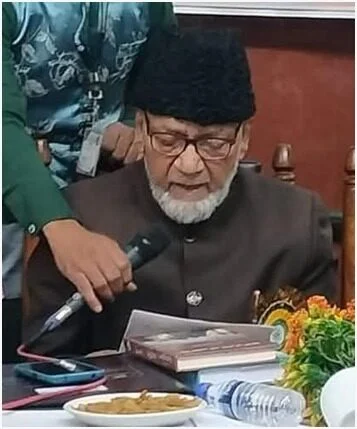
Professor (Dr.) Ahmad Sajjad, a distinguished author, critic, and intellectual who devoted his entire life to the service of knowledge and the Islamic movement, breathed his last at his native place Ranchi, Jharkhand on Sunday, April 26, 2026. He had been unwell for several years. He was 87.
Born in Nalanda, Bihar on12 October 1939, he completed his M.A. in Urdu from Patna University and was teaching at Ranchi College, Ranchi. Later he served as Head of the Department of Urdu, Ranchi University.
Professor Ahmad Sajjad was also a member of Jamaat-e-Islami Hind and served on its Markazi Shura.
He was a great Islamic scholar and Urdu literary figure. His Urdu books include JadeedNazriyat ki KhuliNakami aur Islam ka Roshan Mustaqbil (1990), Hindustan ka JadeedTaleemiInquilab aur Muslim Aqliyat (2000), Ekiswin Sadi ka Challenge aur Milli Taleemi Agenda (2014), Tanqeed-o-Tehreek (1979), TameeriAdabi Tahreek (1994), Tanqeed-o-Tanqeeh (2015), Kya Barre-e-Sagheer ki Urdu Abadi Azab-e-Musalsal ka Shikar Hai (2014), Meer Ghulaam Ali Ishrat Barelvi (1978), and Banda-e-Momin ka Hath ya Tareekh All India Momin Conference (2011).
Besides, he compiled many books, including Bunyadi Masail aur Unka Hal (1973).He was also Editor-in-Chief of Urdu literary magazine, Fankar, published from Hyderabad. All of his works earned recognition in the circles of Urdu literature and Islamic thought. His writings reflect truthfulness, intellectual clarity, and deep movement-oriented insight.
For a long time, he remained at the forefront of community and welfare work in Ranchi and was always among the leading ranks in collective social efforts. In the construction of Idris Hostel and the establishment of Millat Academy, he was in many ways the driving force. For Idris Hostel, he travelled across India with medical students to raise support and mobilise efforts. These two collective projects in Ranchi stand as lasting testimony to his leadership and dedication.
When he was elected President of Idara Adab-e-Islami Hind in 1982, he devoted all his energy, and his heartfelt commitment to the organisation. His tenure remains one of its brightest chapters, especially in terms of organisational tours, literary activities, and mushairas, where he left a remarkable mark. He had also held several discussions with the late Syed Asad Gilani on building an international front for Islamic literature.
Professor Sajjad was a sincere, active, dynamic, compassionate, and visionary personality. One of his greatest qualities was that wherever he lived, he remained fully engaged with his surroundings – constantly striving, questioning, and confronting challenges. Courage, bravery, and speaking the truth were his defining traits. He was straightforward and passionate in expressing his views. His opinions, particularly on the issue of elections, were widely discussed. Whatever work he took part in, he did so wholeheartedly. There was neither hypocrisy nor unnecessary compromise in his character.
His demise is an irreparable loss not only for the Islamic movement but also for Urdu literature and Islamic thought. He was a scholar and man of letters whose writings will continue to serve as a guiding light for future generations.