

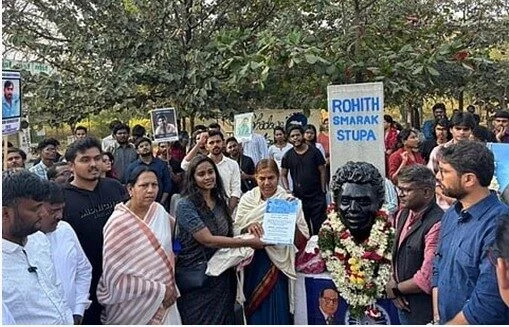
Ten years ago, on January 17, 2016, Rohith Vemula, a PhD scholar par excellence at the University of Hyderabad took his life, after months of administrative discrimination and institutional ostracism on campus. It was not the first or the last ‘institutional murder’ to take place even at UoH itself. Several other first-generation learners, Dalit, Muslim and Adivasi alike, have committed suicide over the past few decades due to institutional discrimination: readers will recall names like Dr PayalTadvi, Darshan Solanki, Mudassir Kamran, Fathima Latheef, Muthu Krishnan, Madari Venkatesh, and S. Anitha. Rohith’s life story – his mother’s struggle to educate him and his siblings and ensure their survival in a caste-supremacist society; his student activism and his profound sense of solidarity for other marginalised communities, including Muslims; and the suicide note he left behind – is all well-known.
Rohith’s case is testament to the fact that while affirmative action has made it possible for marginalised learners to enter prestigious campuses, but the experience on these campuses is often shaped by the forces of caste discrimination and exclusion. Between 2014 and 2021, 122 students enrolled in centrally funded higher education institutions died by suicide, as the Union Education Minister Dharmendra Pradhan informed the Lok Sabha in a written reply in 2021.
Ten years on, Rohith’s mother, Radhika Vemula, fondly known as Radhika amma to the broader student and Ambedkarite community, returns annually to the campus as students organise protests and meetings in his memory. She has also stood in solidarity with student and social movements, alongside with Fathima Nafees, mother of Najeeb, who was attacked and then disappeared from JNU campus in October 2016 and is yet to be found, and Saira Banu, the mother of Junaid, who was stabbed to death in a train in 2017.
Rohith was not only a victim of discrimination but a thinker who imagined solidarities across caste and religious lines, who saw the university as a place that should nurture intellectual freedom rather than police dissent and difference. Ever since the incident of caste discrimination against Rohith and other research scholars in the case, and his subsequent death, there have been talks for the need to introduce a legislation to prevent such incidents, popularly dubbed as “Rohith Act.” This year, the Karnataka government has proposed to introduce what is formally known as Rohith Vemula (Prevention of Exclusion or Injustice) (Right to Education and Dignity) Bill, 2025 at the state level. Although yet to be formally introduced, the Bill seeks to recognise caste-based discrimination in substantive terms and eliminate identity-based discrimination in the state. Despite public assurances, Telangana’s Congress government has yet to draft a similar state level Bill, even as Karnataka is set to table and pass it in its upcoming Assembly session, raising questions about the seriousness and pace of Telangana’s commitment to addressing this issue.
It remains to be seen whether the actual Karnataka bill meets the needs of students and fully conceptualises institutional discrimination substantially; but nevertheless, it offers a window into what progressive legislation can do. This comes in the aftermath of another proposed legislation, the Karnataka Freedom of Choice in Marriage and Prevention and Prohibition of Crimes in the Name of Honour and Tradition (Eva Nammava, Eva Nammava) Bill, 2026, Karnataka’s draft law on honour crimes. The bill demonstrates some political will in drafting legislation that is willing to name social violence for what it is and act decisively against it. By criminalising honour-based violence and intimidation, prescribing stringent punishments, and proactively offering state protection, the bill seeks to check harassers of inter-caste couples in the state, many of whom have experienced violence and intimidation in the name of family honour. As the Eva Nammava, Eva Nammava Bill shows, such legislation can choose to name violence, specify responsibility, and intervene before lives are lost rather than merely mourn them in retrospect.